14 practical tips for using Jev's decision model
A beginner-to-pro list of Jev tips: turn repeated branches in an agent into typed Choice/Score decisions with confidence scores, plus advice on batching, confidence gating and keeping hard rules in code.

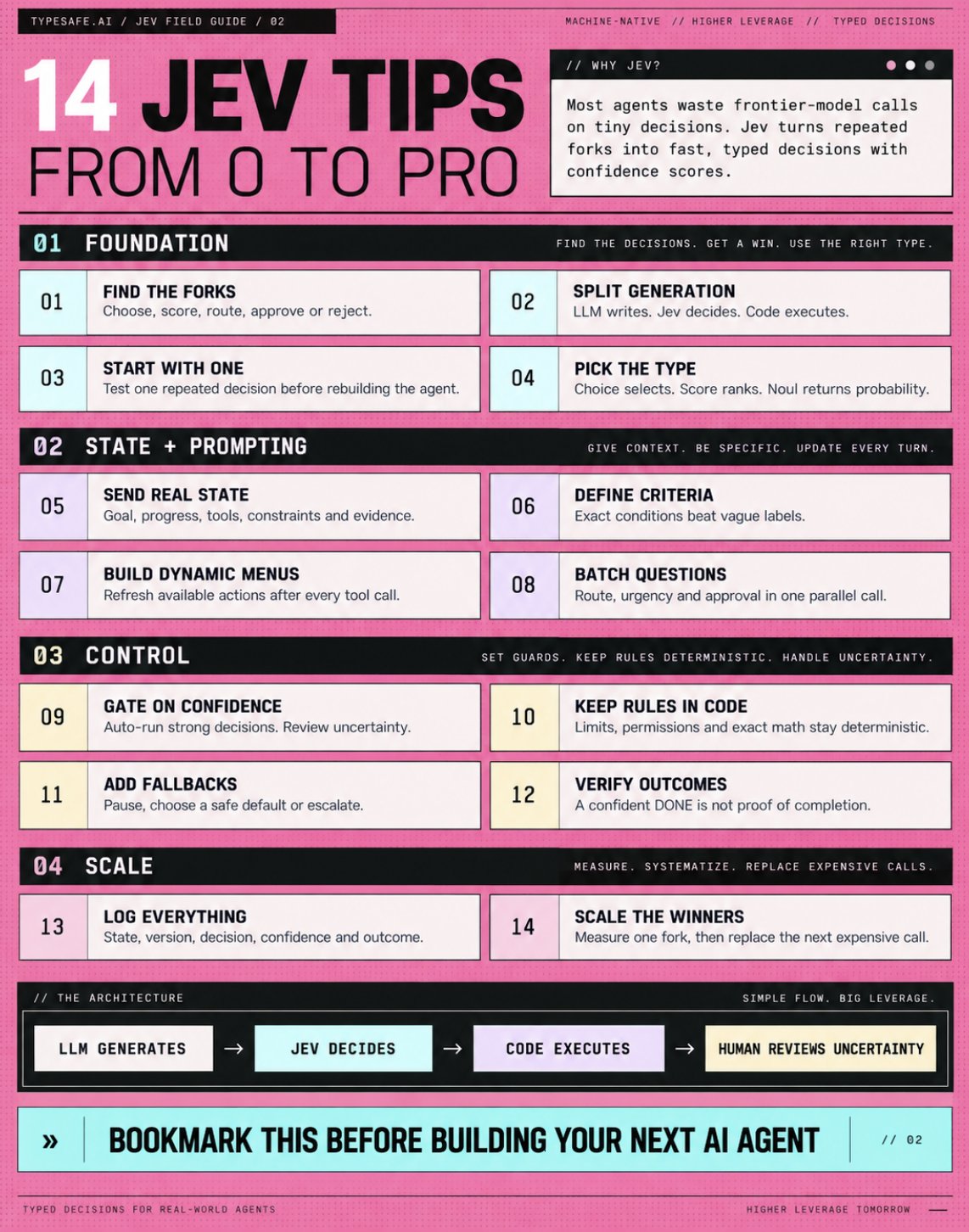
14 JEV TIPS FROM 0 TO PRO: Most AI agents waste their most expensive model calls on tiny decisions: yes or no, which tool to use, what happens next, and whether a result is good enough. Jev turns those repeated forks into fast, typed decisions with confidence scores - while the LLM handles research and writing, and code executes the result. Here’s how to use it: 1. FIND THE FORKS - look for every place your agent chooses, scores, routes, approves or rejects. 2. KEEP GENERATION SEPARATE - let the LLM write text and code; use Jev for decisions between predefined outcomes. 3. START WITH ONE QUESTION - test a single repeated decision in the Playground before rebuilding the entire agent. 4. USE THE RIGHT TYPE - Choice selects an option, Score ranks a value, and Noul returns a probability. 5. SEND REAL STATE - include the goal, completed work, available tools, constraints and evidence the decision actually depends on. 6. WRITE EXACT CRITERIA - “research if evidence is missing” is stronger than vague labels like “pick the best worker.” 7. BUILD DYNAMIC MENUS - regenerate the available actions after every tool call so Jev always chooses from the current state. 8. BATCH DECISIONS - ask for routing, urgency and approval in one call when every question uses the same context. 9. GATE ON CONFIDENCE - execute high-confidence decisions automatically and route uncertain cases to review. 10. KEEP HARD RULES IN CODE - spending limits, action caps, permissions and exact calculations should remain deterministic. 11. ADD A FALLBACK LADDER - if Jev is late or unavailable, pause, use a safe default or hand the task to another model. 12. VERIFY THE OUTCOME - a confident “done” does not prove that the file was saved, the message was sent or the task succeeded. 13. LOG EVERYTHING - store the model version, state, decision, confidence, route and final outcome so the system can improve. 14. SCALE THE WINNERS - start with one expensive decision, measure cost and accuracy, then replace the next repeated LLM call. The architecture is simple: LLM generates → Jev decides → code executes → humans review uncertainty. That split is how one agent becomes faster, cheaper and capable of running thousands of decisions continuously. Bookmark this before building your next AI agent -then read the complete Jev setup below ↓
This post quotes another post: x.com/0xmovez/status/2101007482919227841