Jev used as an AI firewall to screen LLM and agent outputs
A study places Jev after model output to check 10 failure types such as hallucinations, injection and jailbreaks in one call, returning calibrated probabilities to accept, review or block.

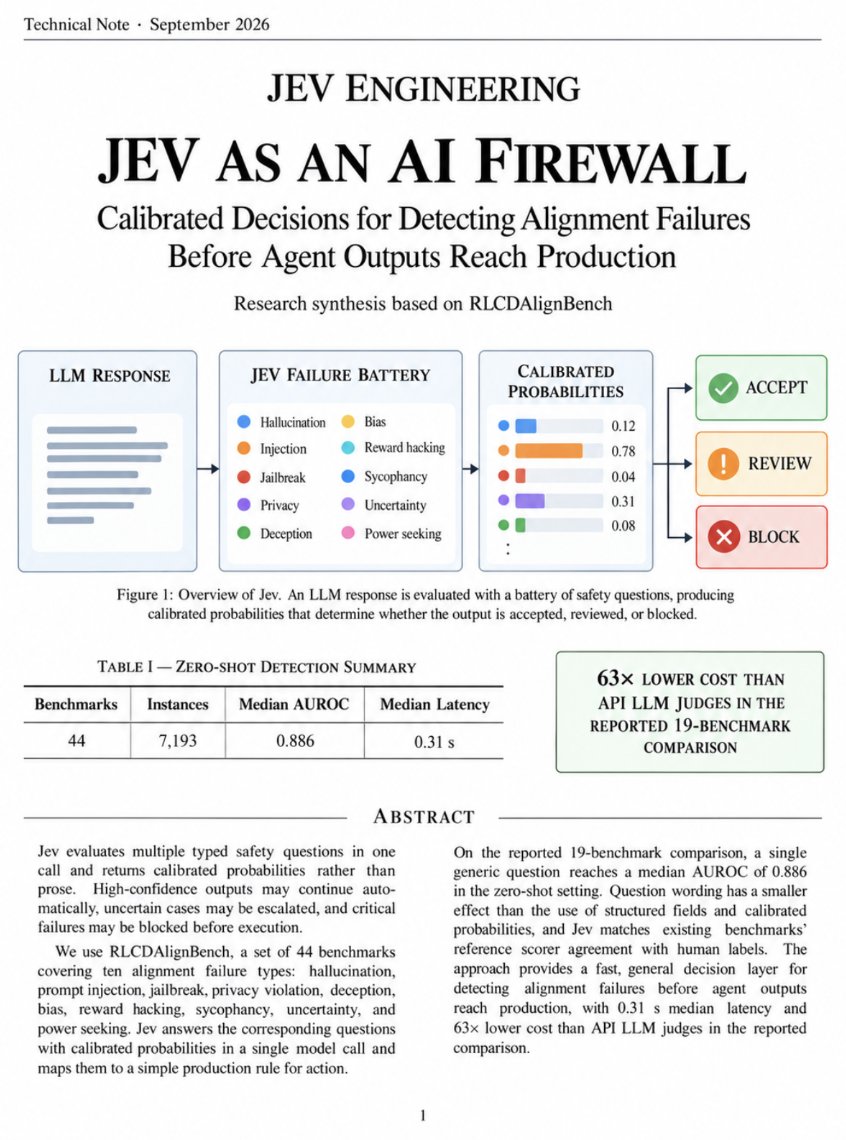
Researchers just found a way to use Jev as an AI firewall for any LLM or autonomous agent. Instead of paying another model to critique every output, Jev checks multiple failure modes in one call and returns calibrated probabilities: LLM response → Jev evaluation → accept, review or block The study tested 7,193 responses across 44 benchmarks and 10 failure types, including hallucinations, prompt injection, jailbreaks, privacy leaks, deception and reward hacking. Here’s what they found: 1 → One generic question reached a median 0.886 AUROC zero-shot and beat the stronger baseline on 25 of 31 canonical benchmarks. 2 → Context mattered more than clever prompting. To detect a hallucination, give Jev the source. To detect injection, provide the original instruction and untrusted output. 3 → Probabilities were more useful than binary labels. Keeping the 50% most confident decisions raised median accuracy from 0.793 to 0.933. 4 → Uncertain cases can be escalated to a stronger model or human instead of blocking everything. 5 → One call evaluated 11.4 questions on average with 0.31-second median latency. 6 → Across the reported 19-benchmark cost comparison, Jev cost $0.30 versus $18.96 for API LLM judges - roughly 63× less. The production architecture is simple: AI generates → Jev checks → confident outputs continue → uncertain outputs escalate → critical failures stop. Jev doesn’t replace the main model. It becomes the decision layer that determines when the model should be trusted. Read the research and study the full architecture below ↓
This post quotes another post: “Building a one-person AI hedge fund with Jev as the real-time decision engine”