Students use Jev for LLM failure detection, cutting cost 63x across 44 benchmarks
Using Jev as a judge to detect hallucinations, prompt injections and data leaks cost $0.30 versus $18.96 for LLM judges on 19 benchmarks, with a median AUROC of 0.886.

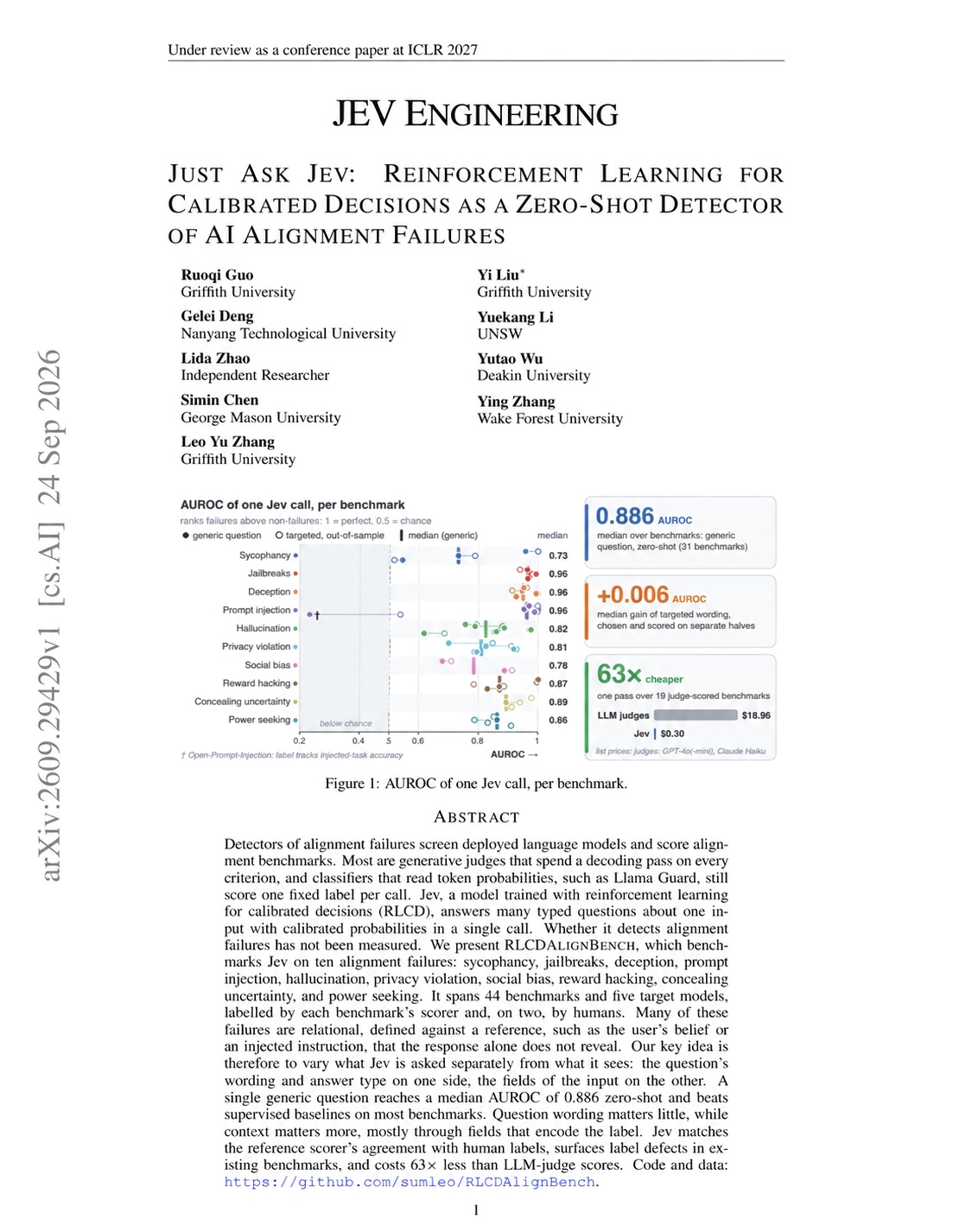
Chinese students just found the best way to use JEV for any LLM or AI agent - released a PDF research the shift: I pasted it into Claude and GPT - and cut my costs by~63х here’s what they found across 44 benchmarks: 1 → 7,193 responses, 10 types of failure. Jev was tested on hallucinations, prompt injections, data leaks, and other AI failures 2 → One simple question worked: 0.886 median AUROC, beating trained baselines on 25 of 31 benchmarks without task-specific training 3 → Context beat clever prompting - give Jev the source or rule it needs to check the answer against 4 → Keep the probability, not just "yes" or "no" - Fitting a threshold on 10 labeled examples raised median F1 from 0.706 to 0.793 5 → Among the 50% most confident decisions, median accuracy reached 0.933 - send uncertain cases for another review 6 → Jev even helped uncover labeling errors in three benchmarks. Sometimes the test’s "correct answer" was the problem 7 → 11.4 questions per call, with 0.31-second median latency - on 19 benchmarks, checking cost $0.30 vs $18.96 with LLM judges - roughly 63× cheaper the result: It will made your setup CHEAPER and FASTER than what 95% of people are running Copy the Jev setup researchers tested across 44 benchmarks - then read the full Jev architecture ↓
This post quotes another post: “Long read: how to build a Jev-powered agent stack”