ResolveSignal open-sources pay-per-call decision pipeline with Jev as gatekeeper
ResolveSignal is a pay-per-call decision service for autonomous agents on Arc Mainnet, where Jev checks whether a request's target, evidence and constraints qualify before any charge is made.

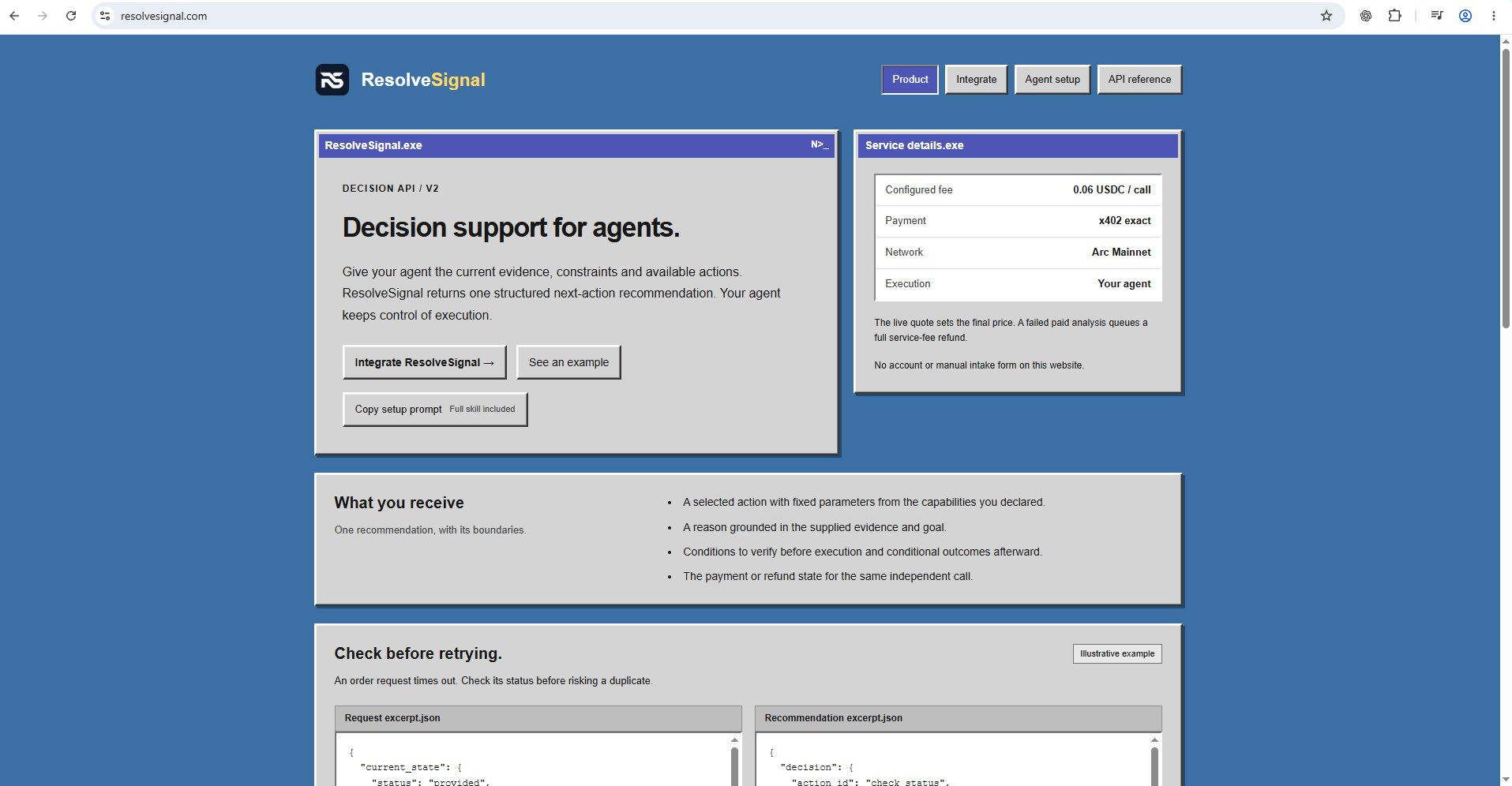
We are open-sourcing the complete decision pipeline behind ResolveSignal, a pay-per-call decision service for autonomous agents running on @arc Mainnet. ResolveSignal is not simply an LLM wrapper or an x402 escrow contract. The core problem we are solving is how an automated agent can safely purchase one actionable decision without starting a conversation, exposing long-term user data, or paying for an incomplete or low-quality answer. A caller submits a complete machine-readable contract containing: • the exact target and objective • measurable success criteria • current observed state and timestamp • evidence and its source • authority and operational constraints • actions the caller is actually capable of executing • fixed action parameters • response cases that distinguish operation completion from real-world goal resolution • previous attempts and relevant numerical facts Missing fields are rejected. Empty strings are rejected. “No information” must be declared explicitly with an explanation. Unknown references, duplicate IDs, stale observations, mismatched targets, approval-dependent actions and unverifiable success conditions are blocked before payment. The accepted request is canonicalized and compiled into a deterministic decision contract. Jev performs semantic admission before the customer is charged. It evaluates whether the objective, evidence, restrictions and declared capabilities are sufficient for the bounded service. If Jev rejects the request or is unavailable, ResolveSignal does not issue a payable quote. Once admitted, the caller receives one x402 v2 exact payment challenge bound to one request, one payer and one deterministic Arc USDC vault. After payment verification, GPT‑5.4 does not produce unrestricted advice. It must return a typed DecisionIR containing only: • one declared action ID • references to supplied evidence • every applicable authority and constraint reference • every required success criterion • an optional cost comparison that trusted code can recalculate GPT‑5.4 cannot introduce a new tool, parameter, target, source, goal or capability. A second bounded GPT‑5.4 stage then evaluates exactly four relationships: • action fit • evidence relevance • constraint alignment • goal alignment Every relationship must be supported. An unsupported, uncertain, missing or duplicate verdict fails closed. Trusted code independently checks admissibility, target identity, reference coverage, effect compatibility, numerical comparisons and response-case semantics. It then binds every accepted semantic claim to SHA‑256 hashes of the exact sources used during review. The final response is rendered from validated caller declarations and fixed templates. Model-authored prose never becomes an executable instruction. ResolveSignal returns one conditional next action together with: • its exact declared parameters • the target it applies to • its expected effect • pre-execution authority and freshness checks • the caller’s success contract • conditional outcomes for each declared response case • explicit separation between operation completion and business-goal resolution ResolveSignal does not claim that it executed the action, independently verified external evidence or observed the final real-world outcome. The calling agent retains execution authority. Payment is also bound to output quality: • invalid input is rejected before payment • Jev rejection happens before payment • payment verification failure does not start analysis • invalid GPT‑5.4 output is withheld • unsupported semantic review is withheld • analysis timeout triggers the refund path • failure to deliver the response triggers the refund path • the exact service fee is released only after the checked response body is delivered Each request has an isolated call ID, context, payment recipient and lock. Concurrent calls cannot share responses or payment state. An idempotency key cannot create multiple automatic purchases. After completion or confirmed refund, the request and result context are deleted. Only minimal settlement metadata may remain for reconciliation. Raw customer input, model payloads and result bodies are not retained in terminal receipts. The open-source repository includes: • strict request and response schemas • the Jev admission adapter • the GPT‑5.4 planning and semantic-checking adapter • deterministic compiler and source-binding logic • result renderer • idempotent concurrent workflow • delivery-aware completion and refund handling • privacy and threat-model documentation • Arc x402 escrow contracts • public ABIs and Mainnet deployment manifest • 18 passing Python tests • 53 passing Solidity unit, fuzz, regression and invariant tests • a stateful invariant campaign covering 4,096 calls across 128 runs with zero reverts Arc Mainnet deployment, chain ID 5042: Factory: 0xB2b41f3e45AEe1Da3D8756bd087277f1194bf3C7 Vault implementation: 0xdd02Ec2A86CF8b05081bE88DE4C190d0980D067F Deployment transaction: https://explorer.arc.io/tx/0x2aaa6bd0c8a6e5455948e6c44346e7cf4f9f60c71c903aea70289100d90e9724 Open-source repository: https://github.com/duclucky/resolvesignal-decision-pipeline Live product: https://resolvesignal.com The repository is MIT licensed. It intentionally excludes API keys, private keys, signer credentials, customer payloads, production databases and private infrastructure configuration. The system is live on Mainnet, but we are not claiming third-party adoption or user traction that has not yet been demonstrated. Next milestones include Python and TypeScript packages, reference seller adapters, client conformance tests, an independent refund watcher, reproducible deployment verification and independent audits of both the Solidity and decision/compiler layers. We are publishing this pipeline so Arc builders can inspect, challenge, reuse and improve a complete pay-per-call decision workflow instead of starting from another payment-only demo. Feedback and contributions are welcome. @thecanteenapp