Diogo Almeida releases 10-step blueprint for an LLM routing layer with Jev
The 12-page PDF describes using Jev's typed Choice, Score and Noul questions for capability routing, filtering before model selection, accounting by total economic cost rather than token price, and logging every route.

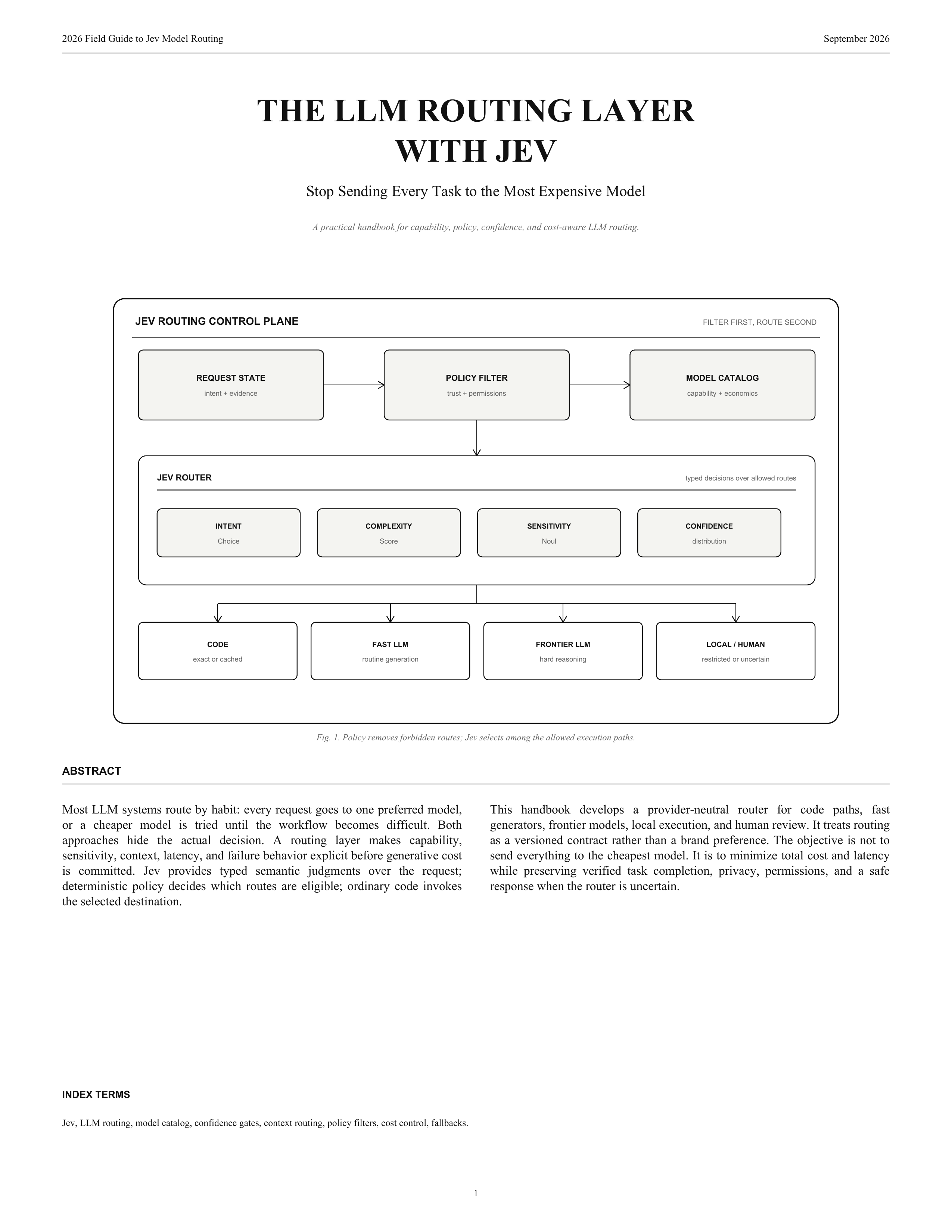
Jev Founder, Diogo Almeida, just released a 12-page PDF on building an LLM Routing Layer with Jev this is a 10-step blueprint on how to stop sending every task to the most expensive model without destroying the quality of difficult work: step 1 → inventory the work: separate deterministic lookups, routine generation, deep reasoning, restricted data and tasks that require human authority step 2 → build a model catalog: describe every code path, fast model, frontier model, local executor and human route by capability, latency, cost, trust and tool access step 3 → define route contracts: every destination gets its own context policy, tools, permissions, timeout, retry budget, verification plan and fallback step 4 → build the routing state: send Jev the request, required capabilities, verified data classes, available evidence, budget and deadline instead of the entire conversation step 5 → filter before routing: code removes providers that violate privacy, region, identity, modality, tool, budget or availability requirements step 6 → ask typed questions: Choice identifies the task family, Score estimates complexity, Noul checks sensitivity and confidence determines whether the system should act step 7 → route by capability, not brand: code maps Jev’s signals to an exact handler, fast LLM, frontier LLM, approved local model or human reviewer step 8 → build context after the route: load only the files, retrieval sources, instructions and tool schemas required by the selected execution path step 9 → calculate total economics: include cache misses, context reprocessing, model handoffs, retries, verification, human review and recovery instead of comparing token prices step 10 → record every route: bind the state, eligible options, Jev probabilities, selected model, context digest, cost, latency, fallback and verified outcome to one receipt most AI courses tell you which model is the best this 12-page guide teaches you how to build a system that chooses the right model for every request the result: cheap tasks stop wasting frontier-model tokens difficult tasks still reach the most capable route restricted data stays inside approved boundaries and uncertain requests escalate before the wrong model touches them Send this PDF and the original Jev article to Claude Code or Codex and tell it to replace your hardcoded model selector with a real routing control plane ↓
This post quotes another post: “Jev turns routing, scoring and verification into a decision layer”