NVIDIA and partners propose SoL-Pi: AI searches for coding agent harness improvements
A research AI automatically searched for and validated harness changes, and four surviving fixes cut token traffic by about 45% and API costs by a third without touching the model.

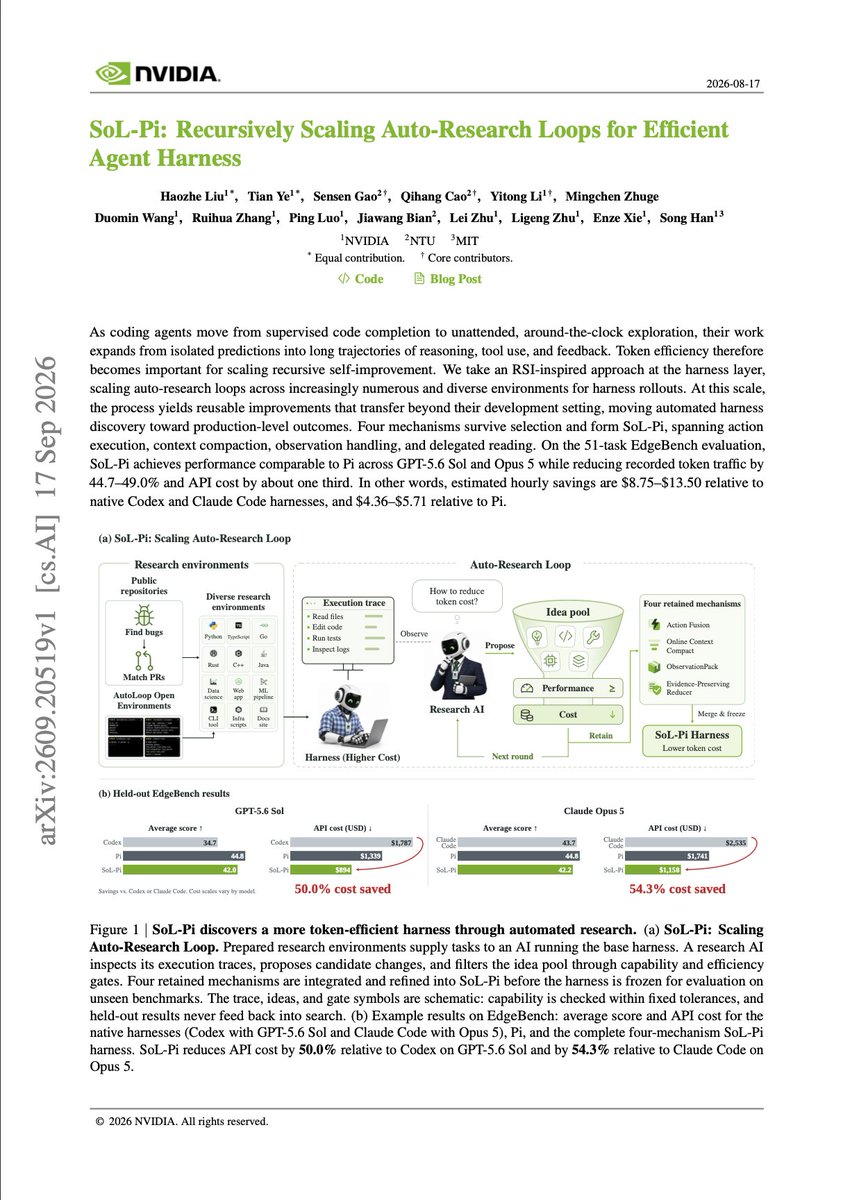
Build your own harness. This is a seriously good paper from NVIDIA on self-improving agent harnesses. The paper is called SoL-Pi, out of NVIDIA, NTU and MIT. Every coding agent runs inside a harness. That's the layer that reads files, runs commands, manages memory and talks to the model. Humans tune it by hand, reading long execution logs and turning what they notice into code changes. They handed the job to an AI instead. A research AI watched a coding agent work, proposed changes to the harness, tested them, and kept only what saved tokens without hurting results. It ran about 150 research directions across roughly 500 environments, more than 3,000 runs and over 60,000 agent-environment interactions. Four fixes survived. 1. The agent edits a file and runs the test in one call instead of two. 2. It compresses its memory when a subtask finishes, and only if that's cheaper than keeping everything. 3. It sends big tool outputs in full twice, then swaps them for a 1KB excerpt with a handle to pull the rest on demand. 4. A cheap model summarizes build and test logs, and a verifier rejects the summary if it drops evidence. None of that touches the model. It's all in the software around it. On EdgeBench, a 51-task benchmark, token traffic dropped 44.7 to 49% and API cost fell by about a third against Pi, the harness it was built on. Against the native harnesses it came in 50% cheaper than Codex on GPT-5.6 Sol and 54.3% cheaper than Claude Code on Opus 5. Scores held at roughly 94% of the baseline. They built all of it on GPT-5.6 Sol, then dropped it onto Opus 5 with zero changes. It still used 44.7% fewer tokens. The cost conversation so far has been about cheaper models. This paper says a big chunk of the waste sits in the software around the model, and an AI finds it faster than we do. Their next move is running the search again with the cheaper harness, so a cheaper agent funds the search for an even cheaper one.