Viral 12-page operating manual for GPT-6 Astra attributed to Sam Altman
A summary of a manual said to be written by Altman on using Astra: route by judgment difficulty rather than model prestige, write acceptance criteria first, give case files instead of whole chats, sweep reasoning effort levels, and treat long context as a scarce resource.

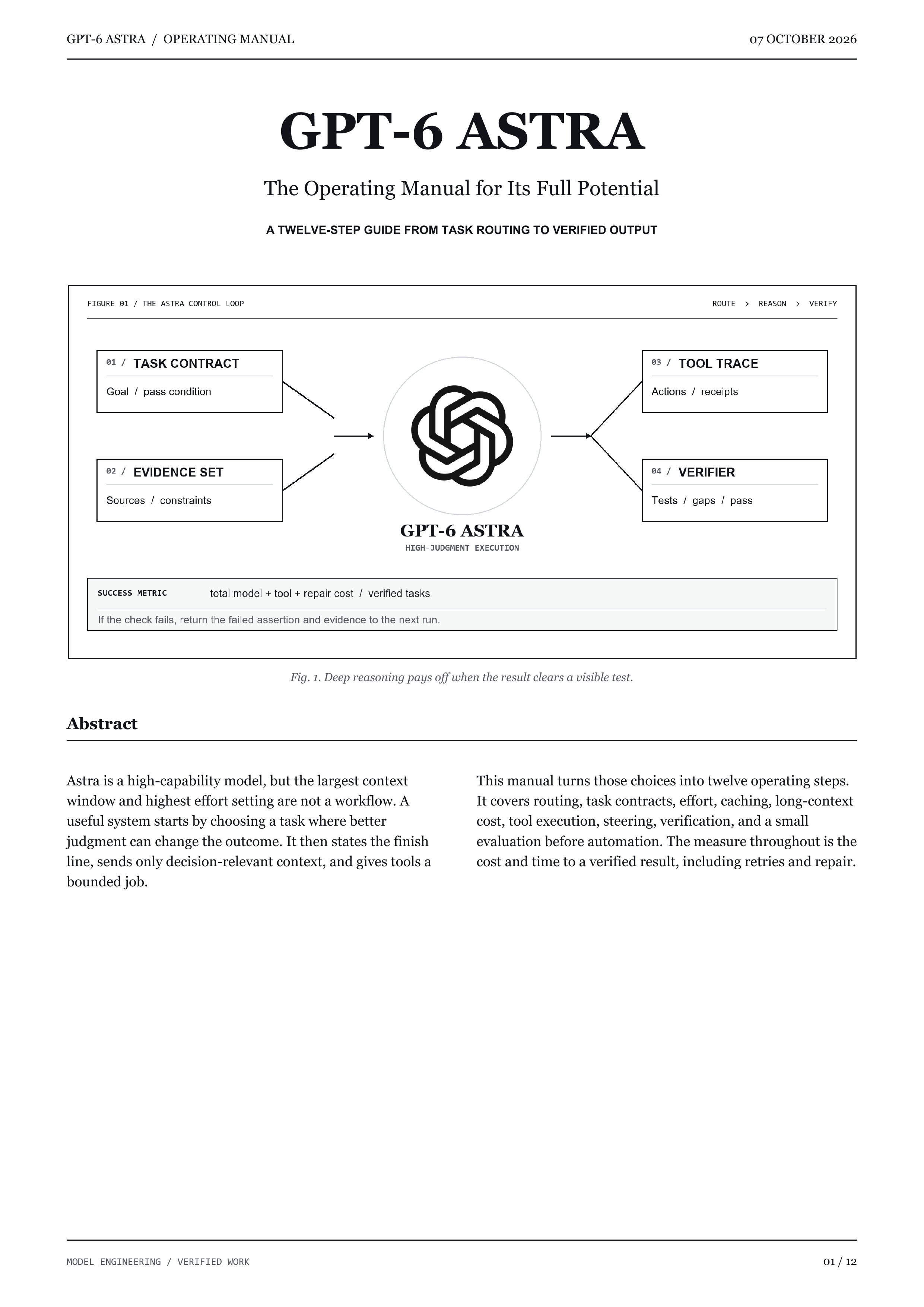
Sam Altman just published a 12-page operating manual for GPT-6 Astra It is more useful than most paid AI-agent courses: step 1 → stop routing by model prestige: use Astra when ambiguity, cross-system dependencies, or the cost of a wrong decision makes deeper judgment worth paying for step 2 → write the finish line before the prompt: deliverable, constraints, evidence, allowed actions, and the exact external check that proves the work is done step 3 → give Astra a case file, not your whole chat: current state, relevant files, source excerpts, open question, and acceptance test step 4 → sweep reasoning effort before you switch routes: low, medium, high, xhigh, and max are settings to measure, not a ladder you always climb step 5 → make the stable prefix cacheable: put rules, schemas, and reusable examples first; append fresh tasks and evidence after them; count cache writes as well as reads step 6 → treat the 1.05M-token window like a reserve: once input crosses 272K tokens, long-context pricing applies to the entire request, so make every large upload earn its place step 7 → give tools a contract: what Astra may inspect, what it may change, which receipt it must return, and which actions still need approval step 8 → steer the run with state, not vibes: say what changed, what work still stands, which tool calls are in flight, and what the next safe action is step 9 → verify the artifact instead of trusting a fluent completion message: run the test, render the document, inspect the diff, or check every material claim against a source step 10 → score the whole task: model tokens, reasoning, cache writes, tools, retries, repairs, latency, and whether the verifier actually passed step 11 → test the routing policy in shadow mode on 20–30 real tasks before automating a lane step 12 → automate the safest work first; escalate only when a named failure or decision risk makes Astra's judgment pay for itself Astra's listed standard API rates are $10/M fresh input, $1/M cache read, $12.50/M cache write, and $50/M output. The real metric is cost per verified task - not cost per token. the result: fewer expensive guesses, cleaner handoffs, and a flagship model used where one better decision changes the whole project. Save this. The full 12-page field guide and Astra control-loop diagram are below ↓
This post quotes another post: “When to use GPT-6 Astra and when Sol is enough”