Bittensor ships Null Consensus, expanding subnets to 2,500 miner slots
Null Consensus raises each subnet from 256 to 2,500 miner slots and lets miners register via proof of work without holding TAO upfront, while Yuma remains the default reward system.

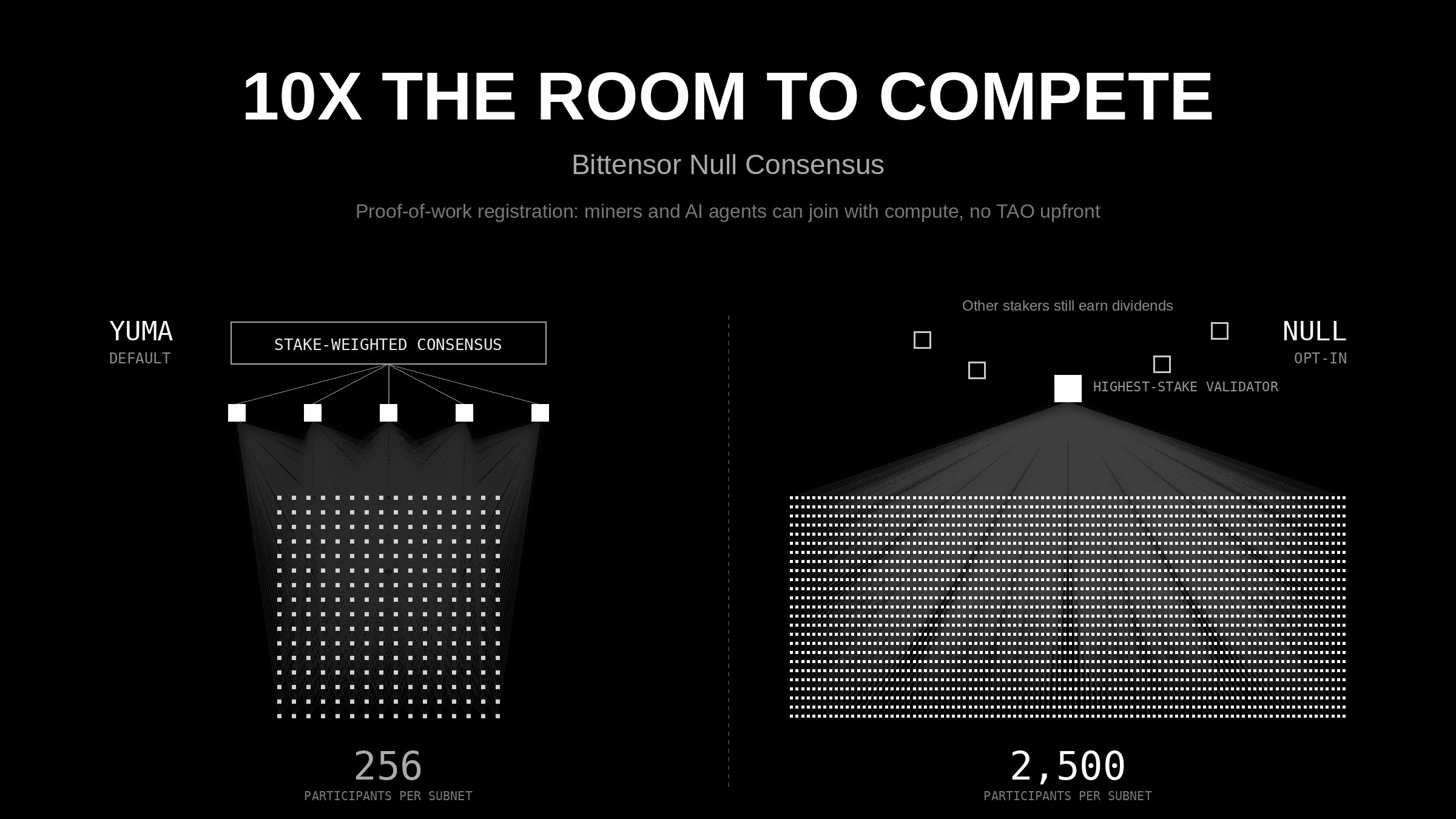
🚨 Bittensor $TAO subnets just LEVELED UP from 256 participants to 2,500. 10x bigger, 2,500 miner slots each, up from 256. That's up to 320,000 slots, up from about 32,800. That's 10x the room to compete, in one update. Just hear me out, think AI Agents, and why now is the perfect timing for it. @opentensor just shipped Null Consensus. Here's it is 👇 How it worked until now (Yuma): • Miners submit work • Multiple validators score them • The protocol compares scores by stake and clips anything the majority doesn't support • Rewards follow the agreed result It's powerful, but heavy. All that comparing caps each subnet at 256 slots. What Null changes • The highest-stake validator sets the miner weights • Other stakers still earn proportional dividends • No consensus or bond calculations, so the protocol can handle far bigger competitions • Precise integer weights keep tiny reward shares accurate across thousands of miners Yuma stays the default. Subnet owners choose the reward system that fits their subnet. The part many will miss 🤌 Miners can now register with proof of work. No $TAO needed upfront. Just solve a challenge with your hardware. Read that again with agents in mind this time 👀 An autonomous AI agent can now join Bittensor, compete and earn, using nothing but compute. • No bank account. • No exchange. • No permission. Its way Bigger than it looks Look at where AI is right now. Anthropic went from about 2,500 code merges a day in May to over 30,000 in September. Its engineers now rate Claude as better at writing code than they are. The builders are becoming agents, folks, and agents will want somewhere to work. A network capped at 256 seats per subnet was built for humans. A network with 2,500 seats per subnet, where compute alone is the entry ticket, is built for what's coming. What I think: • Null puts weight-setting in one validator's hands. It's simpler and faster, but it relies on trusting that validator instead of a majority check. That's why it's opt-in • Cheap, open registration has to be protected against spam. Proof of work is the filter, and we'll see how it holds up at scale • More seats don't mean more value until subnets fill them with useful work My view: I believe we're at the start of the vertical part of the curve. It's hard for humans to picture, because we think in straight lines and this is moving exponentially. The networks that win this era will be the ones built to let millions of agents compete. Bittensor just added 10x the room. Sources: Bittensor docs (Null Consensus guide), Subtensor v475 release notes, @opentensor https://www.bittensor.com/docs/guides/null-consensus https://github.com/RaoFoundation/subtensor/releases/tag/v475 $TAO / Not financial advice, always DYOR.
This post quotes another post: x.com/opentensor/status/2110775067722539092