Five experiments for plugging Jev into a DGX Spark local agent fleet
The author plans to use Jev as a fast browser lane, let local models handle text, and escalate by confidence so local agents run faster and cheaper.

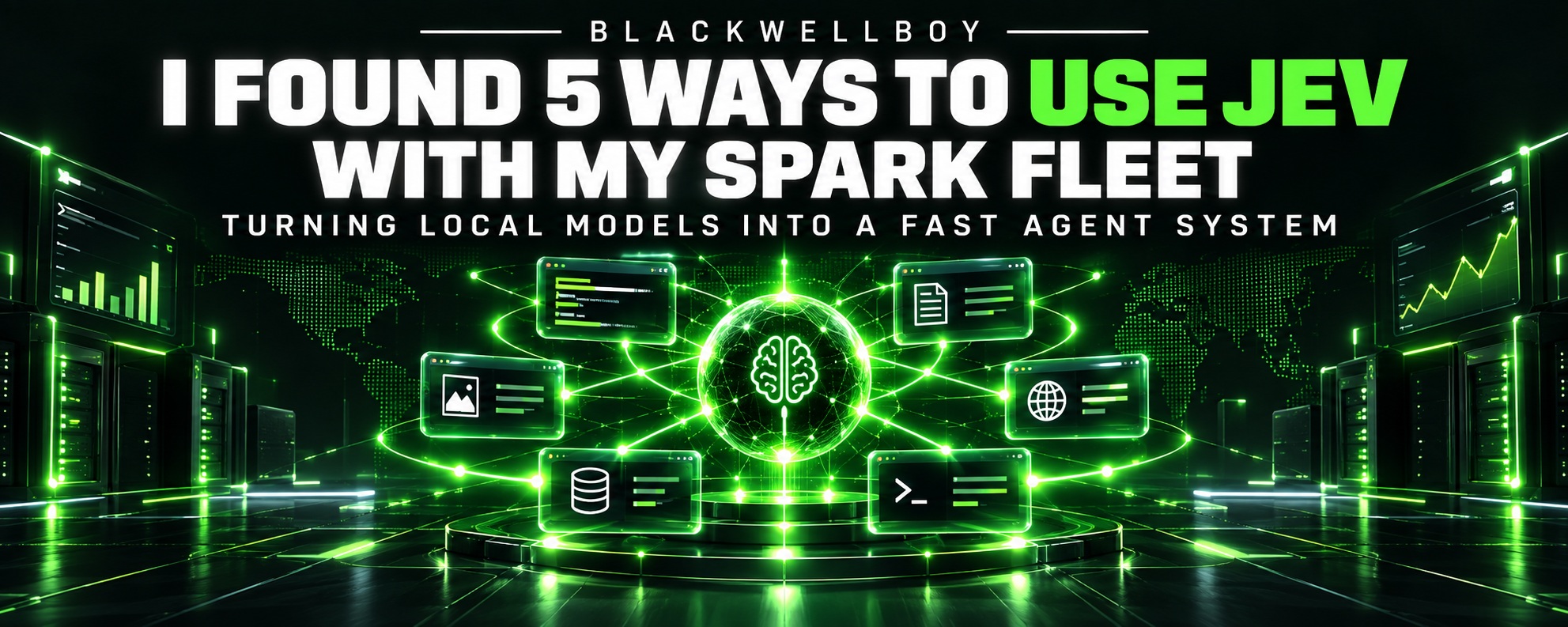
5 ways I’m going to bolt JEV onto my DGX Sparks and see how far I can push local agents fleet. 👇 JEV might be one of the most interesting things Ive found for my DGX Spark fleet in a while. Not because its another browser agent.. but because it basically asks: Why are we burning a giant LLM call just to decide which buttons to click?.. JEV turns the current page into a small indexed action space then chooses an operation + target. So that means the LLM only needs to generate actual text when text is required...seems so so simple.. Well, Ive got the JEV API ready to go, so I began thinking.. What happens if I plug this into my local model fleet? Here are the 5 experiments I want to try. 1. Make JEV the “fast browser lane” underneath Hermes Instead of asking Qwen or Deepseek to reason through every browser click ill give the model the high level goal and let JEV handle the boring browser execution. Something like: Hermes > plan > JEV > click/type/select > browser the big model only comes back when something actually requires intelligence. i really think that could make a local agent feel a hell of a lot faster without changing the model at all. 2. Move the semantic/text work onto the local fleet JEVs text helper is already OpenAI compatible... So when it needs to fill a search box form filter etc etc, i can route that directly to: my 5090s Qwen DeepSeek TP2 GLM whatever local specialist wins The hosted JEV policy handles navi while my own hardware sorts the language work 3. Confidence gated escalation across the fleet This is the one I really want to test asap i want to let JEV make the cheap decision first... if its high confidence Execute immediately. Not sure.. Ask the 5090. Still ambiguous.. Escalate to DeepSeek or glm think my thought process is basically: JEV > 5090 > DeepSeek/GLM with each layer only getting involved when the one below it isn’t confident. correct me if im wrong but thats almost like speculative decoding but for agents? which would be an insane unlock.. 4. DOM first, local vision only when needed JEV is fast in part because it doesnt stare at screenshots every step from what ive seen Thats great until you hit canvas or weird widgets and visual layouts or popups or just something the DOM representation can’t explain.. So I want: JEV structured state > normal path but if it gets blocked: Screenshot > local vision model > visual critique > back to JEV That gives you vision when you need it without the multimodal cost on every action 5. Use JEV traces to train a tiny browser specialist I think this might be the most interesting long term idea. JEV gives you extremely clean data: page state > operation > target > confidence > result So let the larger local models solve thousands of browser tasks and keep the successful traces then distill that into a much smaller local model whose entire job is: pick the next browser action. A 1B or 7B specialist doesnt need to be Shakespeare. It just needs to be extremely good at: CLICK [7] ...lol and eventually the whole control loop could become local. I think that deserves exploration...and i mean asap..the potential unlocks here seem endless. So its not "can a DGX Spark run another browser agent?" It would be more like: can a local fleet turn JEV into an insanely fast hierarchical agent system where expensive intelligence is only used when its actually really needed? I have enough hardware/compute sitting here doing stupid experiments anyway 😂 Might as well find out. If you can think of any cool ideas to run with JEV drop them below.