Jev learning roadmap: from decision models to Choice, Score and Noul
A step-by-step checklist for learning Jev, covering state as input, typed questions, the Choice, Score and Noul decision types, and confidence, to help developers turn application state into actionable decisions.

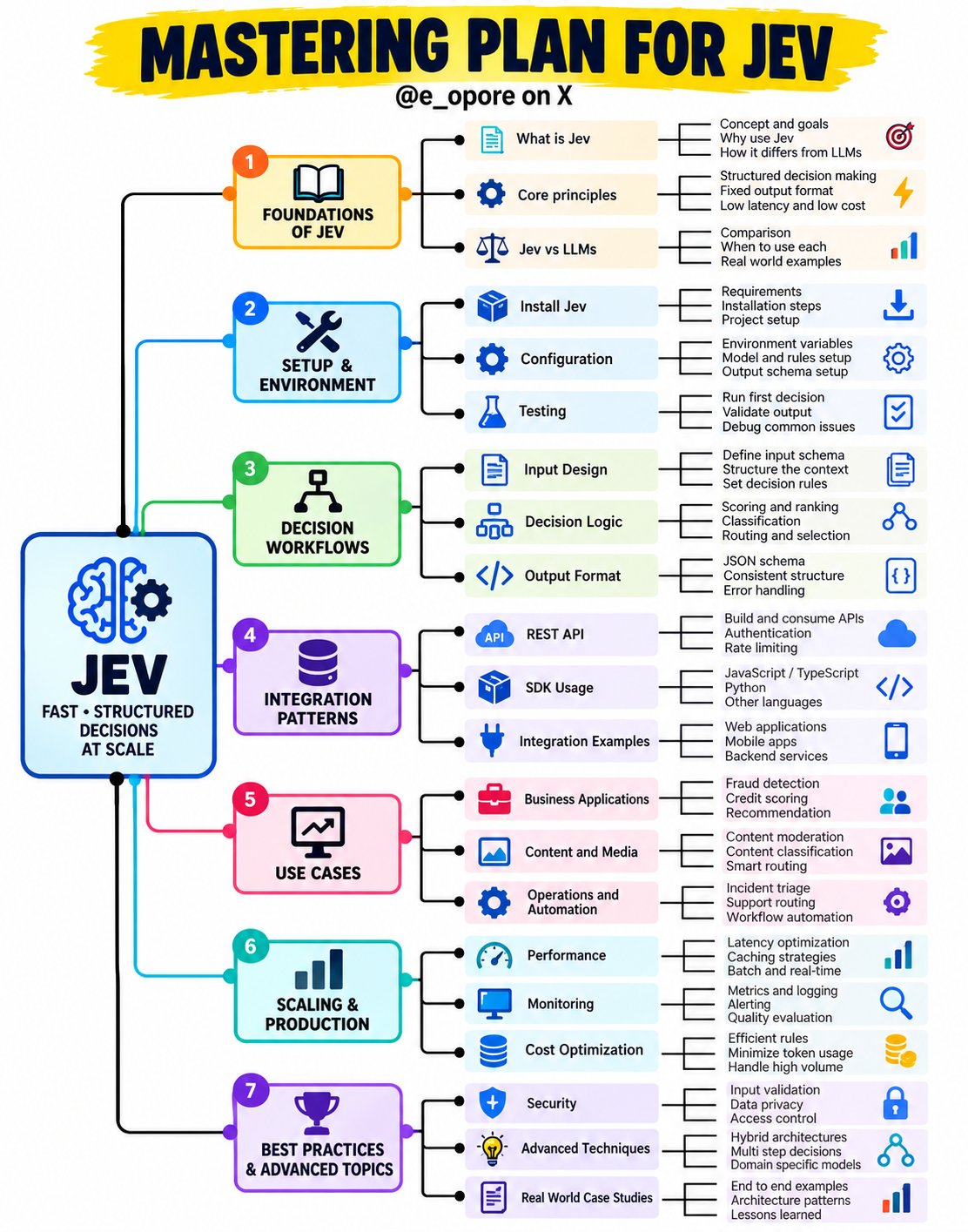
MASTERING PLAN FOR JEV. STEP 1: UNDERSTAND JEV FUNDAMENTALS → What Jev is → Jev vs traditional LLMs → Decision models vs generative models → System One concept → Machine-native intelligence → Structured decision making → When to use Jev Build a strong mental model before integrating Jev into applications. STEP 2: UNDERSTAND THE JEV DECISION MODEL → State as input → Typed questions → Decision outputs → Choice decisions → Score decisions → Noul decisions → Probabilities and confidence → Decision boundaries Jev is designed around the idea of turning application state into decisions software can act on. STEP 3: MASTER JEV INPUT DESIGN → Designing application state → Selecting relevant context → Structuring unstructured information → Minimizing unnecessary context → State normalization → Context quality → State validation Good decisions begin with well-designed state. STEP 4: MASTER TYPED QUESTIONS → Choice questions → Score questions → Noul questions → Defining answer options → Writing decision criteria → Mutually exclusive categories → Ordered scoring criteria → Binary decision boundaries Typed questions define the contract between your application and the decision model. STEP 5: MASTER CHOICE DECISIONS → Classification → Intent detection → Ticket routing → Category selection → Model selection → Workflow routing → Candidate selection → Multi-class decisions Use Choice when your software needs one option from a predefined set. STEP 6: MASTER SCORE DECISIONS → Risk scoring → Priority scoring → Quality scoring → Relevance scoring → Ranking signals → Ordered scales → Score thresholds → Score calibration Scores allow your application to transform qualitative information into actionable numerical signals. STEP 7: MASTER NOUL DECISIONS → Yes/no decisions → Safety checks → Approval decisions → Human-review detection → Risk detection → Policy checks → Binary classification → Probability thresholds Noul-style decisions are useful when software needs to determine whether a specific condition is true. STEP 8: MASTER CONFIDENCE AND CALIBRATION → Decision probabilities → Confidence values → Calibration concepts → Threshold selection → Low-confidence handling → Human review → Fallback strategies → Measuring decision reliability Confidence becomes useful when your application has a defined action for uncertain decisions. STEP 9: DESIGN JEV DECISION PIPELINES → State → decision → action → Decision layers → Business rules → Threshold-based routing → Fallback workflows → Human-in-the-loop systems → Decision logging → Auditability Keep the model responsible for the decision signal while your application remains responsible for the resulting action. STEP 10: INTEGRATE JEV INTO APPLICATIONS → API integration → Request construction → Response handling → Typed output processing → Error handling → Retries → Timeouts → SDK integration Learn to make Jev a reliable component inside real software systems. STEP 11: COMBINE JEV WITH LLMS → LLM + Jev architecture → Generation vs decision separation → LLM for reasoning and generation → Jev for classification and routing → Agent decision gates → Structured workflow control → Hybrid AI architectures → Cost optimization Use the right model for the right job instead of forcing every task through a generative LLM. STEP 12: BUILD AI AGENTS WITH JEV → Agent routing → Tool selection → Tool safety checks → Action approval → Human escalation → Agent guardrails → Workflow decisions → Multi-step agent systems Jev can serve as a decision layer inside agent workflows where predictable, bounded decisions are required. STEP 13: BUILD REAL-WORLD JEV USE CASES → Customer support routing → Lead scoring → Content moderation → Fraud detection → Risk assessment → Recommendation reranking → Document classification → Human-review routing → AI safety checks Focus on repetitive decisions where the expected output is known in advance. STEP 14: MASTER JEV PERFORMANCE → Latency optimization → Batch decisions → Parallel questions → Request optimization → Context optimization → Throughput → Cost analysis → Production scaling Decision systems should be designed around measurable latency, throughput, reliability, and cost requirements. STEP 15: MASTER JEV EVALUATION → Building evaluation datasets → Creating labeled examples → Accuracy measurement → Precision and recall → Calibration evaluation → Threshold testing → Error analysis → Regression testing Never assume a decision model is reliable simply because individual outputs look reasonable. STEP 16: BUILD PRODUCTION-GRADE DECISION SYSTEMS → API reliability → Observability → Logging → Metrics → Tracing → Rate limiting → Retries and fallbacks → Versioning → Monitoring decision drift Production systems need more than a working API call. STEP 17: MASTER JEV SECURITY → Sensitive data handling → Input sanitization → Access control → API key management → Secrets management → Data minimization → Audit logging → Human oversight Secure decision infrastructure protects both application data and downstream actions. STEP 18: MASTER JEV SYSTEM DESIGN → Decision service architecture → API gateway integration → Microservices integration → Event-driven decisions → Queue-based processing → Caching → Distributed decision systems → High-availability architecture Learn how to design Jev as part of a larger production architecture. STEP 19: BUILD REAL-WORLD PROJECTS → AI customer-support router → Lead scoring system → Content moderation gateway → AI agent safety layer → Fraud-risk classifier → Recommendation reranker → Human-review decision engine → LLM + Jev hybrid agent Projects transform Jev knowledge into practical engineering expertise. STEP 20: INTERVIEW PREPARATION AND ADVANCED SKILLS → Jev architecture questions → Decision-model design questions → LLM vs Jev comparisons → AI system design → Decision calibration scenarios → Production debugging → Performance optimization → AI agent architecture → Real-world decision system discussions The goal is not simply to call Jev's API, but to understand when a decision model is appropriate, design reliable decision boundaries, integrate it into software, and operate it in production. JEV HANDBOOK Get the complete Jev Handbook with deep explanations, decision-model fundamentals, typed decisions, Choice, Score and Noul, calibration, API integration, LLM + Jev architectures, AI agents, production systems, and real-world decision engineering: https://codewithdhanian.gumroad.com/l/nzgyeh