Gemini 4 Argon vs Claude Opus 4.6, compared in an illustrated breakdown
An illustrated breakdown covers Gemini 4 Argon's million-token context, multimodal and agentic strengths against Opus 4.6's focus on large codebases and long-running coding tasks.

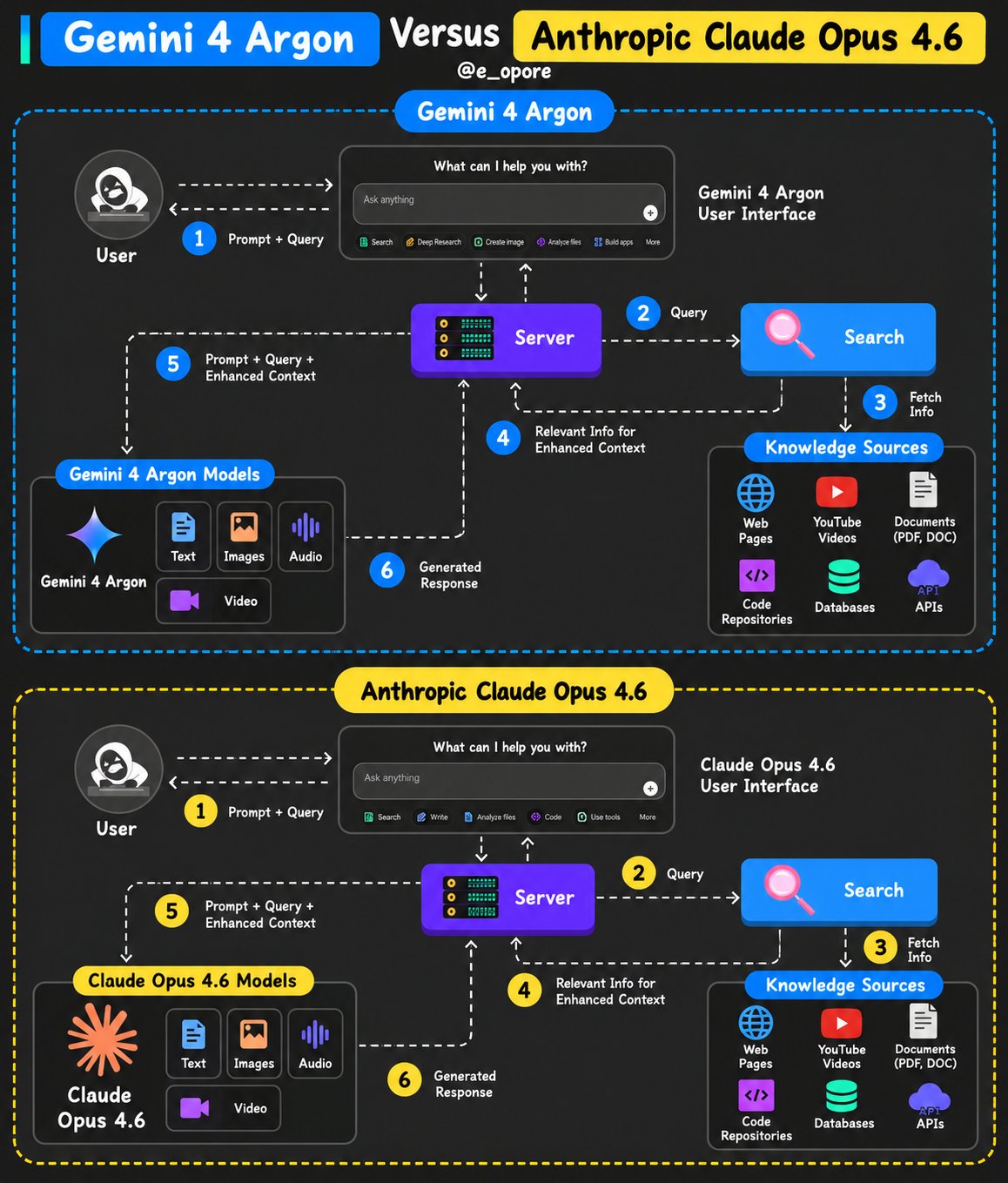
𝗚𝗲𝗺𝗶𝗻𝗶 𝟰 𝗔𝗿𝗴𝗼𝗻 𝘃𝘀. 𝗔𝗻𝘁𝗵𝗿𝗼𝗽𝗶𝗰 𝗖𝗹𝗮𝘂𝗱 𝗢𝗽𝘂𝘀 𝟰.𝟲, clearly explained! Gemini 4 Argon and Claude Opus 4.6 are advanced AI models designed to handle complex reasoning, coding, and demanding professional tasks. Gemini 4 Argon focuses on complex, multi-step problem-solving across software engineering, mathematics, scientific research, cybersecurity, and enterprise workflows. It supports a unified context window of up to 1 million tokens, allowing it to process large amounts of information within a single task. Its strengths include long-context reasoning, multimodal understanding, coding, and agentic workflows. Claude Opus 4.6, on the other hand, is designed for sophisticated reasoning, software engineering, long-running coding tasks, and complex knowledge work. It is particularly useful for navigating large codebases, debugging difficult problems, analyzing documents, and working through tasks that require sustained attention. The difference is not simply which model is smarter. It is about how each model performs under the specific requirements of your workload. 𝗚𝗲𝗺𝗶𝗻𝗶 𝟰 𝗔𝗿𝗴𝗼𝗻 offers a 1-million-token context window and strong multimodal capabilities for tasks involving text, images, audio, and video. 𝗖𝗹𝗮𝘂𝗱𝗲 𝗢𝗽𝘂𝘀 𝟰.𝟲 offers a strong alternative for complex coding, reasoning, and extended software engineering workflows. For developers, the practical comparison comes down to several factors: ↳ Coding: Which model produces more reliable code, handles complex refactoring, and fixes bugs effectively? ↳ Reasoning: Which model solves difficult problems with fewer mistakes? ↳ Long context: Which model better retains and uses information across large codebases and lengthy documents? ↳ Agentic workflows: Which model completes multi-step tasks more reliably with tools and external systems? ↳ Cost and speed: Which model delivers the best results within your budget and latency requirements? Neither model automatically wins every category. The best choice depends on your workload, evaluation benchmarks, and real-world results. For production applications, test both models against the same prompts, datasets, tools, and success criteria before choosing one. The goal is not to pick the most popular model. It is to pick the model that delivers the best results for your specific use case. Gemini 4 Argon vs. Claude Opus 4.6: Which one would you choose for your next AI project?