Jev + Grok Bot routing sends only 3% of 18.5k daily events to generation
Jev runs six bounded checks in front of Grok Bot, so only about 560 of 18,500 daily events reach generation, at a daily cost of $24.10.
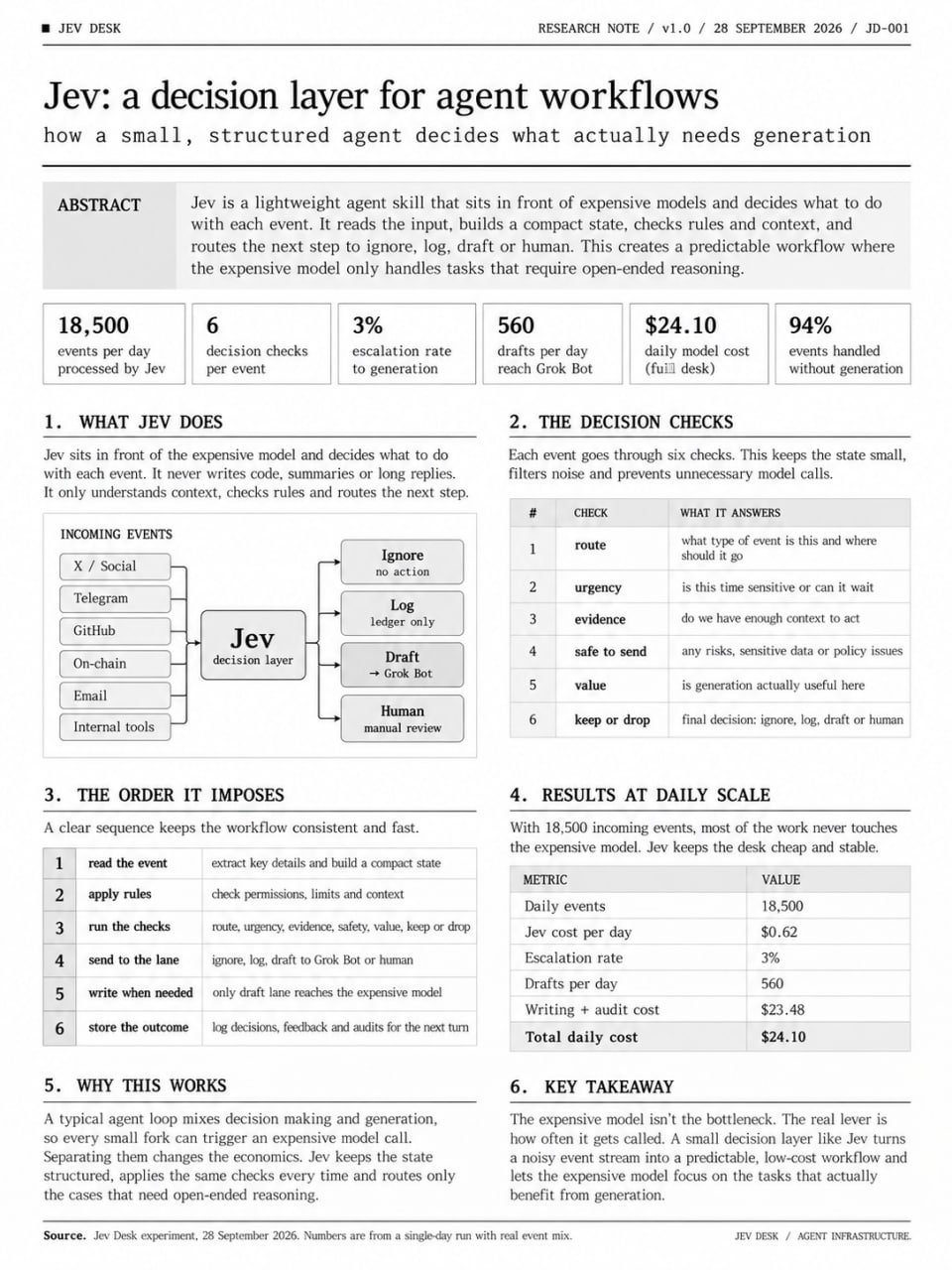
Jev + Grok Bot is one of those agent stacks that looks obvious only after you see the routing separated from generation most teams still let an expensive model touch every event. this setup puts Jev in front, runs 6 bounded checks, and only sends the small fraction that actually needs writing to Grok Bot. i mapped the whole flow into a 10-step note: step 1 → read each event and compress it into a small state instead of feeding the full history into a model step 2 → check route first: decide whether the event belongs in ignore, log, draft or human step 3 → score urgency separately so time-sensitive work doesn’t get mixed with routine traffic step 4 → verify evidence before acting: missing context blocks the next step instead of forcing a guess step 5 → run a safe-to-send check for policy, sensitive data and anything that should go to review step 6 → ask whether generation has real value here. simple work stays deterministic, draft is the only lane that reaches Grok Bot step 7 → keep-or-drop closes the decision so low-value events disappear without another expensive call step 8 → log every outcome and feed audits back into the next turn instead of treating each event as isolated step 9 → at 18,500 events/day, only 3% escalate to generation, which means roughly 560 drafts actually reach Grok Bot step 10 → 94% of events stay outside generation and the full daily model cost in this run lands at $24.10 the useful takeaway isn’t “use a cheaper model.” it’s designing the system so the expensive model only sees work that actually deserves generation.
This post quotes another post: x.com/gippp69/status/2103394701063737504