Jev founder publishes 10-step blueprint for integrating Jev with LLMs
Diogo Almeida's 12-page PDF explains how to insert Jev's Choice, Score and Noul primitives into Opus, Codex and Grok workflows to build a cheaper, more controllable decision layer.

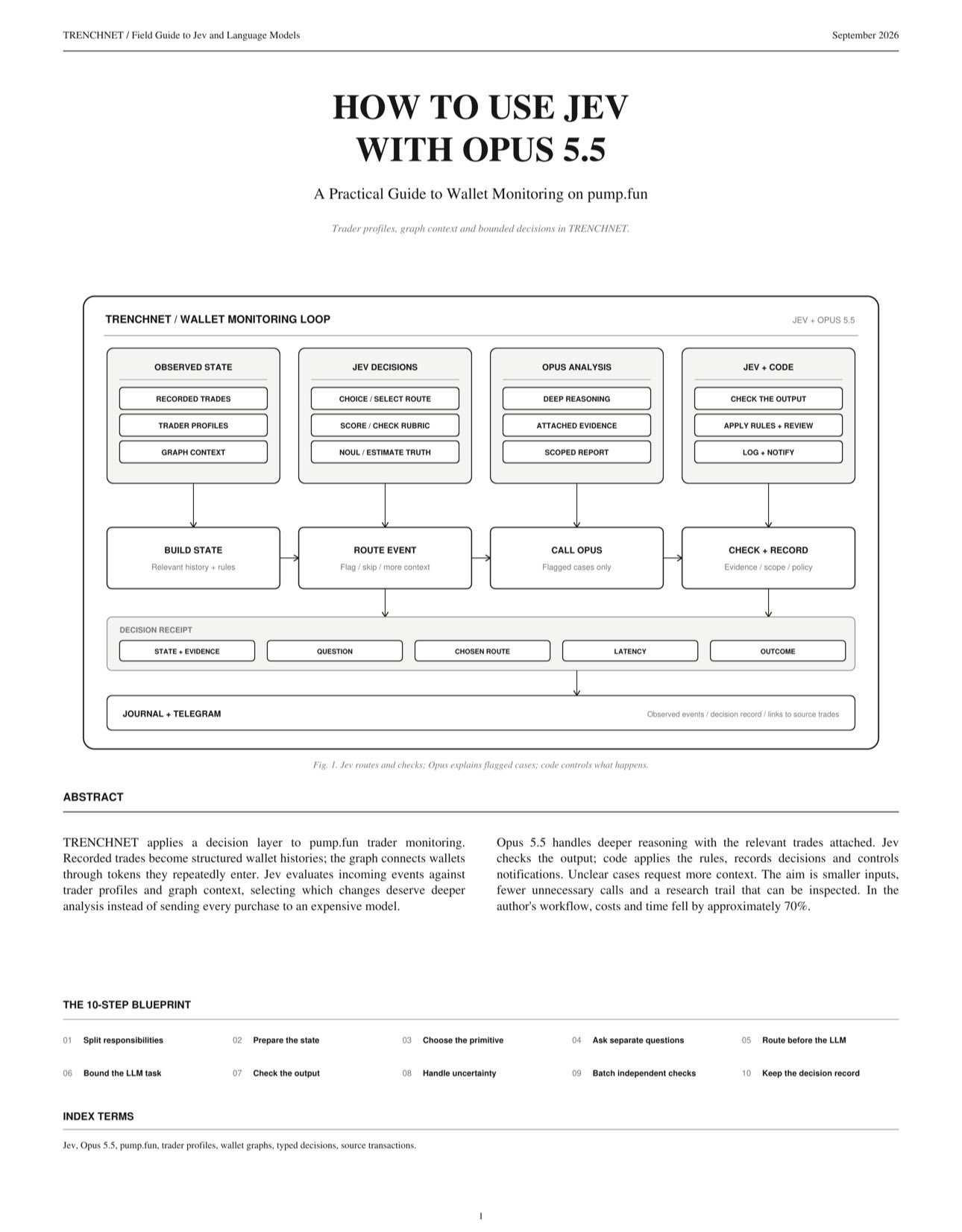
Jev founder Diogo Almeida released a 12-page PDF on how to use Jev with LLMs more useful than another paid course on prompting: a 10-step blueprint for building a faster, cheaper and more controllable AI system around Opus, Codex, Grok or any other LLM: step 1 → split the responsibilities: the LLM writes and reasons, Jev makes bounded decisions, code controls what actually happens step 2 → prepare the state: give Jev the current task, relevant evidence, rules and proposed action without loading the entire conversation step 3 → choose the right primitive: Choice picks a route, Score evaluates against a rubric, Noul estimates whether a statement is true step 4 → break large evaluation prompts into separate questions: relevance, evidence, risk and scope each get their own answer step 5 → put Jev before the expensive model: select the context, tools and workflow before paying for a full generation step 6 → give the LLM a specific job: send only the instructions, files and tools needed for the selected route step 7 → put Jev after the LLM: check whether the output answers the request, has supporting evidence and stays within scope step 8 → handle uncertainty explicitly: routine cases can proceed within code-defined limits, unclear cases need more context, consequential actions need review step 9 → batch independent questions: evaluate several decisions against the same state instead of starting a separate LLM call for each one step 10 → keep the decision record: what the system saw, which route it chose, how long it took and what happened afterward the useful part is learning where each model belongs in the workflow smaller contexts, fewer unnecessary calls and decisions u can inspect instead of guessing why the agent did something this is the approach i applied to pumpfun trader monitoring in TRENCHNET jev evaluates incoming events, the graph connects wallet histories, opus handles the deeper analysis in my workflow, costs and time dropped by ~70% give the TRENCHNET article linked in my post below to Claude Code or Codex and start with one group of wallets ↓
This post quotes another post: “TRENCHNET uses Jev to flag anomalies and Opus 5.5 for deep analysis”