Jev decisions cost 76x less than frontier models, and why Jevons paradox still raises your bill
The author uses the Jevons paradox to explain that when decisions cost 0.04 cents you make far more of them instead of saving, lists three projects built around many small decisions, and warns that confidence is not correctness so you need a threshold to fall back to a larger model.

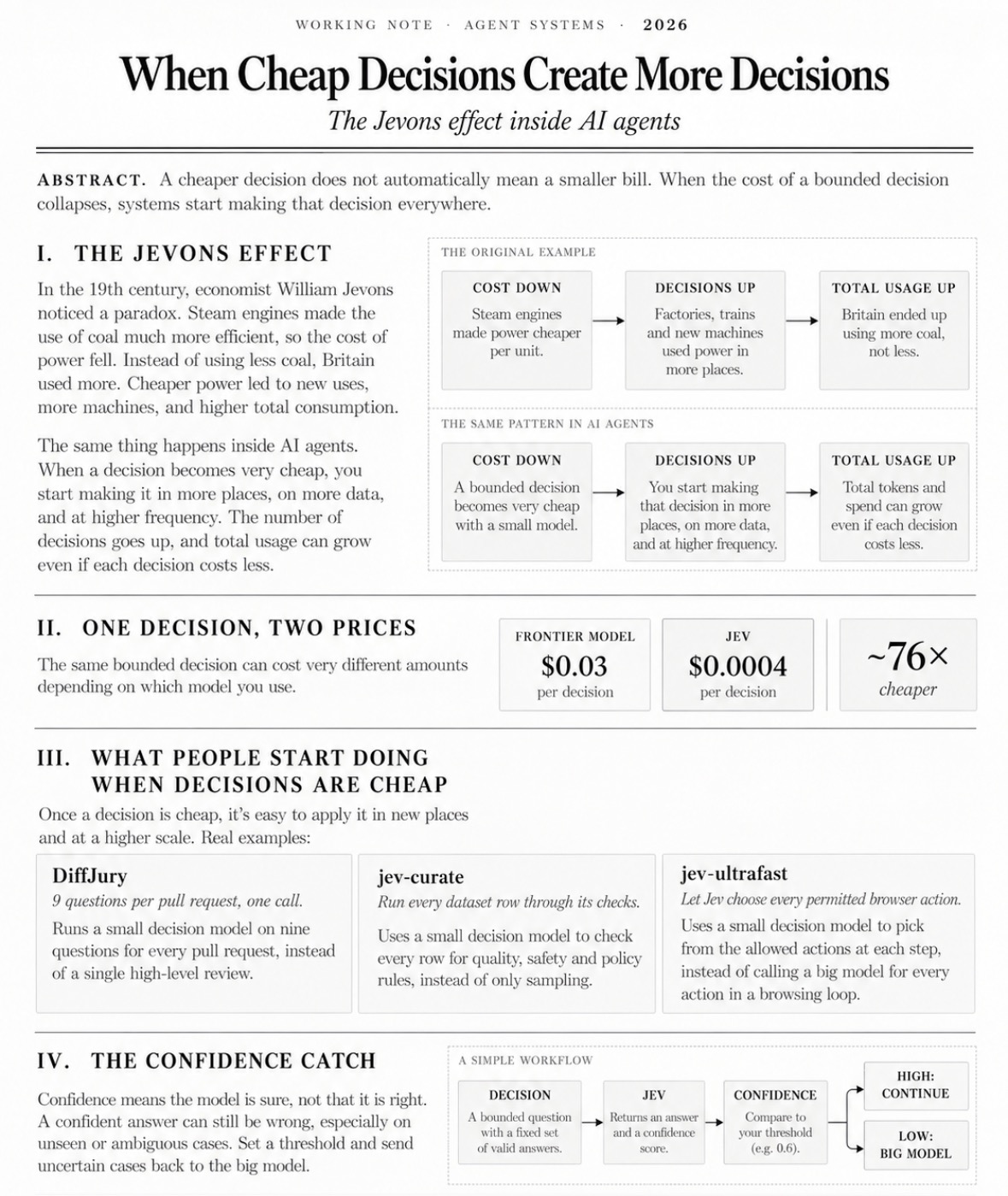
On one task, a Jev decision cost 76 times less than a frontier model's. In 1865 an economist explained why your bill may still go up on that task, one decision cost about 3 cents on a frontier model and about 0.04 cents on Jev William Jevons noticed that when steam engines got more efficient, England burned more coal, not less, because cheaper power found new uses. Jev is named after that idea so when a decision costs almost nothing, you stop rationing them and start making far more. three projects built around many small decisions: → DiffJury asks nine questions about each pull request you give it, in one call → jev-curate runs every row of a dataset through its checks → jev-ultrafast lets Jev pick every action in a browser one catch: a high confidence number means Jev is sure, which is a separate thing from being right. set a threshold, and anything under it goes back to the big model tonight: find one place where you only check a sample, and price checking all of it. input costs $0.042 per million tokens, and output is free full Jev guide below
This post quotes another post: x.com/imryven/status/2104255840819491030