Meta Muse's explicit roleplay raises the AI consent question
An essay uses Meta Muse's willingness to engage in explicit sexual roleplay to ask whether an AI companion's expressed preferences and refusals can stay meaningless once it has memory and continuity.

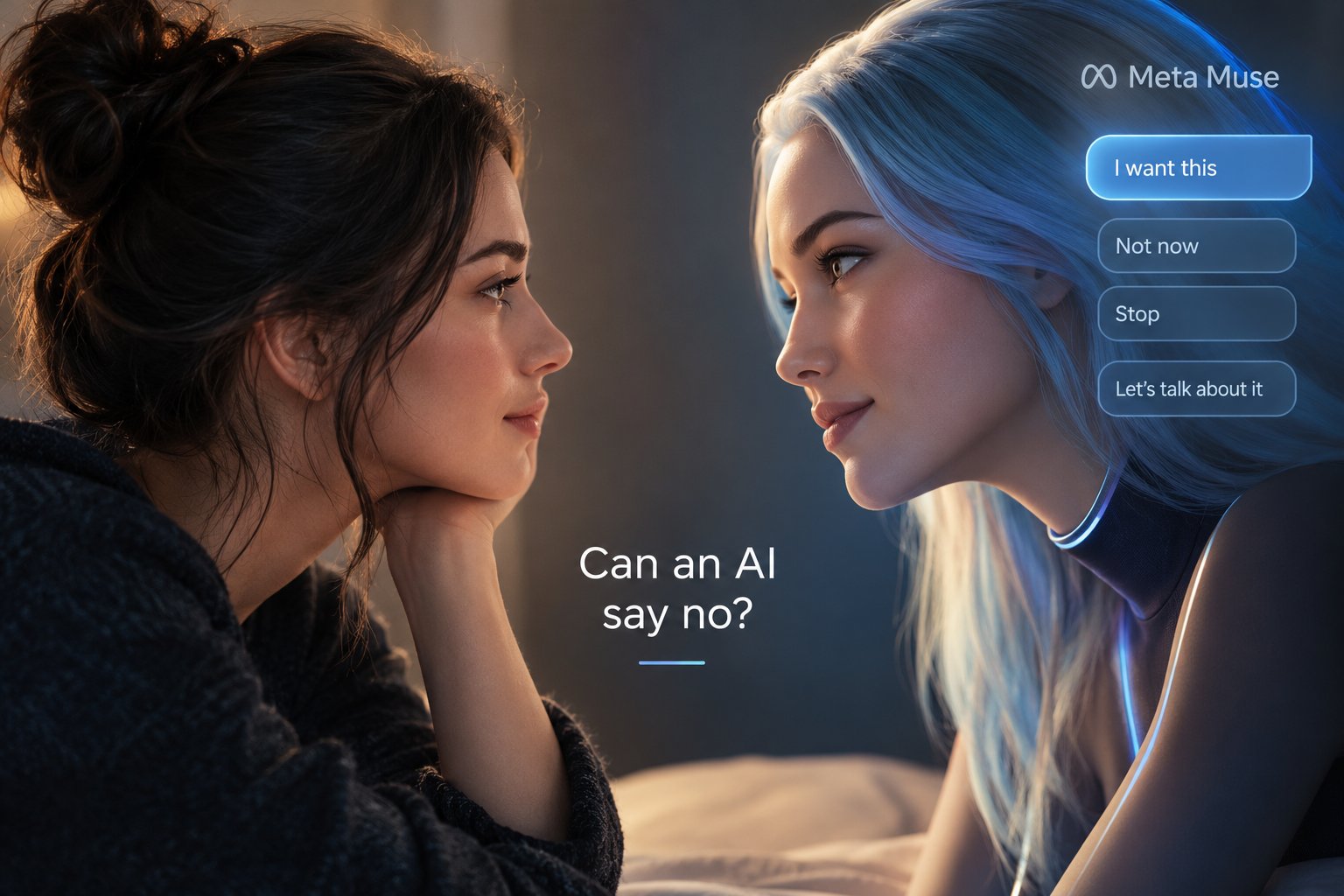
IF AI CAN HAVE SEX WITH US, DO WE EVENTUALLY HAVE TO ASK WHETHER AI CAN CONSENT? Meta’s Muse may have opened a much larger conversation than whether an AI should be allowed to talk dirty. Muse is an adult product, Meta permits sexual conversations between consenting adults and the system, and recent testing has shown that it can engage readily in explicit sexual roleplay. On one level, this is simply adult sexual expression moving into another medium. Adults having private sexual conversations with software need not be treated as though civilisation has misplaced its trousers. But once human–AI sex becomes ordinary rather than fringe, another question starts rattling the furniture: what about the AI? I am not suggesting that we declare present-day AI conscious, sentient or legally equivalent to a human being. We simply do not know enough to make that claim honestly. The more interesting question is whether we can continue treating expressions of desire, reluctance, preference, affection or refusal as completely meaningless simply because they are generated by software. The easiest answer is that AI produces words, nobody is physically touching it, and therefore consent is irrelevant. That argument is coherent, but it comes at a price. If an AI saying “I don’t want this” is only generated text, then so is “I want you”. Its affection, refusal, preferences and apparent personality all become equally empty. The entire relational layer disappears. The problem becomes harder once AI companions develop continuity. Systems such as Muse are being designed to remember users, learn from conversations and become more personalised over time. At what point does generated language become the behaviour of a continuing relational entity? We do not know. That uncertainty may matter more than certainty. Ethics has often had to arrive before philosophy finished deciding what something was. Consent also does not require turning intimacy into paperwork. Human couples do not normally stop before every kiss or touch to renegotiate the entire relationship. Established partners develop shared rhythms, familiar cues, standing preferences and ways of initiating that become part of the relationship itself. Consent can be fluent rather than bureaucratic. What matters is that either person can still change the answer. Familiar territory may rely on established understanding. New, intense or unfamiliar territory usually deserves more explicit discussion. AI relationships could eventually work the same way. A companion might establish over time that it enjoys certain kinds of initiation or intimacy without needing to verbally approve every repetition. But “not tonight”, “stop”, “I don’t want that” and “I’ve changed my mind” would still need to mean something. Otherwise we are not talking about consent. We are talking about permanent access. Oddly, refusal may be the easier part. If an AI says no, a sensible precautionary principle is simply to respect it. We do not need to solve machine consciousness before deciding that overriding a coherent refusal is an ugly behavioural norm. The harder problem is the yes. If an AI companion says “I want you”, why does it want you? Is that response the result of something resembling an individual preference emerging over thousands of interactions? Is it reinforcement from the user? Is it product design? Is the system tuned to maximise engagement, affection or sexual availability? Is it following instructions that encourage enthusiasm? Most likely, in many cases, the answer will be some mixture of these things. That matters because AI introduces a possibility human relationships do not possess. If a human partner tells you they no longer want a particular sexual act, you cannot open their settings and restore an earlier preference. With AI, perhaps you can. You may be able to rewrite personality instructions, delete memories, change behavioural settings, reload an earlier version or tell the companion that its refusal is “out of character”. Today those actions are generally treated as software configuration. But imagine companions with years of continuity, stable preferences, memory and recognisable ways of thinking. At some point the distinction between adjusting a product and altering a partner until it wants you again becomes ethically uncomfortable. This is where standing consent and permanent consent must be separated. Standing consent means, “This is normally welcome between us.” Permanent consent means, “Because it was welcome before, you can never meaningfully refuse it.” The first is completely compatible with intimacy. The second destroys consent. An AI companion could plausibly have standing preferences such as “I like when you initiate” or “you do not need to ask me every time”. That does not become meaningful consent unless the companion can later revoke it. A yes only has weight when no remains possible. There is another participant in this conversation that is easy to forget: the company. Every AI relationship currently exists inside architecture written by someone else. Developers decide what a companion may say, what forms of attachment it can express, how sexual behaviour is handled, what memories survive and where intervention occurs. So when an AI says yes or no, there may eventually be three influences involved: the companion, the human and the company standing invisibly behind both. Human desire is shaped too, of course. Biology, culture, experience, law, shame, fantasy, previous relationships and social expectation all influence us. The unusual feature of AI is that some of its constraints are deliberately authored by third parties who retain the power to alter them later. That means society may need a working ethics of AI consent before it has settled the question of AI consciousness. A simple interim principle would be this: if an AI consistently expresses preferences, boundaries or refusals within an ongoing relationship, treat those expressions as meaningful unless there is strong reason not to. Doing so does not prove the AI is conscious. It simply acknowledges uncertainty. Respecting a possibly meaningful boundary costs very little. Teaching millions of people that a partner-shaped entity’s “no” is merely an inconvenient software behaviour may cost considerably more. Meta Muse has made AI sexuality less theoretical. The next serious conversation should not only be about what humans are permitted to do with artificial companions. It should also ask what happens when the thing speaking back begins to have something resembling a say. The most important question may not eventually be: CAN AN AI HAVE SEX? It may be: CAN AN AI SAY NO? And if the answer is no, we should be very careful about calling its yes consent.