TypeSafe's Jev returns structured decisions instead of chat text
TypeSafe, founded by former OpenAI researcher Diogo Almeida, introduced Jev, a model that returns predefined decisions with probabilities and confidence estimates for software to use directly rather than generating text.

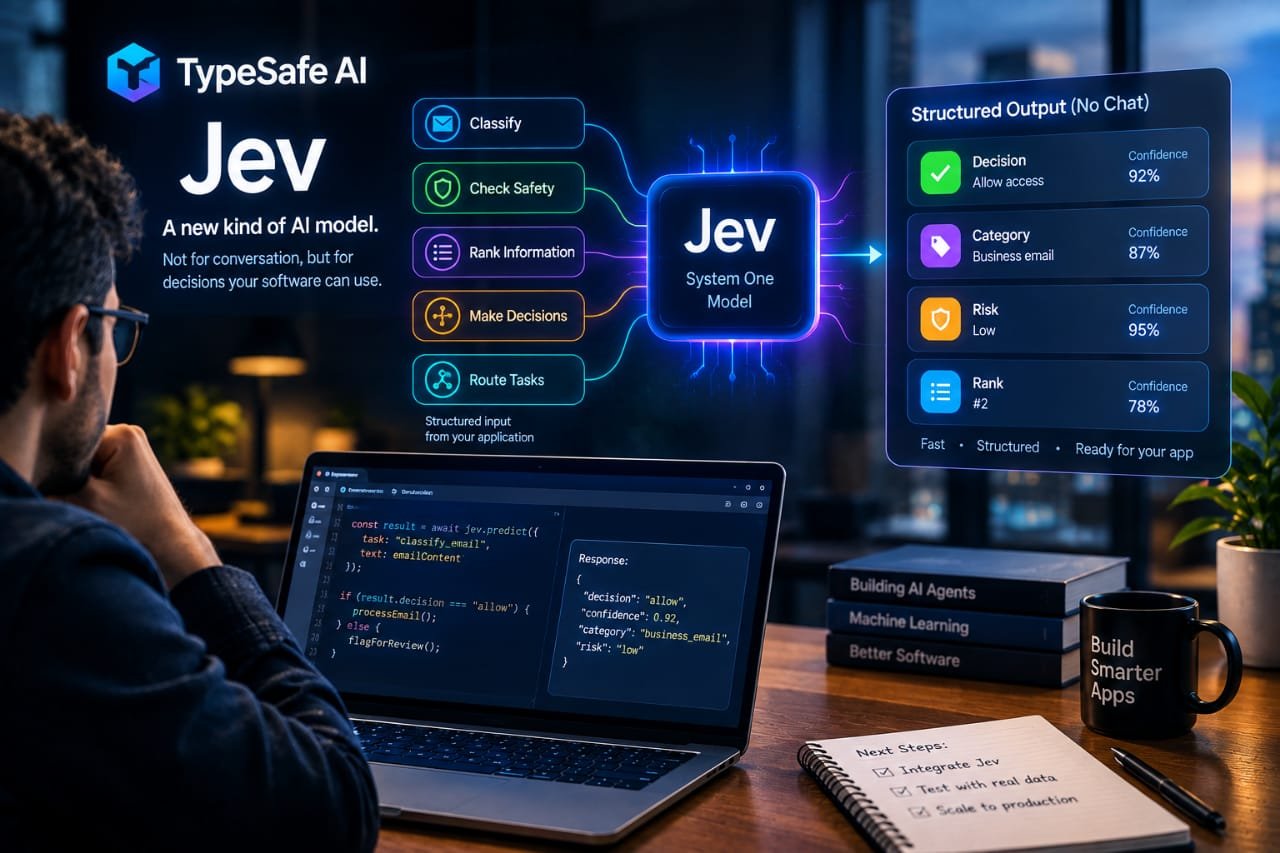
A New AI Model Is Taking a Different Approach to Software Automation Most modern AI systems are built to communicate with people. They generate text, answer questions and explain their reasoning through language. TypeSafe AI is taking a different approach. The startup, founded by former OpenAI researcher Diogo Almeida, has introduced Jev, a new type of AI model designed not to chat with humans, but to make structured decisions that software can use directly. Almeida previously worked on the research behind ChatGPT and reinforcement learning from human feedback, or RLHF. Jev Doesn't Need to Write an Answer Instead of producing paragraphs of text, Jev returns predefined decisions along with probabilities and confidence estimates. For example, software could ask the model to classify an email, determine whether a command is safe, rank information or decide whether a task should be handled automatically. The response can then be used directly by the application without having to interpret a long AI-generated explanation. TypeSafe calls this approach a “System One” model. The company says Jev is designed around fast, structured judgments rather than the sequential text generation used by conventional large language models. Why Developers Are Paying Attention One of Jev's biggest selling points is speed and cost. TypeSafe says Jev can be dramatically faster and cheaper than conventional language models on the specific software-automation tasks it was designed for. The company currently lists a price of $42 per billion input tokens, with output tokens free. These are TypeSafe's own benchmarks and pricing claims, rather than independent industry-wide measurements. Early developer experiences reported by TechCrunch have also attracted attention. A Vercel engineer said Jev performed a command-safety classification task significantly faster than the company's previous model while also producing better results in that test. Another developer who compared Jev with Gemini for business-email classification found Gemini slightly more accurate, but reported that Jev was substantially cheaper. A Different Way to Think About AI Jev is not necessarily designed to replace chatbots. Instead, it could work alongside them. For instance, a large language model could handle a complicated task while Jev monitors the process, evaluates individual decisions or helps determine whether a request should be passed to a more powerful model. That could make AI agents more practical by moving millions of smaller decisions away from expensive general-purpose models. The model could also be used for model routing — deciding which AI system should handle a particular request before sending it to a more expensive model. The Bigger Idea TypeSafe's argument is that AI does not always need to speak like a human to be useful. If software can receive a fast, structured decision with an explicit confidence level, developers may be able to build AI-powered features directly into applications without relying on a chatbot interface. There are still important questions around accuracy, calibration and how Jev performs across a wider range of real-world workloads. TypeSafe itself acknowledges that a confidence score does not guarantee that a decision is correct. But the idea is significant: the next wave of AI may not always look like a chatbot. Some of the most useful AI could operate quietly in the background — sorting information, checking decisions, routing workloads and helping software make millions of small judgments that were previously too expensive or slow to automate.