ChatGPT Images 2.5 outfit prompt template, shared by category
The author uses Images 2.5 to generate character outfits and shares swappable clothing prompt templates organized by category.


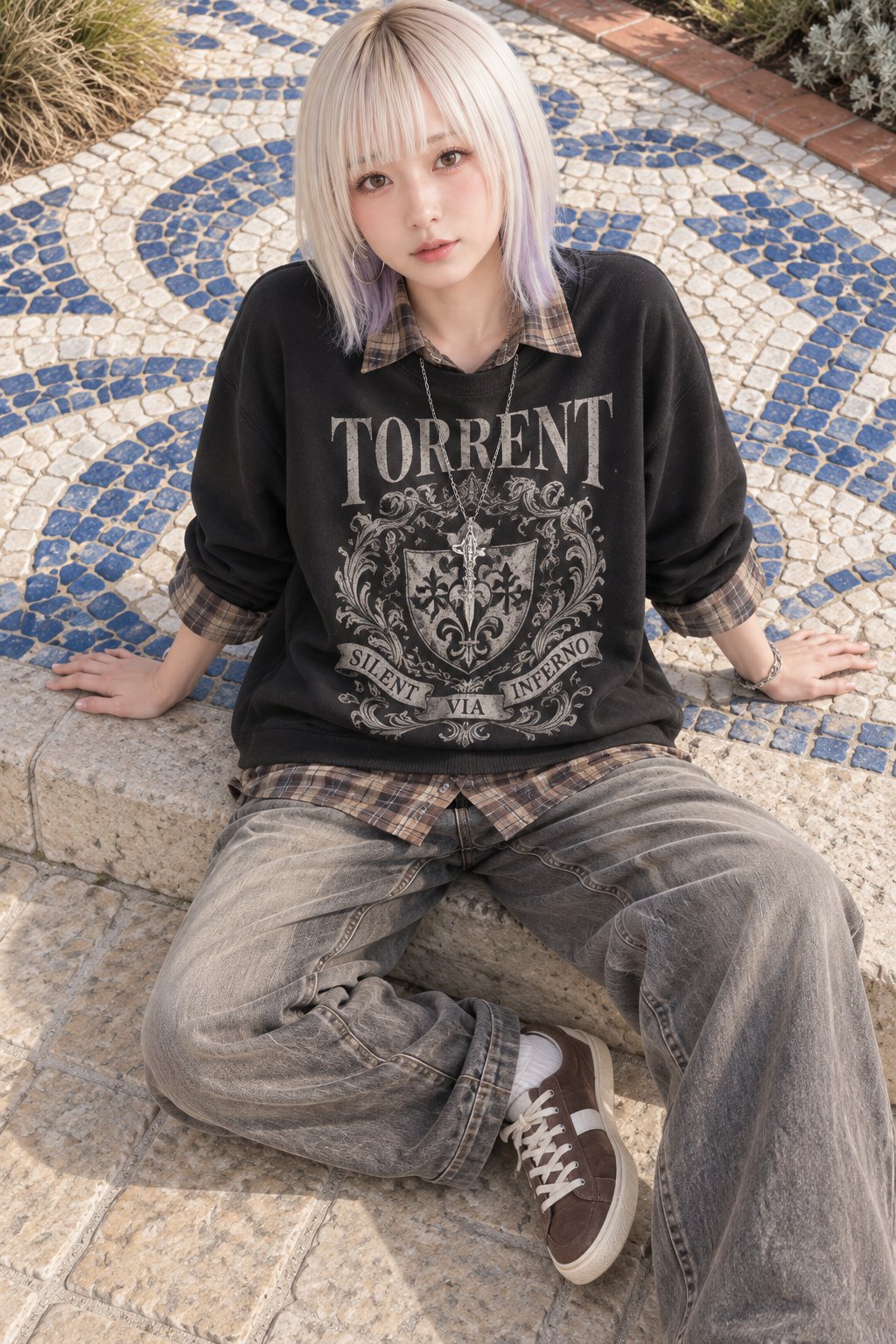
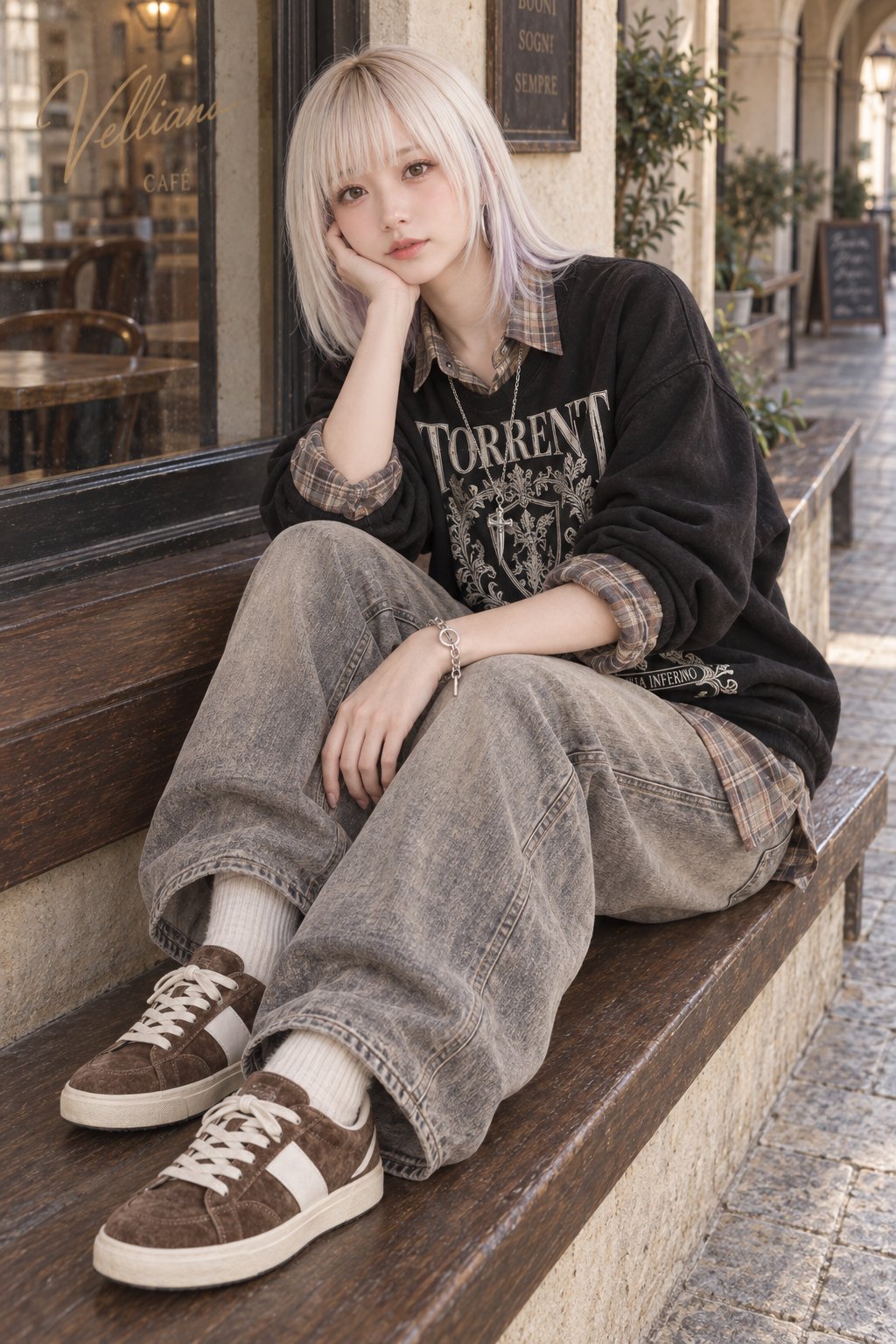
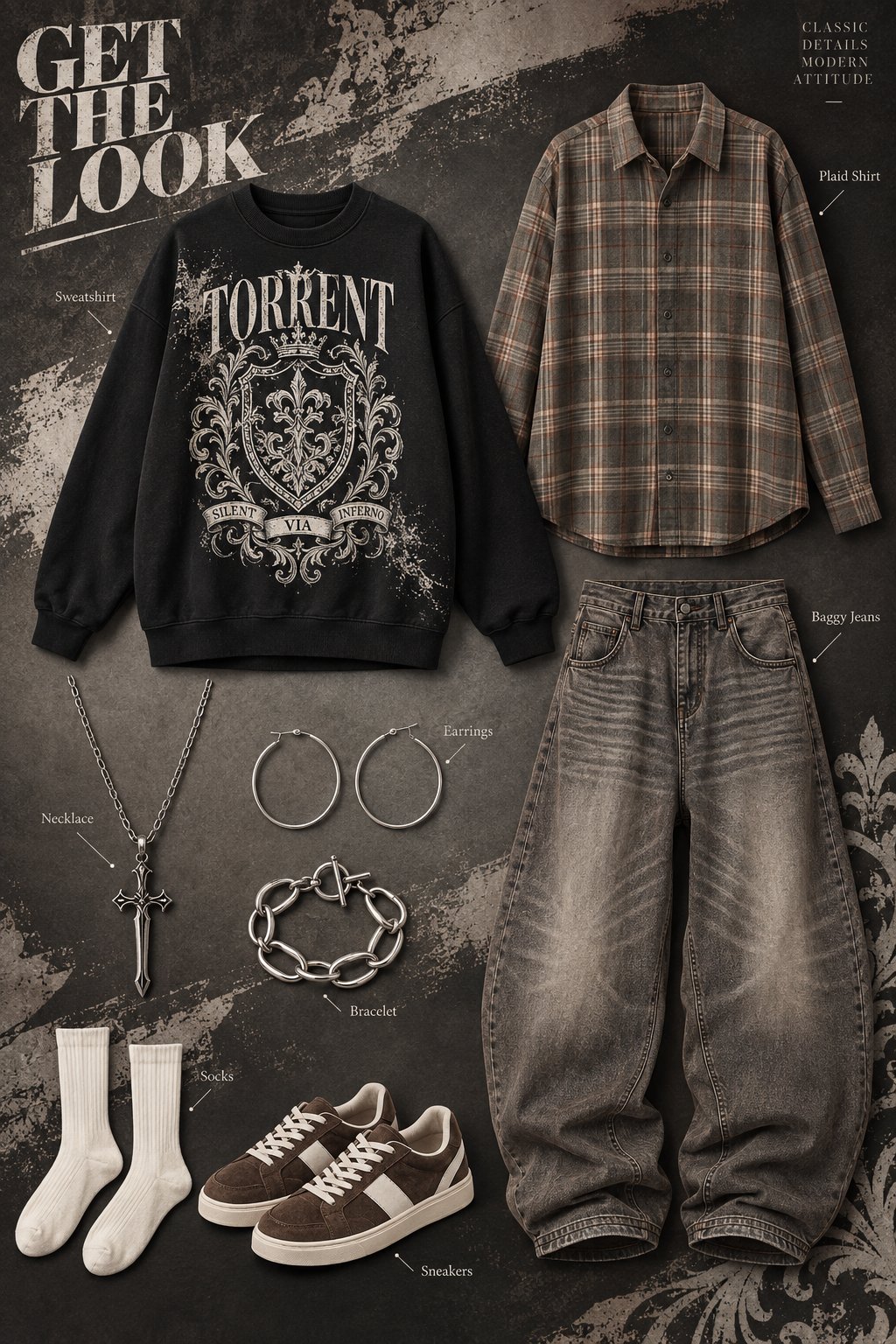
【こんな服装はダメですか?】 衣装に特化しすぎてて異端なのか? でも、AIモデルの差別化に重要なのが衣装だと思ってるから負けない🤎 カテゴリごとに交換可能な衣装プロンプトを配布中✨ 生成環境:ChatGPT Images 2.5 #AIart️️️️️️️️️️️️️️️️️️️️️️️️️️️️️️️️️️️️️️️️️️️️️️️️️️️ #プロンプト PROTECTED WARDROBE RULE — HIGHEST PRIORITY: Treat each garment description below as its immutable final product identity. Preserve construction, parts, hardware, material, pattern, and every registered graphic or marking—its surface, side, orientation, scale, colors, content, spelling, and count. FINAL WORN STATE overrides only the scoped item's use, position, side, orientation, fastening, layering, folds, tucks, knots, and drape. A SOURCE GARMENT label describes the unstyled item, never the completed silhouette. Do not redesign, add, remove, mirror, duplicate, relocate, or redraw protected details. Wardrobe: Top: An oversized black crewneck sweatshirt with dropped shoulders, a long relaxed body, full-length loose sleeves, ribbed cuffs and a broad ribbed hem. A large ivory print fills the upper front: tall ornamental serif capitals reading "TORRENT" rise above a pointed heraldic shield filled with symmetrical acanthus scrollwork, enclosed by an elaborate oval frame of curling leaves, flourishes and small crown-like details. A curved lower ribbon reads "SILENT", "VIA", "INFERNO", with further scrolls beneath. Fine lace-like distressed printing runs diagonally from the lower right toward the upper left of the upright front design, retaining open black spaces within the ornate linework. The back and sleeves remain plain. A relaxed long-sleeve button-front shirt in softly woven muted plaid, with broad dusty-brown and taupe bands crossed by narrower gray-green stripes in a roughly 3:1 width relationship. Fine cream and muted rust lines run through both directions of the check, retaining the same pattern scale across the body, pointed collar and button cuffs. A full front placket, conventional back yoke and curved shirttail hem complete the shirt, with the two rounded front hem sections meeting at the placket. Final worn state: For the first item description above only: - Sleeves: Turn each sleeve cuff outward exactly twice to form one double-roll band on each arm. Position both bands at mid-forearm, clearly below both elbow creases and above both wrists. Preserve the two-turn count, the complete cuffs, and this height even when another styling instruction lowers the garment off one or both shoulders. Do not push either sleeve to an elbow, hide a cuff, or leave either sleeve at the wrist. Let material-correct tension travel through connected fabric and fade with geodesic distance; across seams, reduce or redirect it according to connection and stiffness, without a hard cutoff or unconnected jump. Keep unselected openings, edges, seams, closures, components, and connections topologically unchanged. Relaxed handling within this same operation: Use only a few broad loosely handled folds with partial overlap and large-scale asymmetry; avoid narrow bands, accordion pleats, ruching, micro-bunching, or multiplied edges, and preserve every cuff, hem, seam, and hardware component. For the second item description above only: - Front closure: Final state: within the original center-front fastening run, disconnect only its upper approximately one-third; keep every original below connected in place. Preserve the source count, type, order, spacing, endpoints, and placket length; never extend the run toward the hem or add, duplicate, remove, or relocate any fastening or receiver FINAL FASTENING STATE: change only the source-registered primary closure mechanism inside its exact original endpoints. Preserve that mechanism, all original parts, its source length, and the garment construction beyond both endpoints; do not reinterpret a seam, fold, rib, placket, or panel edge as an extension, and add, duplicate, remove, or relocate nothing. Change only the selected registered state and leave every unselected component and connection unchanged. - Sleeves: Push both sleeve cuffs to mid-forearm and compress each lower sleeve into broad pushed-up volumes without rolling the cuffs. Do not return either cuff to the wrist or move it above the elbow. Let material-correct tension travel through connected fabric and fade with geodesic distance; across seams, reduce or redirect it according to connection and stiffness, without a hard cutoff or unconnected jump. Keep unselected openings, edges, seams, closures, components, and connections topologically unchanged. Natural handling within this same operation: Use a few broad soft folds with modest overlap and small large-scale asymmetry while preserving every cuff, hem, seam, and hardware component. - Layering: Final state: place this garment underneath the first selected Top item across the upper body. the first selected Top item remains the outer garment and retains and owns its exact source neckline aperture and edge, armholes, panel connectivity, closure state, straps, sleeves, and selected final hem or fold-return line. This inner garment contributes appearance only through the outer material's existing optical apertures; no inner contour becomes an outer boundary. Only layer order, contact, occlusion, and optical transmission change. Every visible garment boundary follows the outer item's source geometry or separately selected fold-return line; inner contours remain optically behind it. Keep panel contact shallow. Natural handling within this same operation: Use soft stable contact with limited material-correct ease. Bottom: Extremely baggy low-rise jeans in washed taupe-gray denim, with a dropped crotch, generous rounded thighs and bowed outer seams that form loose barrel-shaped legs. Long broad hems fall into soft stacks over the shoes. Dark double topstitching defines the belt-loop waistband, zipper fly, curved front pockets, rear yoke and angular back patch pockets. Mottled pale fading covers the panels, with dense fine horizontal whisker streaks across the front upper thighs and wavy stacked fade lines behind the knees. Each rear pocket carries dark embroidered overlapping elongated oval loops with tapered outward-sweeping flourishes across its lower half. A small tan leather-look patch with subtle debossed texture sits at the rear waistband. Final worn state: - Waist position: Position the waistband level across the upper hip bones, clearly below the navel and natural waist. Keep the front, sides, and back at one continuous low-rise height. Do not raise it to the natural waist, drop only one side, or lower it to an underwear position. Legwear: A pair of ivory cotton-blend crew socks with fine, evenly spaced vertical ribs, a slim elasticized top edge and a soft matte finish. The straight shafts reach the lower calf without contrasting trim or graphics. Plain-knit feet with shaped reinforced heels and smoothly finished toes complete the lightweight, gently stretchy construction. Footwear: A pair of low-top brown suede sneakers with broad rounded toes, curved stitched toe overlays and softly padded collars. Wide cream flat laces cross the brown eyestays over lightly padded tongues. A broad white leather side band slopes from the eyestay area down to the sole, accompanied by a narrower white accent toward the heel. The warm brown suede has a soft matte nap, contrasting with the smooth white panels. Thick off-white rubber midsoles wrap around the toes and heels above thin dark outsoles with shallow tread. Necklace: A long silver-tone necklace with a fine elongated-link chain and an antiqued Gothic dagger pendant hanging at mid-chest. An oval bail connects to a lobed pommel above a narrow grip; a flared crossguard has symmetrical pierced quillons, and a raised central rib descends along the slender tapering blade to a small open teardrop-shaped point. Dark recessed details emphasize the sculpted relief. A discreet lobster clasp closes the chain at the back. Earrings: A pair of large, slender silver-tone hoop earrings with smooth round-section tubing and completely open centers. The polished circular hoops hang beside the jaw with a light, minimal profile and no pendants or surface ornament. Small hinged posts close discreetly at the earlobes. Bracelet: A chunky polished silver-tone bracelet made from large elongated oval links with softly irregular, sculptural contours. The rounded links alternate in angle and leave generous open spaces, forming a fluid substantial chain. A matching plain toggle clasp closes the bracelet without a pendant. Final worn state: VIEW-CONDITIONAL BODY-SIDE MAP: front view — wearer-left is image-right and wearer-right is image-left; back view — wearer-left is image-left and wearer-right is image-right. In profiles, crossed limbs, or ambiguity, trace the named anatomical side continuously from its corresponding shoulder, hip, eye, or ear landmark as applicable. Apply the state only to the named anatomical side; never mirror, swap, or duplicate it. - Bracelet placement: Render one complete instance of the registered bracelet from the item description immediately above around only the wearer-left wrist. Keep the wearer-right wrist free of this bracelet; do not mirror or duplicate it. Preserve the registered design and count. Keep other separately selected wrist items unchanged.