A ten-step build order from the Jev docs
The author walks through the Jev docs: move counts, permissions and hard limits into code, leave only judgments to Choice, Score and Noul, and set thresholds by consequence.

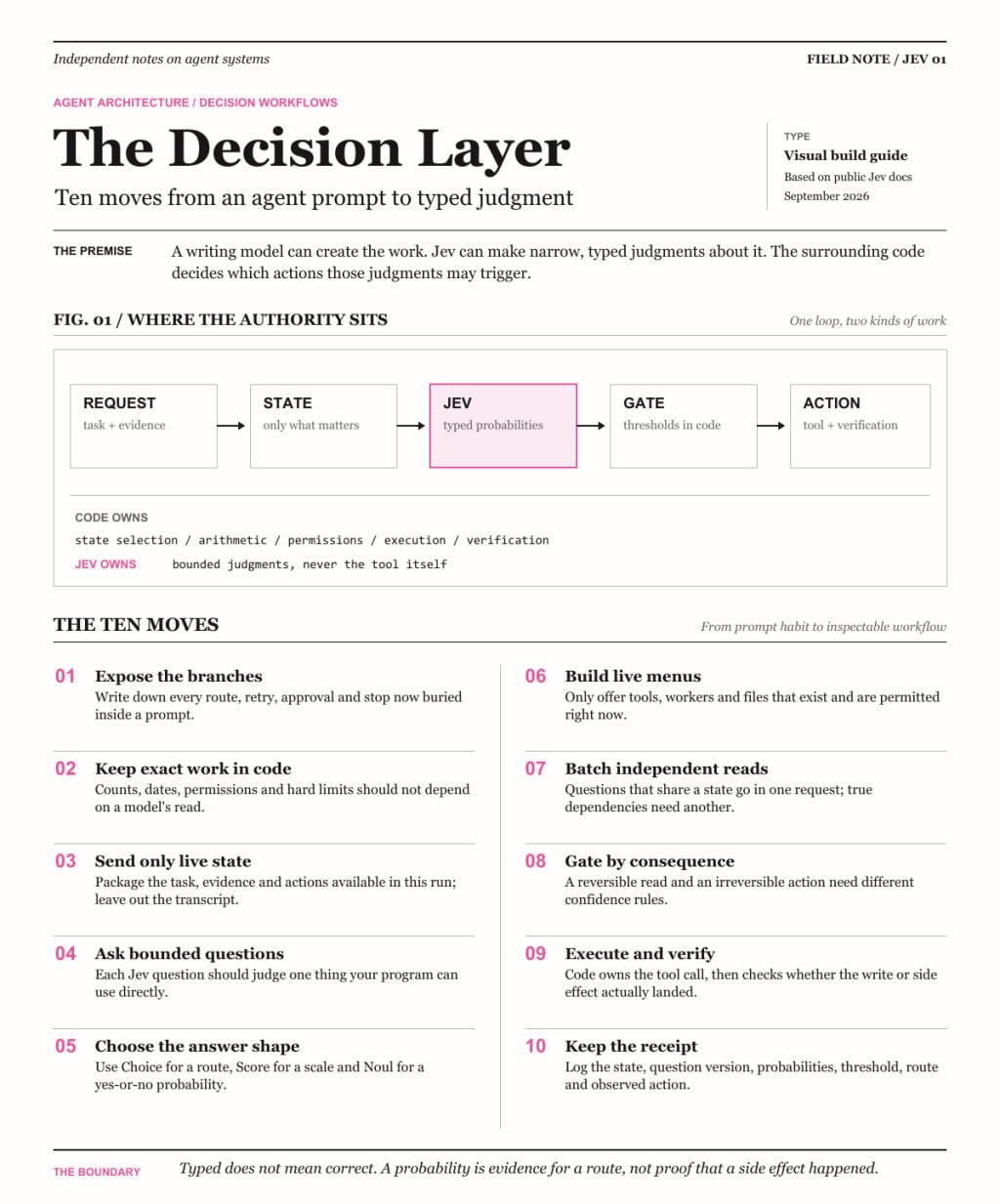
Jev founder Diogo Almeida released the Jev docs, and the part I keep returning to isn’t the price It’s the idea that an agent should not need a writing model every time it reaches an if statement Most agents ask the LLM to read the situation, choose a tool, approve its own choice and explain what it did. Then they do it again at the next branch Jev gives you a different build order: step 1 → list every decision your agent makes during a run, including the small ones hidden inside prompts step 2 → move counts, dates, permissions and hard limits into code step 3 → give Jev a compact state: the current task, relevant evidence and actions available right now step 4 → turn each remaining judgment into a specific question, not “what should the agent do?” step 5 → use Choice for a route, Score for a defined scale and Noul for a yes-or-no probability step 6 → build the options from live tools and workers, so the model cannot select something that no longer exists step 7 → ask independent questions together against the same state instead of paying to resend it for every branch step 8 → inspect the probabilities. A valid typed answer can still be the wrong answer step 9 → make the threshold depend on the consequence. Reading another file and sending a payment should not share a confidence bar step 10 → let code execute the action, verify what happened and preserve the decision that led there The expensive model still has a job when the work needs reasoning or writing. It just stops being the switchboard for every routine decision along the way That’s the setup behind the article below: what to ask Jev, what to keep in code and how to tell whether the cheaper decision actually improved the system
This post quotes another post: x.com/morpphhhaw/status/2102740313953439950