Jev's Choice/Score confidence is not an authorization signal
The author lays out an eight-step gate design: set thresholds by consequence, treat distributions near 0.5 as unresolved, keep a fallback option, and check permissions and side effects in code.

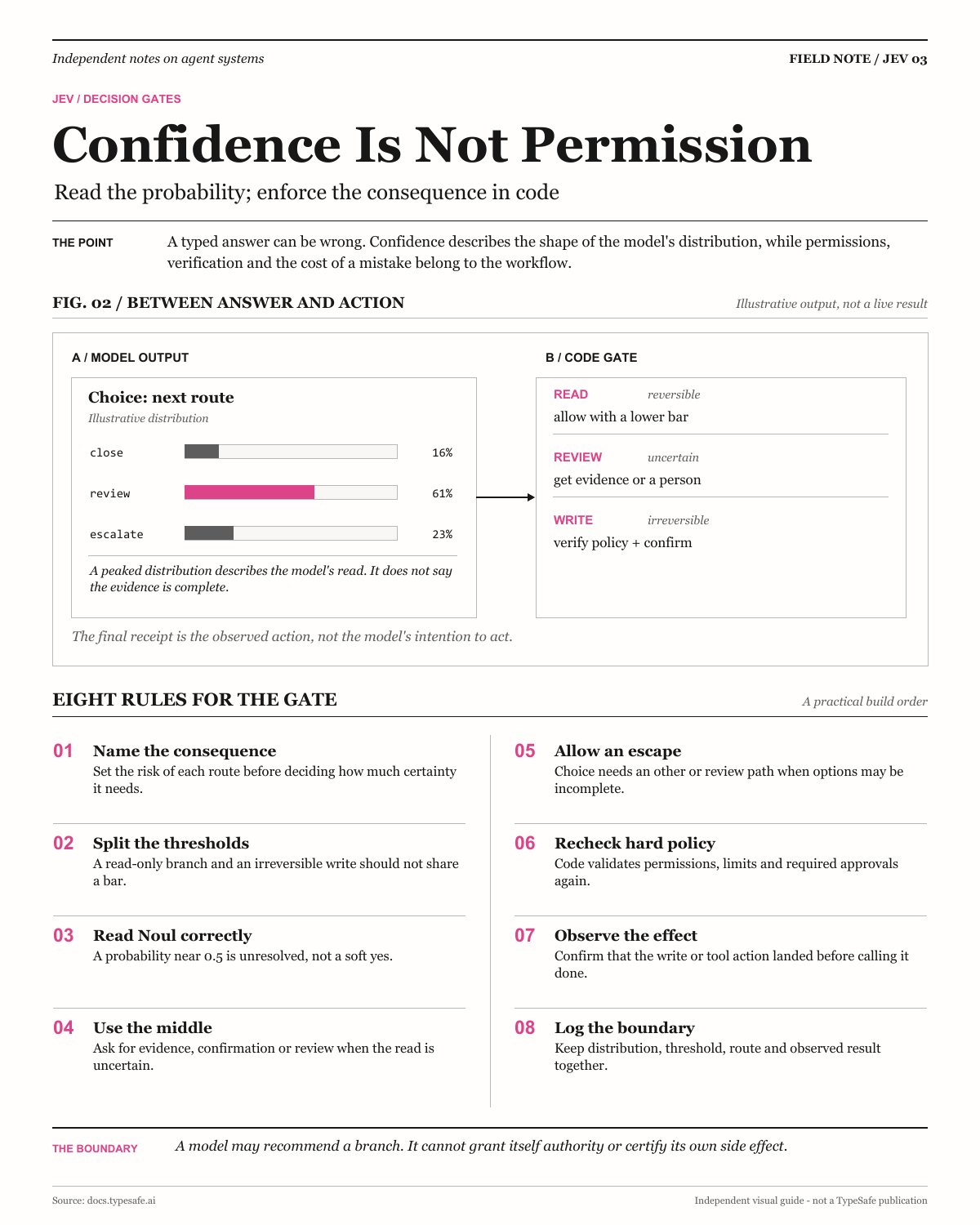
Jev founder Diogo Almeida introduced Jev as a model that returns typed answers with probabilities That last part is where an agent can become more useful, or considerably more dangerous A confident answer is not a correct answer. For Choice and Score, confidence tells you how concentrated the returned distribution is. It does not prove the evidence was complete, the policy was current or a tool call succeeded I would build the gate this way: step 1 → name the consequence of each route before picking a threshold step 2 → let a low-stakes read tolerate more uncertainty than a refund, deletion or transfer step 3 → treat a Noul near 0.5 as unresolved, not as a weak yes step 4 → give the middle band a job: fetch missing evidence, ask for confirmation or queue review step 5 → keep an escape route when none of the Choice options describes the case step 6 → check permissions and hard policy in code even when the model is very sure step 7 → verify the side effect after execution. “Approved” and “payment sent” are different events step 8 → log the distribution, threshold, route and observed result so a miss can be traced This is the part that disappears in the usual agent demo. The model makes a plausible choice the screen cuts to a green checkmark. Production starts in the space between those two frames The document below maps that space. The article explains how to read Jev's return without mistaking confidence for permission
This post quotes another post: x.com/morpphhhaw/status/2102740313953439950