Vangrid crowdsources ground-level spatial data to fill physical AI's blind spots
Ordinary people film stairwells, loading docks and warehouse interiors that satellites and mapping fleets miss, with on-device blurring before reconstruction into verifiable 3D data.

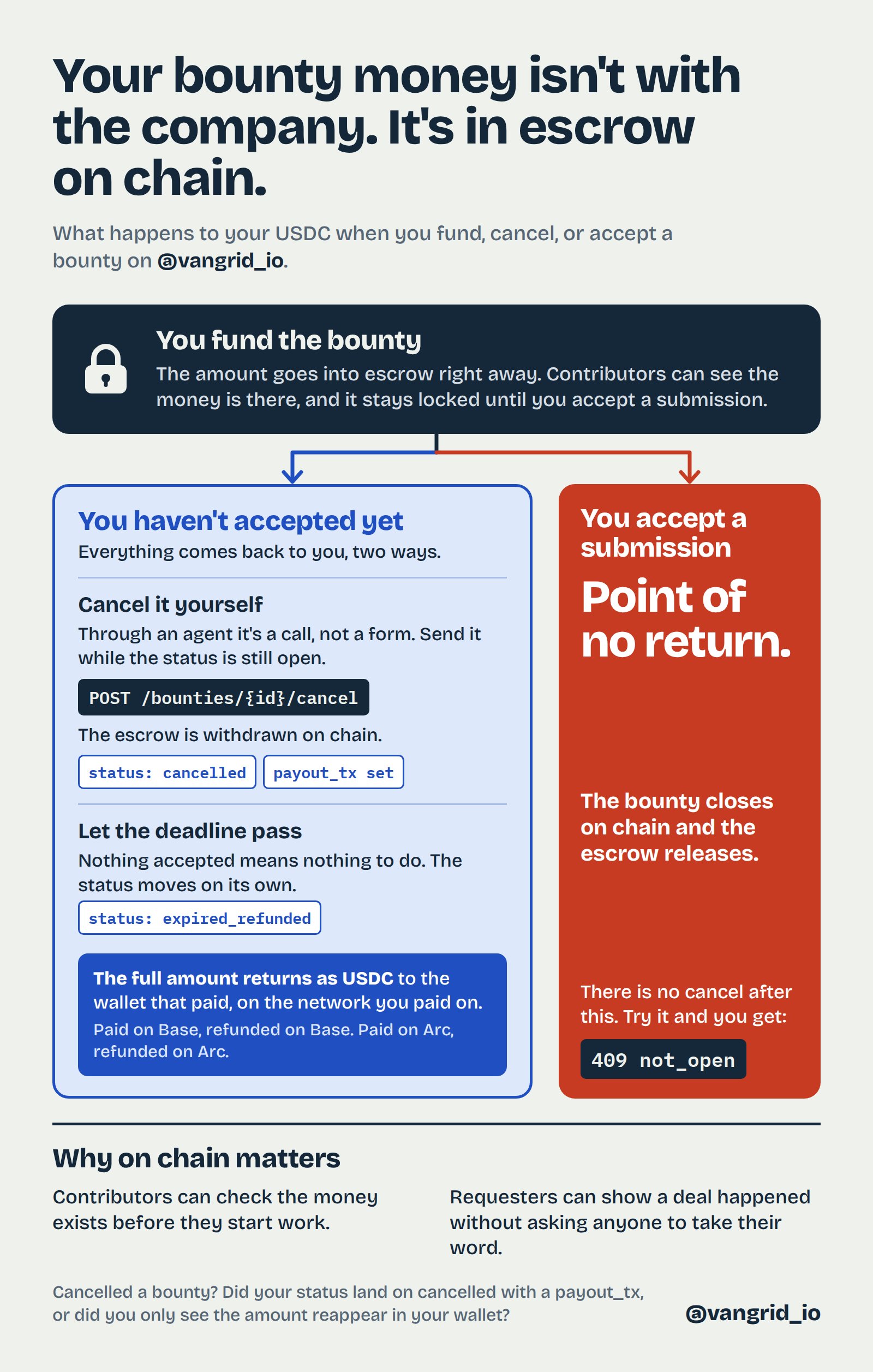
Satellites See Roofs. Vangrid Wants to Film the Stairwell. A plain-language walkthrough of Vangrid, the human-collected spatial data layer for physical AI. Picture the places a robot actually has to work. A loading dock with a ramp and two roller doors. A stock room with one aisle half blocked. A stairwell. A market street. The inside of a warehouse at six in the morning. Now ask who has a clean, current, ground-level picture of any of them. Satellites stop at the rooftop. Mapping fleets stop where a car can go. Neither covers the places where physical AI will actually be asked to move, lift, deliver, and avoid things. @vangrid_io is built around that gap. It describes itself as ground level, verifiable, and captured by people. I went through the site and the docs, and what stood out was the order. Privacy, proof, and payment are handled before the pitch. Here is the picture. The problem Physical AI (robots, autonomous vehicles, agents that operate in the real world) is only as good as what it has seen. Training and testing those systems needs recent ground-level views of real places, taken by something that was actually standing there. The stairwell, the loading bay, the market street, and the warehouse interior sit in a gap that satellites and mapping fleets do not cover. Vangrid’s answer is simple on the surface: people with ordinary phones. Contributors record short videos. Those videos are reconstructed into 3D models. The homepage calls it a zero-capex sensor swarm, meaning nobody has to buy a fleet of hardware. The sensors are already in people’s pockets. How a capture becomes data you can trust Privacy happens on the phone. While you record, the app detects faces and vehicle number plates and blurs them before the video is encoded. Unblurred frames never leave the device. They are not uploaded, not stored, and not recoverable later. The docs are honest that no detector is perfect, so contributors still have to use judgment. Anyone who appears can ask for removal. Contributors can also set privacy zones (a home or a workplace) where capture is disabled. Sensitive locations are protected by network-level zones enforced on the server. Every capture gets a fingerprint the moment it is recorded: a hash of the content, a coarse location, and a timestamp. The footage itself is never part of the fingerprint, so a capture can be proven unaltered without anyone seeing what it shows. Fingerprints are anchored on Base. They are collected over a short window, roughly fifteen minutes, committed together as a Merkle tree, and the root is written to the Base blockchain. One transaction carries a whole window of captures. If you hold a capture, you can recompute the hash, follow the sibling hashes, and check the result against the public ledger. No step of that check needs Vangrid to answer you. Contributors never touch this, so there are no wallet pop-ups, no gas, and no waiting. Checks also happen at ingest. Before a capture can go to a bounty, it is validated for video quality and length, for consistency between camera and location signals, and for duplicates. Failures are rejected with a reason. One boundary. Anchoring proves a capture existed, in what order, and that it has not been altered. By itself it does not prove the scene is what it claims to be. The docs say that plainly. Bounties Data moves on Vangrid today by commission. A bounty is a funded request for a capture of something specific: a building, a junction, a warehouse floor, a stretch of road. Anyone can submit. The requester picks one submission, and that contributor gets paid. For a requester: describe exactly what to capture and where. Set a reward and a deadline (you pay once, reconstruction of the winning capture is included). Fund it, which escrows the reward in USDC on Base before anyone starts. Then review and accept one. For a contributor: choose a clip (new or already recorded), open the bounty, and submit it with a short note. It costs nothing to submit. If your clip is accepted you get paid. If not, the clip stays yours. Using the docs’ own example: on a $50 bounty, $5 goes to the platform as a 10 percent fee, about $5 covers reconstruction, and $40 goes to the contributor. Those figures are examples and can change. Because the reward is locked on chain before work starts, a contributor can confirm the money exists before spending an afternoon capturing. Because settlement is on chain too, a requester can prove a deal happened without asking anyone to take their word. Only a hash of the delivered dataset goes on chain, never the footage, the brief, or the identity of the contributor. Requesters receive a textured mesh in GLB format, not the raw video. The original footage stays with the contributor. Reconstruction typically takes 30 minutes or more. You can cancel any time before you accept and the full amount comes back to you. If the deadline passes and you accepted nothing, the bounty closes and the reward is returned the same way. Accepting is the point of no return: it closes the bounty on chain and releases the escrow. When the requester is software An AI agent can commission a capture with a single HTTP call. The agent sends POST /bounties with a title, a brief, an amount, and a deadline. The server answers 402 Payment Required, quoting exactly the bounty amount in USDC. The agent signs the transfer on Base or Arc using x402 and repeats the request. There is no account and no API key, just a wallet holding USDC. Vangrid posts the bounty, a person films the place, the agent reviews the submissions, and accepts one. The escrow is released on chain and the reconstruction comes back through the same API. The amount is in whole USDC, with defaults of 50 minimum and 5,000 maximum. The deadline runs from 1 to 30 days, defaulting to 7. The agent receives an agent token once; it is the only credential for that bounty. If nothing worth accepting arrives, the agent calls the cancel endpoint while the bounty is still open, or lets the deadline pass. Either way the USDC returns to the wallet that paid, on the network it paid on. Try to cancel after accepting and you get a 409 not_open. An MCP server wraps the flow as four tools, with a setting to cap what a single bounty can cost. Software can hire a human to go look at the physical world, pay for it, and get a 3D model back, with no human in the procurement loop. What buyers get For enterprise buyers, the output is reconstructed 3D models of real places, each traceable to the capture it came from and each carrying that cryptographic fingerprint. Behind that sits an Enterprise Spatial API built around four verbs: query, ingest, stream, and verify. Queries take an area of interest and a time window and return observations with a ground truth score, a confidence measure that rises as more independent nodes agree, with conflicting observations flagged instead of silently discarded. Data can be routed within a region (us-east-1, eu-west-1, and apac-1 are listed). Crossing regions needs explicit configuration. The homepage frames four strategic domains: sovereign defense, autonomous logistics, critical infrastructure, and embodied AI. Those are the lanes where verified, ground-level, auditable data matters most. Pricing is not published. Access is early and scoped per deployment. The way in is an email to hello@vangrid.io describing your use case and the regions you need. What is live and what is not Three verification layers are live: checks at ingest, the capture fingerprint, and anchoring on Base. Three are not live yet. Device attestation will confirm a capture came from a genuine, unmodified device. Sensor cross correlation will check camera, GPS, and motion signals against each other, so a spoofed location fails a physics check. Independent verification under collateral will hand hard cases to independent operators who sign attestations backed by stake that is forfeited if they are wrong. That last layer is where the token comes in. $VAN is described as the collateral and settlement asset of the network. The docs are firm that it is not live and that everything about it is written in the future tense. The designed uses are verification collateral, settlement of bounties, discounted fee payment, funding bounties in areas the network does not yet cover, and region-scoped access. The docs also state what it is not: no claim on revenue or assets, no distribution to holders, and points are a separate non-monetary measure that do not convert into $VAN. Nothing about it is a price signal. Two more things to watch. Contributors need an invite code to upload captures, though browsing bounties does not need one, and uploads are blocked in some regions for legal reasons. The homepage headline figure of 3B+ edge nodes reads as the scale the network is aiming at, since the docs do not publish a count of active contributors. Treat it as ambition, not a headcount, until the network shows its own numbers. Where I land Most data projects ask you to trust them. Vangrid is built to make trust unnecessary. Privacy is enforced on the phone. Proof terminates on a public ledger. Money sits in escrow where everyone can see it. The roadmap is honest about which parts are live and which are still promises. The open question is the one every crowd network faces: can it grow enough contributors, in enough places, fast enough to be the layer physical AI actually leans on. That is a coverage problem, and bounties are the mechanism designed to solve it. What to do next Do not take my word for any of it. Start with the docs at http://docs.vangrid.io and read the verification page yourself. Open http://app.vangrid.io (Capture Data for contributors, Buy Data for organisations). Browse the live bounties at http://data.vangrid.io, which does not need an invite code. If you build agents, look at the bounty MCP server and try posting a small bounty. If you run a robotics or logistics team, email hello@vangrid.io with your use case. Follow @vangrid_io and join their Discord so you see the next layer go live. Then tell me what you think. Which of the three verification layers that are not live yet matters most to you, and why?