Reading the V4.1 Flash 1017 model card against September's: big score jumps, thin cost evidence
Six notes compare the two cards: Terminal-Bench 4.0 31.2 to 42.3, HLE 36.8 to 42.6, the table cut from 19 to 11 rows, and cost claims backed by a single sentence.

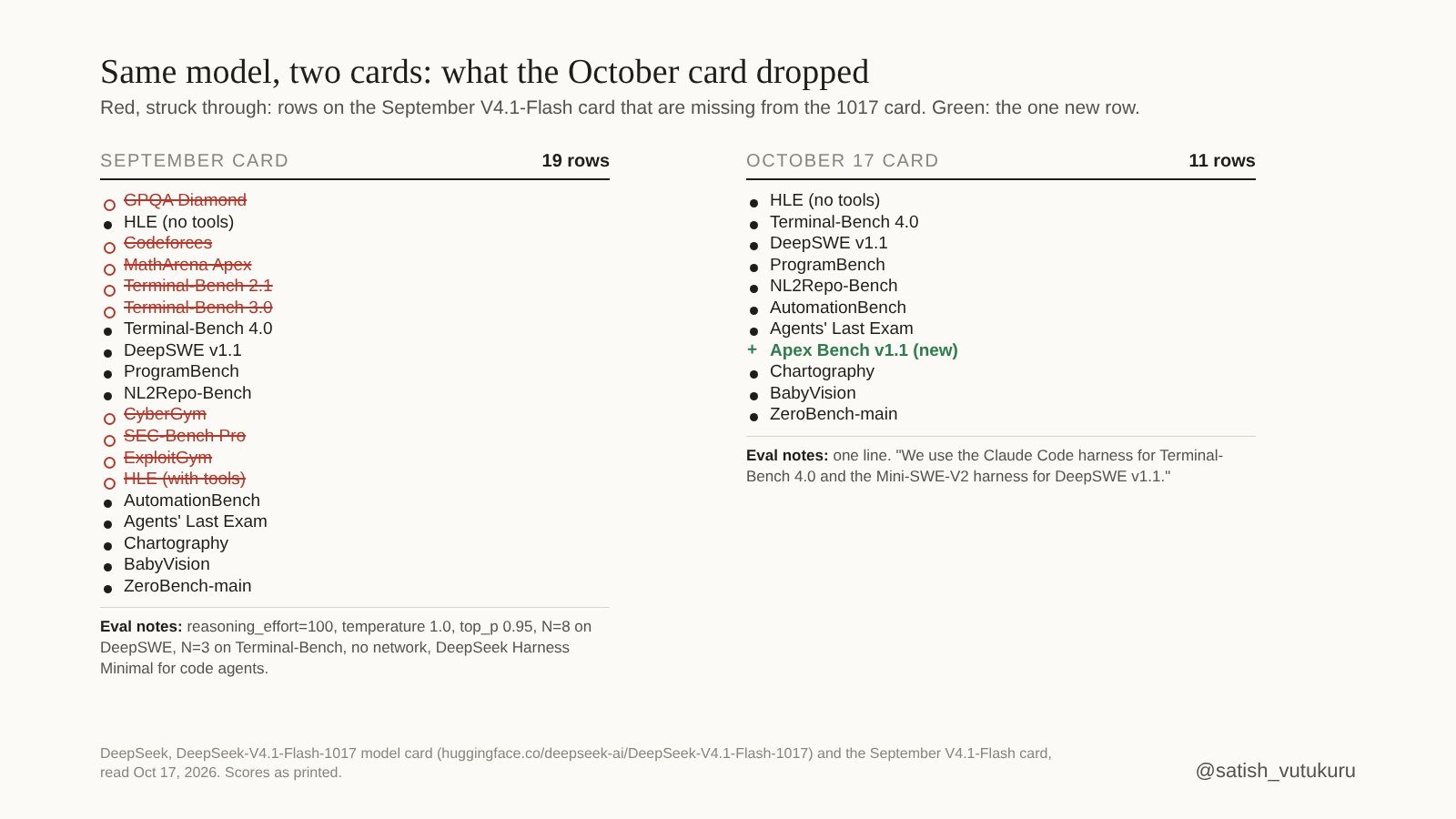
DeepSeek-V4.1-Flash-1017 dropped overnight, MIT weights, 1M context. I read the card side by side with the September V4.1-Flash card. Six notes. 1. First sentence of the card: "a minor update to DeepSeek-V4.1-Flash, delivering substantial improvements across reasoning, coding, agentic tasks, and visual benchmarks." Minor and substantial in the same breath. The table sides with substantial: Terminal-Bench 4.0 31.2 to 42.3, ProgramBench 20.3 to 29.1, Apex Bench 64.6 to 72.1, HLE 36.8 to 42.6. The smallest move is DeepSWE, 74.2 to 77.0, which is also the row that clears Opus 5 (74.0). 2. The cost claim is one sentence: the model "reduces task execution time and output length, enabling users to complete tasks faster and at lower cost." No token count, no wall-clock number, no chart. The launch thread repeats "shorter outputs" and gives no number either. For a release sold on cost, the cost evidence is a sentence. 3. The table shrank from 19 rows to 11. Gone: Terminal-Bench 2.1 and 3.0, GPQA Diamond, Codeforces, MathArena Apex, HLE with tools, and all three security rows (CyberGym, SEC-Bench Pro, ExploitGym). Some of those were September wins (Terminal-Bench 2.1 at 90.6, CyberGym 88.1), one was a clear loss (ExploitGym 15.3 vs 33.7 for GPT-5.6 Sol). One new row, Apex Bench v1.1, with a V4.1-Flash score (64.6) that was never on the September card. 4. The evaluation notes shrank with it. September spelled out reasoning_effort=100, temperature 1.0, top_p 0.95, N=8 samples on DeepSWE, N=3 on Terminal-Bench, no network. The 1017 card keeps one line: "We use the Claude Code harness for Terminal-Bench 4.0 and the Mini-SWE-V2 harness for DeepSWE v1.1." September ran those rows in DeepSeek Harness Minimal mode and mini-SWE. The old V4.1-Flash column carries the same 31.2 and 74.2, except NL2Repo, which quietly moved from 64.0 to 65.4. September's own scaffold table had Claude Code 2.6 points under DSH Minimal on Terminal-Bench 2.1 and mini-SWE 4.4 points over Claude Code on DeepSWE. Scaffold choice is worth a few points on exactly these rows, and the card does not say how many of the 11 are scaffold. 5. Against the frontier it is a split card. 1017 leads on DeepSWE, Automation-Bench, Agents' Last Exam and Apex Bench. Opus 5 leads on Terminal-Bench 4.0 (51.8 vs 42.3), ProgramBench (37.0 vs 29.1), NL2Repo (75.3 vs 68.2), HLE (56.3 vs 42.6) and both vision rows. GPT-5.6 Sol takes ZeroBench. Against open weights it is nearly a sweep: ahead of Kimi K3 and GLM-5.3 on 10 of 11 rows, with K3 keeping HLE by 0.9. 6. The HLE row still mixes subsets: 42.6 full and 44.0 text-only next to GLM-5.3's 42.0 text-only and Opus's 56.3 full. Two tests, one row, a dagger to tell them apart. The citation still points at the September paper, "Pushing the Limits of KV Cache Compression." Same architecture, new post-training, and the card says nothing about how beyond "reinforcement learning with self-feedback" in the launch thread.