Marketing agent infra: classifying raw sources with Jev to build a knowledge wiki
Describes the three parts of marketing agent infrastructure (centralized knowledge, a data warehouse, and a tool layer), where Jev classifies raw material to decide which wiki page the content belongs on.

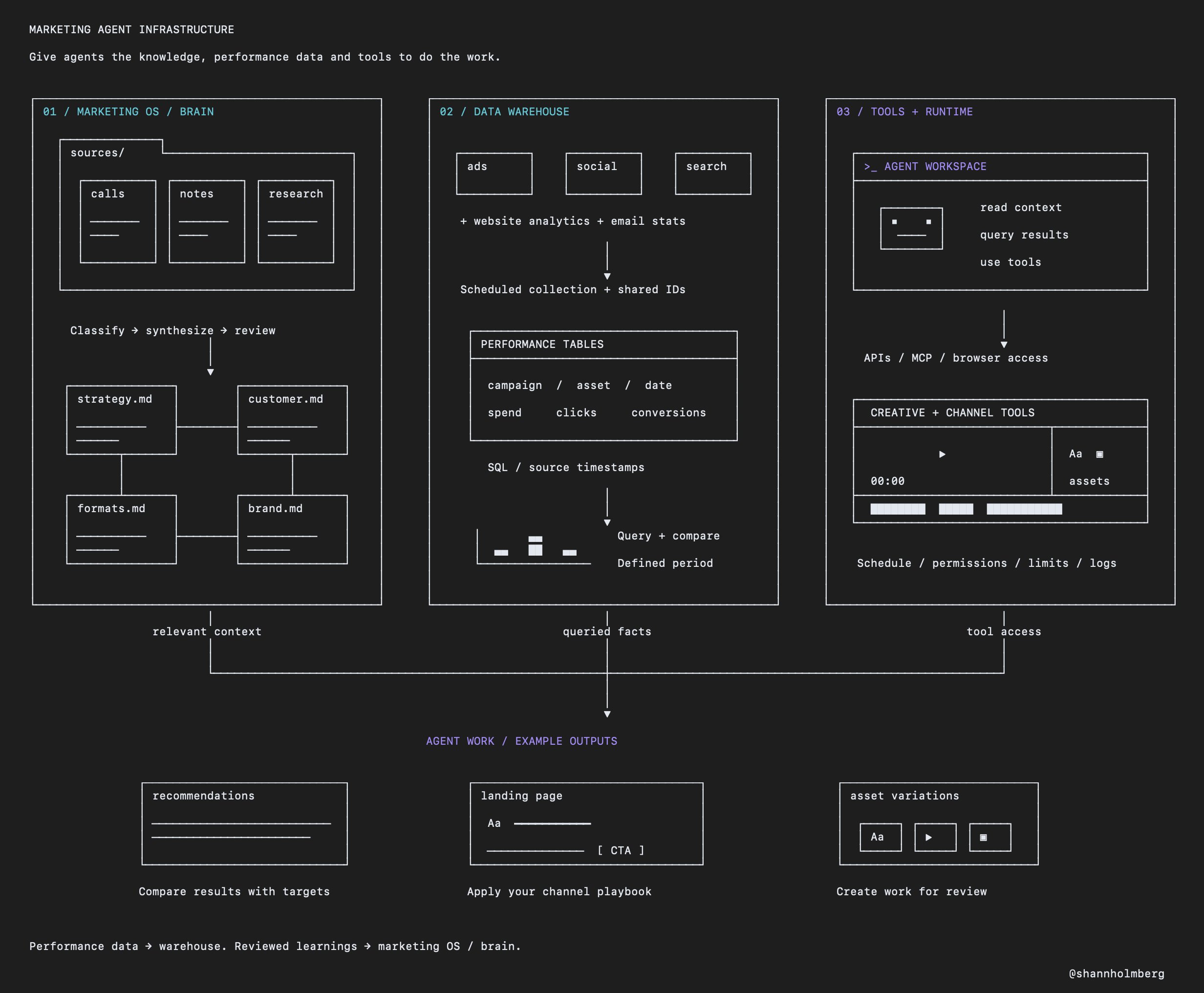
marketing agent infra is one of the most important things businesses need to get right it gives your marketing team the context, data and tools to generate revenue outcomes it consists of 3 main things 1. centralized context / knowledge there are many ways to set up a marketing OS / brain, a simple starting point is an LLM-maintained wiki keep the knowledge in markdown (.md) files, with YAML for details such as the source, date and topic the setup works like this: > raw sources go into folders grouped by source or marketing function > a model such as JEV classifies the information so the system knows where it belongs > an LLM reads the sources and updates the relevant pages in your wiki folder > each page links back to its sources and related knowledge this includes everything from company strategy to the exact formats you use on each channel: > positioning, offers and ideal customer profiles > customer journeys, buying triggers and objections > campaign goals, plans and previous decisions > brand rules, writing style and visual references > channel playbooks, content formats and approved examples > experiments, results notes and your feedback when an agent starts a task, it reads the relevant wiki pages and follows links to supporting material your team resolves conflicting information and reviews important changes before they become approved company knowledge 2. data warehouse this brings together ad spend and results, social stats, Google Search Console data, website analytics, email performance and more the setup works like this: > data pipelines collect information from those systems on a schedule > the warehouse stores it with dates and identifiers for campaigns, assets and channels > shared definitions explain how each metric is calculated > agents query the relevant data and return the results with the reporting period include the metrics your team uses to make decisions: > ad spend, impressions, clicks and conversions > social reach, engagement, saves and video watch time > search queries, impressions, clicks and average positions from Google Search Console > website traffic sources, landing-page activity and conversion events > email deliveries, clicks, unsubscribes and conversions where tracked consistent campaign names, tracking links and identifiers help connect results across sources your agents can then investigate questions such as: > which creative variations generate conversions at a lower cost? > which social formats get saved or watched for longer? > which search queries bring relevant visitors to your website? > which landing pages receive traffic but generate few conversions? agents query the warehouse for historical analysis, reducing repeated requests to channel APIs the collection process still uses those APIs, so it needs to respect their limits and record when each source last updated keep the performance data in the warehouse and save the interpretation in your marketing OS / brain 3. tools + runtime this is how agents use the context and data to do the work tools give them access to your channels and production software the runtime is where the agents run, including the model, computer or cloud environment and task scheduler the setup works like this: > connect the tools your agents need through APIs, MCP connections or browser access > give each agent the files, accounts and permissions required for its task > run recurring tasks through a scheduler, such as cron > record what ran, what changed, what failed and what needs your input for creative work, that could mean access to your design files, image models, video tools and editing software for campaign operations, it could mean access to your email platform, ad accounts, website and social channels a scheduled agent could query yesterday’s campaign performance, compare it with your targets and prepare recommendations using your channel playbooks another could use an approved campaign plan to create asset variations and return them for review set spending limits, retry limits and clear approval requirements before those tasks run if a task fails, the system should record the failure and notify the person responsible, with enough context to continue the work
This post quotes another post: x.com/1455999313453195265/status/209800474353675…