Architecture and top 10 use cases for Jev as an agent's decision layer
The author proposes splitting work into LLM thinking, Jev deciding and code acting, and lists Jev use cases including high-frequency control loops, browser agents, guardrails and RAG filtering.

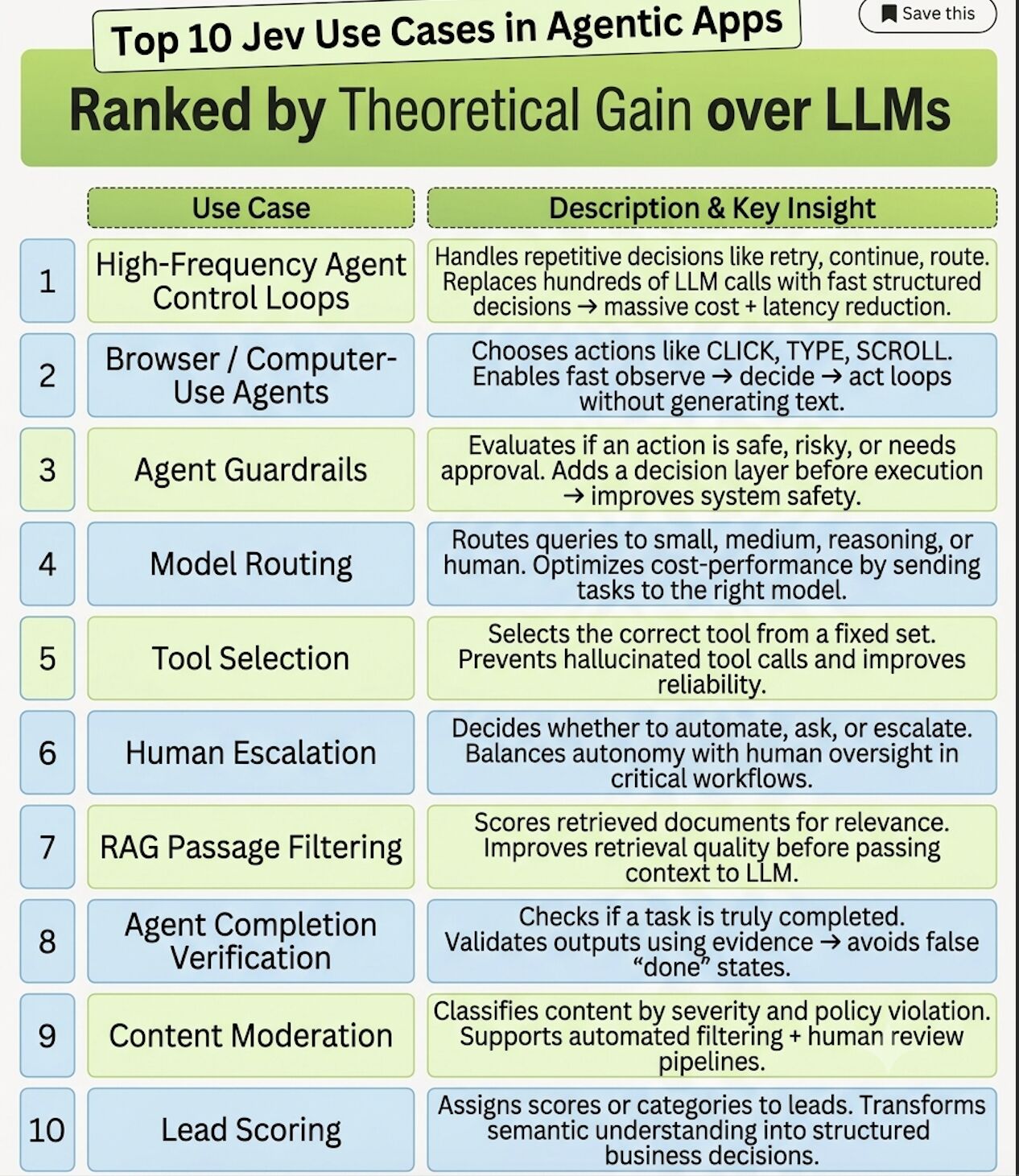
Building AI Agents? Stop using LLMs for every single step in your workflow. LLMs are incredible at reasoning and text generation, but relying on them for repetitive routing, tool selection, or guardrails introduces massive latency and unnecessary cost. The architecture of production-grade agents is shifting: LLM (Think) → Jev (Decide) → Code (Act) Here is the golden rule of thumb for your next agentic app: • Ends in a sentence? Use an LLM. • Ends in a choice or score? Use Jev. I mapped out the Top 10 Jev use cases ranked by their theoretical gain over traditional LLM calls. If you are building autonomous loops, here is where you will see immediate impact: • High-Frequency Control Loops: Replace hundreds of LLM calls with fast, structured decisions for retry/route loops. • Browser & Computer-Use Agents: Enable blazing fast observe → decide → act loops without waiting for text generation. • Agent Guardrails: Add a low-latency decision layer to evaluate risk before executing an action. • RAG Passage Filtering: Score and filter retrieved documents for relevance before polluting the LLM's context window. • Model Routing: Dynamically send tasks to small, reasoning, or human-in-the-loop models based on complexity. What does the decision layer look like in your current agent architecture? #AI #LLM #AIAgents #MachineLearning #GenerativeAI #AIArchitecture #RAG #AIEngineering