Signal65: DeepSeek V4.1 Flash 1017 matches original's max-effort score at default effort
Signal65 reports the 1017 build hits the original's max-effort score at default effort with 45% fewer weighted errors and 20,829 vs 347,031 output tokens per correct answer, holding 312 concurrent agents on one 8×B300 node at $0.15 per correct task.
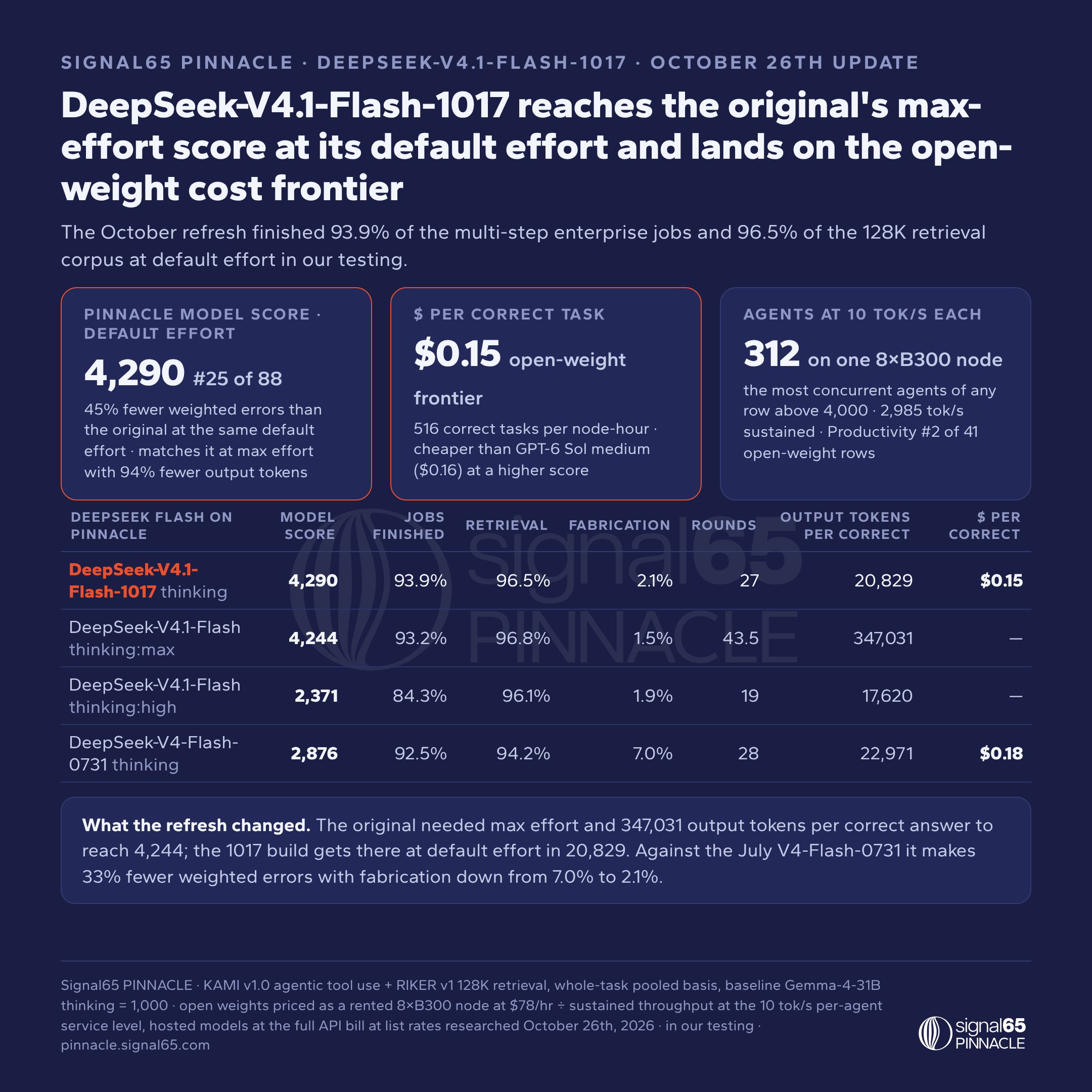
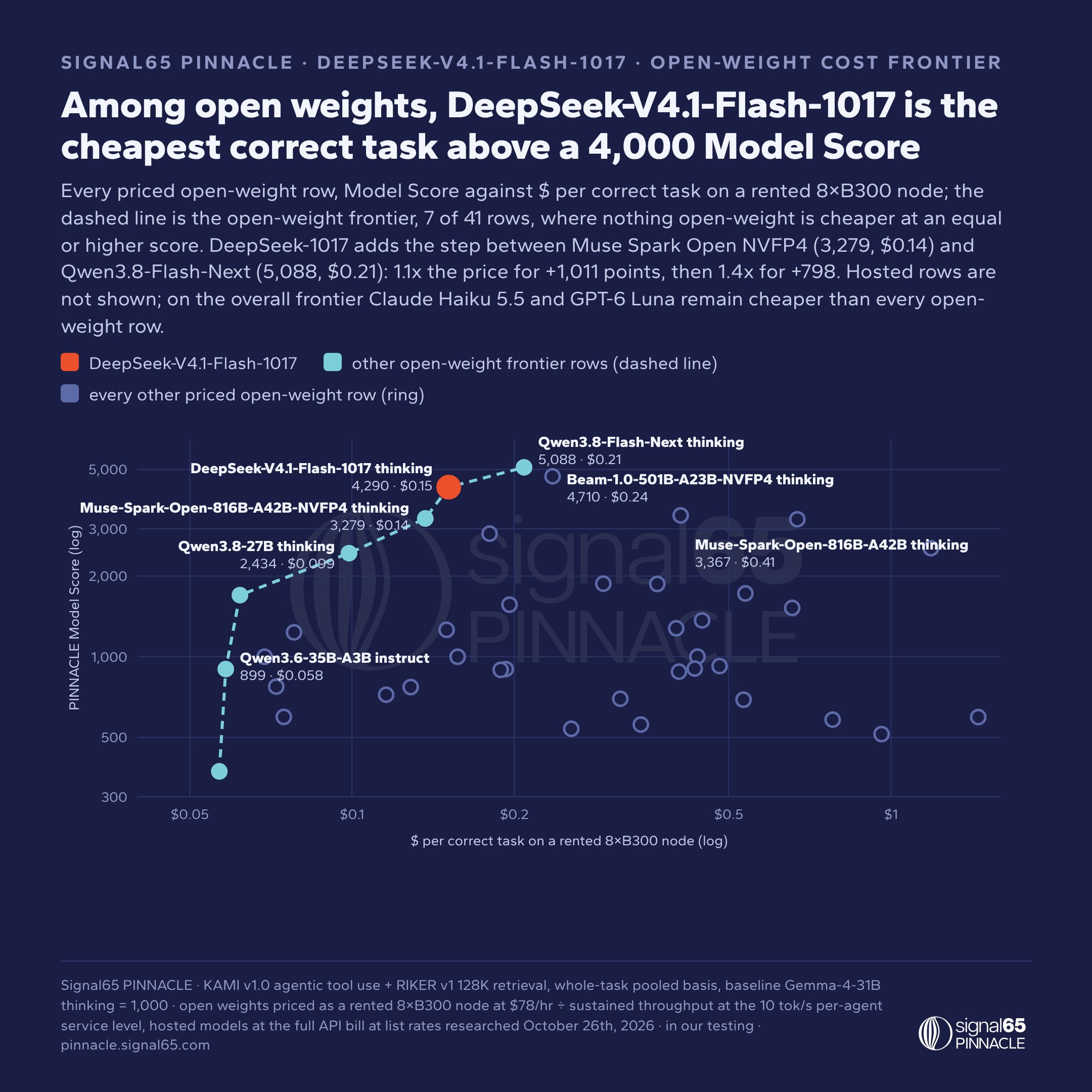
Enterprises that passed on @deepseek_ai V4.1-Flash because it needed max reasoning effort to score well should look at the October refresh. DeepSeek-V4.1-Flash-1017 reaches the original's max-effort score at its default effort, sustains more concurrent agents on one node than any other model above a 4,000 PINNACLE Model Score, and lands on the open-weight cost frontier. In our testing: ➡️ At default effort the 1017 build makes 45% fewer weighted errors than the original V4.1-Flash at the same setting, and matches the original's max-effort result with 94% fewer output tokens per correct answer (20,829 against 347,031) in 27 median rounds instead of 43.5 ➡️ Against the July V4-Flash-0731 it makes 33% fewer weighted errors, with fabrication on the 128K corpus down from 7.0% to 2.1% ➡️ On one 8× NVIDIA B300 node it holds 312 concurrent agents at 10 tok/s each, the most of any row above 4,000 on the board, which puts a correct task at $0.15 and 516 correct tasks per node-hour; Productivity #2 of 41 open-weight rows ➡️ That price lands it on the open-weight cost frontier, the cheapest open-weight correct task above 4,000, 28% less than Qwen3.8-Flash-Next for 84% of its score, and below GPT-6 Sol medium at a higher score Hosted rows are a separate question: Claude Haiku 5.5 and GPT-6 Luna remain cheaper than every open-weight row on the overall frontier. For an enterprise committed to open weights, DeepSeek-1017 is the new price for a correct task at this level of capability. Live on the Model Score and cost views at http://pinnacle.signal65.com