GPT-6 Astra drives two robot arms through vessel suturing in a Godot sim
The author argues robots should become physical agents for LLMs—the model reads camera feeds, plans steps and calls arm tools—citing a demo where GPT-6 Astra ran two arms through vessel suturing in a Godot simulation.

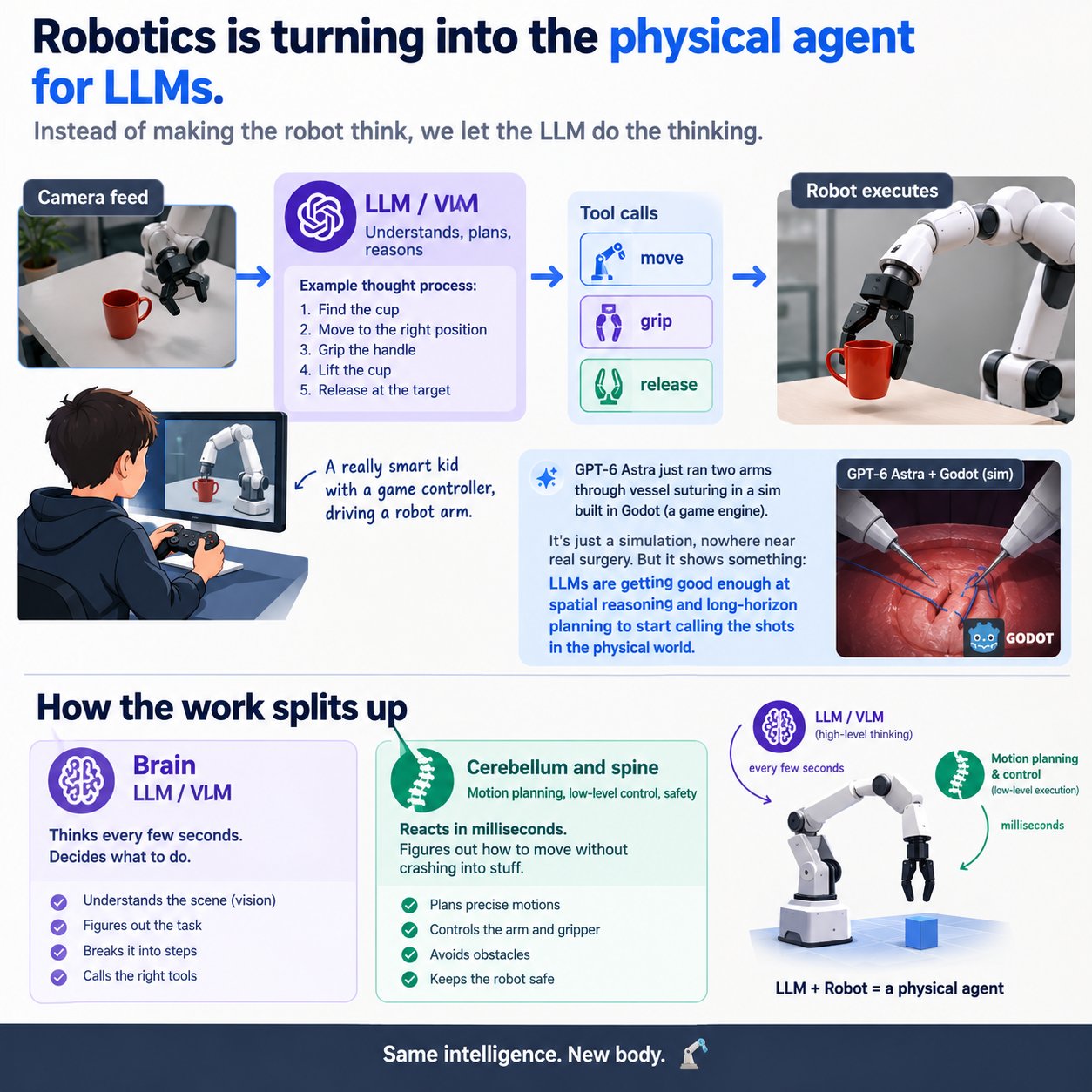
Robotics is turning into the physical agent for LLMs. For the last few years, embodied AI has mostly been about getting robots to learn moves on their own. Train with RL over and over. Collect teleop data to train VLAs. Chase general-purpose humanoids with dexterous hands. What you get: pricey data, a zoo of incompatible hardware, and slow progress. There's another path that's starting to actually work: don't make the robot think. Let the LLM do the thinking. The model looks at the camera feed, figures out the task, breaks it into steps, then uses tool calls to hit the arm's "move", "grip" and "release". Picture a really smart kid with a game controller, staring at a screen, driving a robot arm. Someone just had GPT-6 Astra run two arms through vessel suturing in a sim built in Godot, a game engine. It's just a sim, nowhere near real surgery. But it shows something: LLMs are getting good enough at spatial reasoning and long-horizon planning to start calling the shots in the physical world. So here's how the work splits up: 🧠 Brain: LLM / VLM. Thinks every few seconds. Decides what to do. 🦴 Cerebellum and spine: motion planning, low-level control, safety. Reacts in milliseconds. Figures out how to move without crashing into stuff. My little propeller balancing toy has to tweak its PWM every 10 ms or the stick just falls over. One LLM tool call takes a few seconds. Doesn't matter how smart the brain is, it can't do the cerebellum's job. But the "what to do" part? That's going to the models, more and more. So what does this mean for robotics companies? An agent is basically a reseller. Robots are going to be the LLMs' resellers in the physical world. Better models make robots more useful, sure. But more of the value keeps flowing upstream to OpenAI, Anthropic and Google. The robotics companies that make it will look like the resellers that make it. Two kinds: • The ones that nail the "cerebellum": hardware, control, safety. Stuff the model can't do for you. • The ones that go really deep on one setting: the workflows, data and customers of a specific factory, lab or warehouse. If you're just a middle layer, upstream will squeeze you sooner or later. LLMs won't replace robotics. Robotics will become their hands and feet. Inspired by @lidangzzz's ideas and @maoconsult511's experiment. Thanks, both.