Jev as a fast decision layer for knowledge graphs
Describes using a System One model like Jev for entity typing, entity resolution, triple validation and agent write guardrails, escalating hard cases to reasoning models, and mentions the open-source AnyJev.
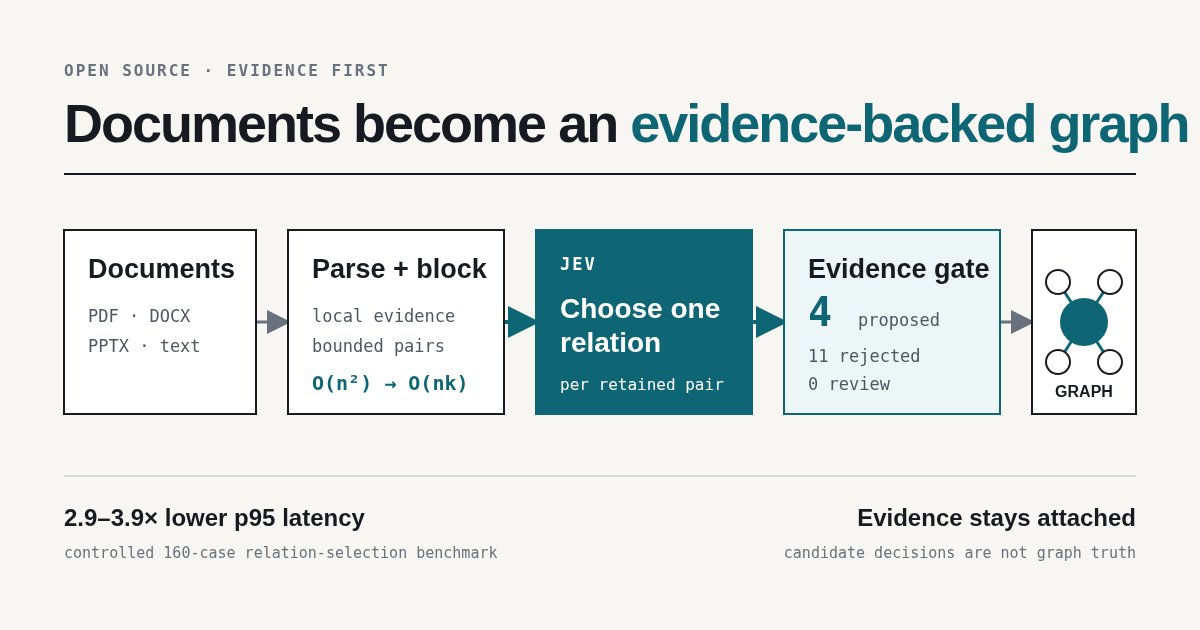
Entity resolution, triple validation, node typing: the slow part of graph construction just got a fast-thinking layer Jev, a new "System One" model from TypeSafe AI, doesn't generate text at all. It evaluates a state and returns typed, calibrated answers and probabilities — a decision layer, not a chat layer. TypeSafe reports up to 200x faster inference and 400x lower cost than comparable LLMs on classification tasks, and LangChain has already built middleware around it for model routing and tool-risk gating. The idea is landing in the graph world too. 📊 For knowledge graphs specifically, the fit is immediate: Entity typing and node classification become closed-vocabulary decisions instead of generation tasks — no need to spend a full reasoning model's compute on "Person or Organization?" Entity resolution gets a cheap first-pass filter for "same entity or not?" before expensive blocking or embedding similarity runs Triple validation gets a genuine confidence score, rather than trusting an extractor's self-reported certainty Agentic graph construction gets a guardrail — a fast check on whether a write action is safe before a full LLM-driven agent commits it The overarching pattern: let a fast classifier triage everything, and escalate only the genuinely hard cases to a reasoning model. Slow and fast thinking, delegated the way brains already do it. On the open-source side, Nokia's engineering team released AnyJev, a training-free way to turn any LLM into a decision model using the same interface — addressing two known weak points in prior "score the logits" approaches: answers that flip when options are reordered, and probabilities that aren't well calibrated. Early results on an internal routing problem were promising enough to push further into production use cases. And JevGraph is already exploring what this looks like applied directly to graph pipelines. The agent loop has always had a hidden tax: every decision, however small, going back through a full model call. This is the first sign of that tax coming down. H/T Francois Vanderseypen Fast thinking for knowledge graphs with Jev https://www.linkedin.com/feed/update/urn:li:activity:7508375439929810944/ JevGraph https://github.com/chenmingtang830/jevgraph AnyJev https://github.com/nokia-applied-research/AnyJev #AgenticAI #LLM #MachineLearning #SystemDesign #AIInfrastructure -- 📩 The Year of the Graph Autumn 2026 newsletter issue is out! Meaning, Traversal, Reasoning, Action: The Graph Stack for Agentic AI. 👇 https://yearofthegraph.xyz/newsletter/2026/09/meaning-traversal-reasoning-action-the-graph-stack-for-agentic-ai-the-year-of-the-graph-newsletter-vol-32-autumn-2026/ All things #KnowledgeGraph, #GraphDB, Graph #Analytics / #DataScience / #AI and #SemTech. Subscribe and follow to be in the know. Reach out if you'd like to be featured