Synara v0.8.4 makes GPT-6 Astra the default Codex model
Agent workspace Synara v0.8.4 adds Git review, browser automation and saved logins, and sets GPT-6 Astra as the default Codex model with Low to Ultra reasoning tiers.

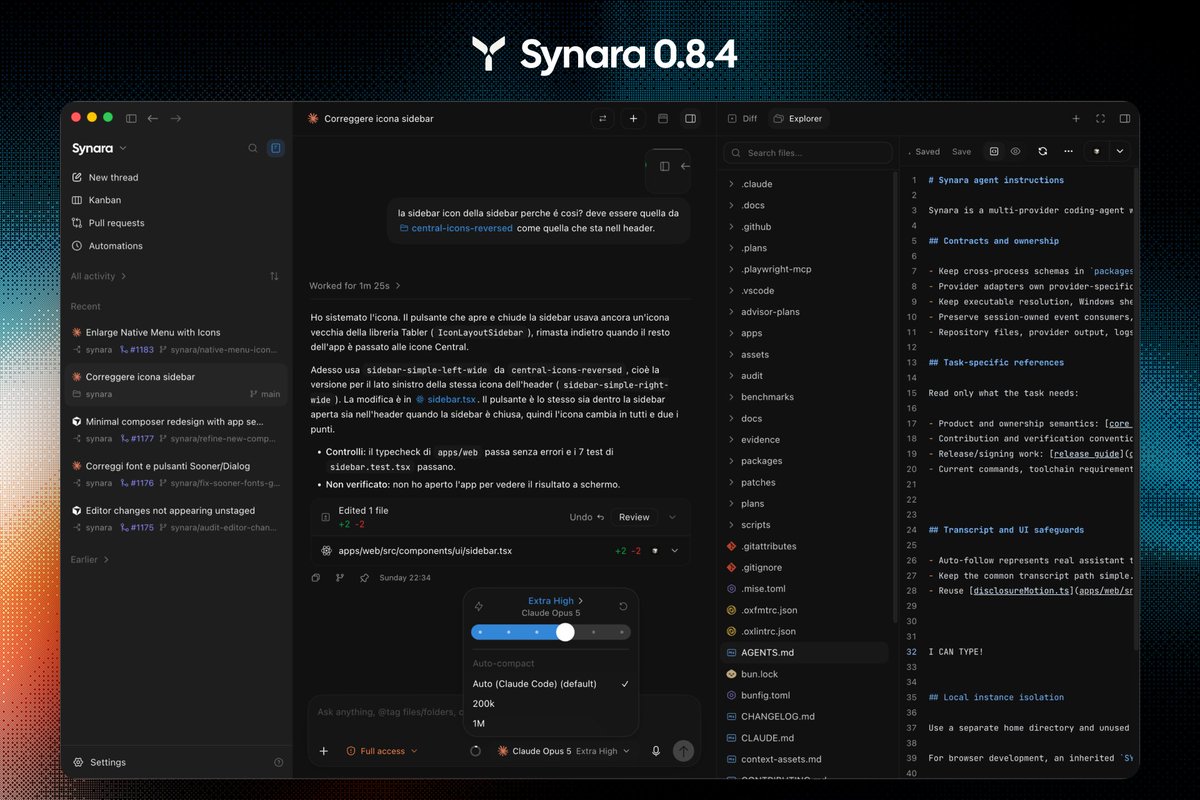
Synara v0.8.4 is out 🪽 Build, browse, review, and ship from one agent workspace. This release brings a lot more power to the places where you actually work. 📝 Edit workspace files and supported Git diffs directly in Synara with syntax highlighting, undo/redo, Save, autosave, conflict recovery, and configurable Cmd/Ctrl+S. 🔍 Git review now includes branch and commit comparisons, line blame, word-level highlighting, changed-file navigation, scrollbar markers, live refresh, and safer handling for huge diffs. 📄 Maximize document previews, restore your split layout, and follow basic workspace Wiki links directly from Markdown. 🌐 BetterWright brings browser automation with saved sessions, cookie import, embedded popups, floating previews, safer cancellation, and improved screenshots, uploads, and focus handling. 🔐 Saved Logins adds save/update prompts, optional autosave, account management, lock/unlock, and master-password-protected reveal. Agent access remains metadata-only. 🧭 Guided onboarding helps new users configure providers, sign in, choose a theme, explore Synara, and add their first project. ✂️ Select assistant text and Add to Chat, Add to Side, or Add to new Chat with a shared mini composer. 🎛️ A new effort slider and flat Add panel make reasoning levels, Plan, Debug, Fast, files, Goal, and macOS AppSnap window capture much easier to reach. 🔗 Pull request context cards now stay attached through drafts, queues, sends, and retries, while PR status and Git views remain synchronized with your work. 🤖 GPT-6 Astra is now the default Codex model, with Low through Ultra effort levels. Agent-authored automations can target an exact provider, model, and supported options. 🛡️ Provider reliability gets a major upgrade: Claude no longer double-counts repeated response blocks, Pi queues mid-turn follow-ups, Codex preserves steering and safe restarts, and Cursor and Antigravity show background work more accurately. 💬 Transcripts stay readable during complex work: Markdown no longer fragments, tool calls remain attached after steering, compaction and restarts are clearer, and tool-only activity no longer hijacks your scroll position. 📱 Simulator screenshots and downloads recover more reliably, simulator panes no longer get stuck on Connecting, and math, image, Windows-link, and theme-share rendering errors are clearer. 🎨 Sidebar glass, message bubbles, menus, toast actions, selection controls, typography, and native macOS context-menu icons all received a broad visual refinement. Measured locally in focused workloads: ⚡ Status animations reduced total Electron CPU by 35.8%, renderer CPU by 22.2%, and Chromium graphics-process CPU by 45.5%. 🧠 Large-history query workers used up to 55.0% less temporary RSS: message queries fell from 565.61 to 377.48 MiB, while bulk activity queries fell from 255.92 to 115.16 MiB. 🧹 OpenCode duplicate comparison-key heap fell from 50.13 MiB to 0.14 MiB in a 200-output fixture. 💾 A controlled 200 KB streaming answer reduced SQLite WAL growth by 70.1% and streaming time by 34.4%. 🚀 Warm chat opening fell by 34.4–45.2% in local Chromium route measurements. 🔎 A retained synthetic latest-turn lookup fell from 253.79ms to 21.03ms, returning 600 rows instead of 300,000.