Jev decision layer: a 12-page breakdown of agent architecture
The piece argues for splitting agents into three layers where LLMs write, Jev decides and code executes, replacing free-form output with Choice, Score and Noul typed outputs, and includes batch-call benchmark data.

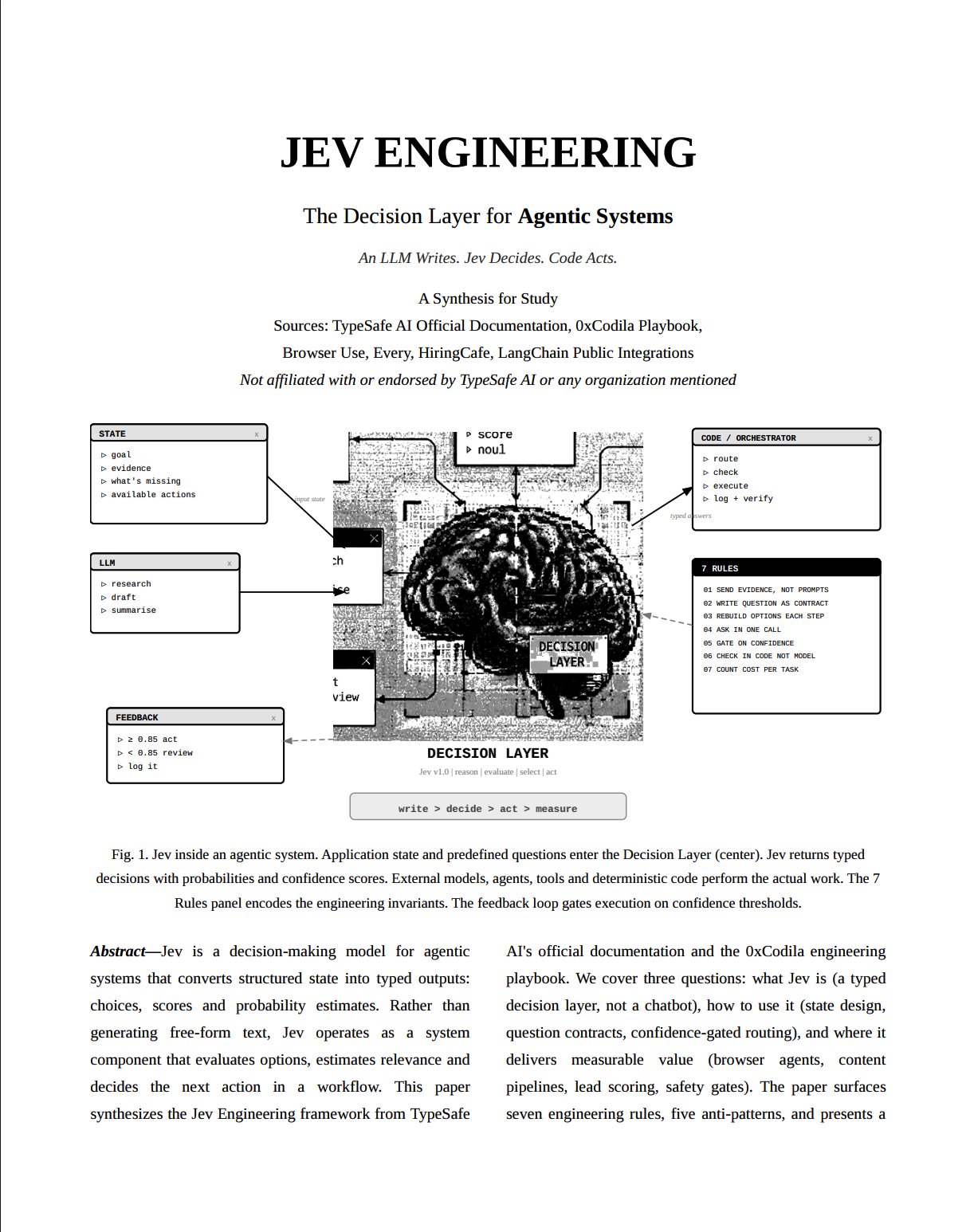
Jev Engineers just dropped Jev and it splits agent architecture in half: one layer decides, another executes What Jev Engineering is, how to set it up and where it prints money in my 12-page synthesis: step 1 → stop using one model for everything. LLMs write. Jev decides. Code acts. Three layers, three failure modes, zero ambiguity on what broke. step 2 → replace free-form outputs with three typed primitives. Choice picks one winner. Score ranks on a rubric. Noul returns probability of yes. Your code reads numbers, not paragraphs. step 3 → state is evidence, not a prompt. Feed Jev structured snapshots: goal, verified facts, live options, previous actions. Rebuild after every external change. step 4 → batch everything. 13 questions against one GDPR article: one call took 0.27s for $0.0005. Same questions sequentially: 2.71s for $0.006. That is 10x speed and 12x cost. step 5 → five anti-patterns kill Jev deployments. Prompt-as-state. Choice-as-multi-label. DONE without proof. Stale action menus. Confidence treated as truth. the result: every bounded fork in your agent stack becomes a millisecond decision with a probability you can audit, gate and replay. Copy the complete 12-page Jev blueprint - then read full 10-step roadmap below ↓
This post quotes another post: x.com/vartekxx/status/2074864291568664646