研究揭示不同 Agent 的算力瓶颈差异巨大
高丽大学与微软亚研测量三类 Agent 的耗时与 CPU 占用,发现加核让问答 Agent 快 13 倍、网页搜索 Agent 只快 4%,资源调度比堆硬件更有效。

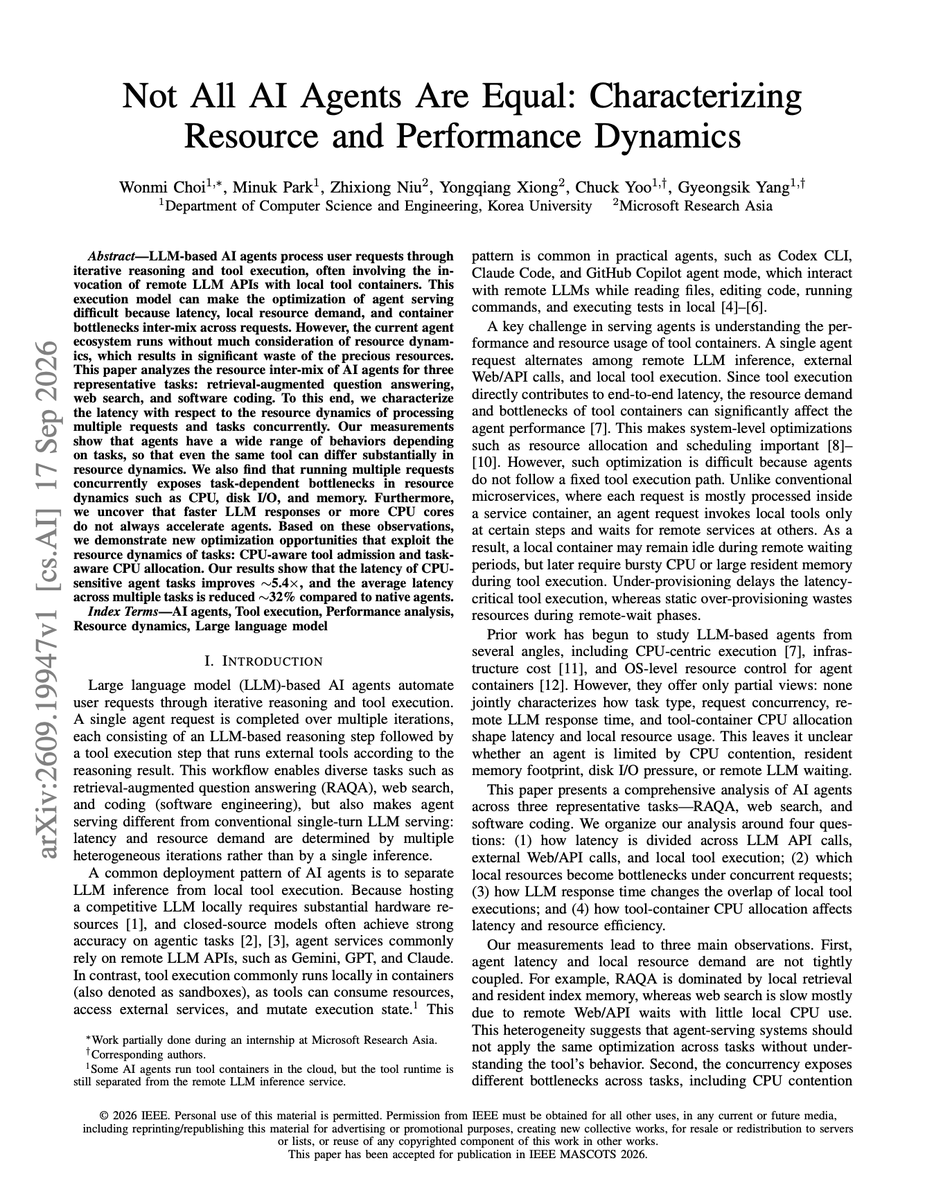
More computing power made one AI agent 13x faster and another only 4x. This is a seriously good paper from Korea University and Microsoft Research Asia on where agents spend their time. The results are messier than the "just add more compute" crowd assumes. Many of the agents you've used, like Claude Code and Codex, work in two halves: > The thinking happens on a remote model like Gemini, GPT, or Claude. > The doing happens on a local machine, where tools search files, run code, and fetch web pages. The researchers ran agents on three kinds of jobs (answering questions from a document library, searching the web, and writing code) and measured where the time went and how much computing power each one used. The web search agent was one of the slowest they tested. It also used the least CPU, averaging 14%, because it spent nearly half its time waiting on websites to respond. The question-answering agent was the opposite. It spent 62% of its time searching its own library and averaged 86% CPU use. So a slow agent doesn't always need more hardware. Sometimes it's just waiting. Then they added cores. Going from 2 to 8 made the question-answering agent 13x faster. The same upgrade made the web search agent about 4% faster. One fix doesn't fit every agent either. Limiting how many tools run at once made the question-answering agent 3.2x faster. The same rule made the coding agent 2.8x slower. The best result needed no new hardware at all. They took the same 6 cores, gave more to the agent that needed them and fewer to the one that was waiting, kept the tool limit on the question-answering agent, and average response time dropped 32%. The question-answering agent got 5.4x faster. The web search agent got 28% slower, which barely mattered because it was mostly waiting anyway. The default move for every slowdown is a bigger model or a bigger server. This paper shows you can end up paying for hardware that sits idle while your agent waits on someone else's server. How many AI teams are buying more compute when they should be checking what their agents are waiting on?