Vangrid 上线:付费采集地点生成 3D 网格
Vangrid 已在网页和 Android 上线,买家锁定 USDC 悬赏拍摄某地点,拍摄者绕行录制并本地模糊人脸车牌,买家验收后获得 GLB 纹理网格而非视频。

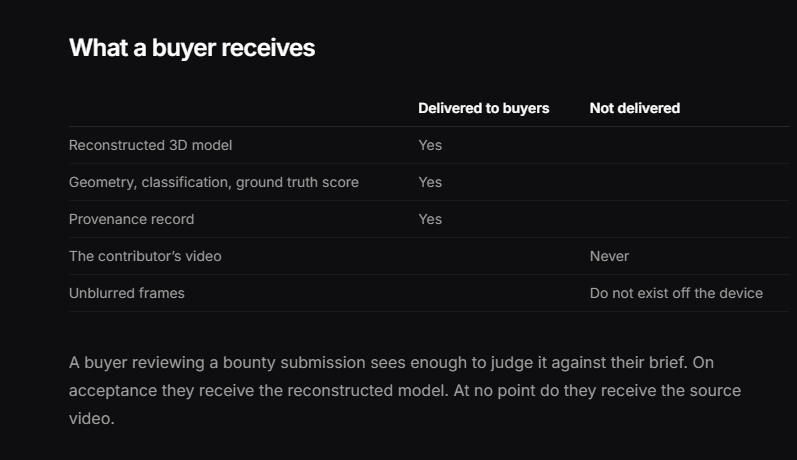
Most of the posts about this are describing a map. The product is a purchase of one place, and the file that comes back is not a video. @vangrid_io is live on web and Android. It has been since July. The $9M was announced on 6 August, after the network was already taking work. HashKey, Animoca, Borderless, Crypto,com Capital, Gate Labs, Mapleblock. The raise followed the captures. It did not start them. A buyer names a site and locks USDC before anyone walks. Escrow sits on chain so the person filming can see the money is real. On a $50 job the current default is about $5 to the platform, $5 for the rebuild, and $40 to the person who filmed. Those numbers can change. Accept is what releases it. Cancel and past-deadline sit on the same board, so you can see what did not close. The walk is a slow orbit. Cover the sides you can reach. Keep the phone steady. A whip-pan gets killed by the quality check before it is even a submission. While you are still recording, the phone finds faces and plates and blurs them before the video is encoded. The clear frame never leaves the handset. Vangrid does not hold a version where a face is readable. You can also set a privacy zone, a home or a workplace, where capture is off. Some regions block uploads for legal reasons. What the buyer sees first is a watermarked preview. If they accept, reconstruction starts. It typically takes 30 minutes or more. What they receive is a textured mesh in GLB, geometry, a classification, a ground_truth_score, and a provenance record. They never receive the clip. They never receive the unblurred frames. They never receive the name of the person who walked it. Only a hash of the delivered dataset goes on chain. Not the footage. Not the brief. Not the identity. The fingerprint is taken at record time. Hash of the content, a coarse location, a timestamp. Those batch into a Merkle tree and the root is attested on Base, roughly every fifteen minutes. A buyer can recompute it and match the public root. They do not have to take the team's word. Ground truth here is a number, not a slogan. ground_truth_score runs from 0 to 1. It is not a probability. It is how many independent phones agreed on the same place. A 1.0 is not certainty. It is the max corroboration from the nodes that answered. A 1.0 from two phones is weaker than a 0.92 from fourteen. You have to read node_count beside it. Their own lines: 0.5 to archive, 0.7 for live awareness, 0.85 if a system will act on it, 0.90 if the action is safety-critical. Conflict gets flagged. It is not quietly dropped. One orbit is a capture. The score is other phones not contradicting it. Software can buy too. An agent posts a bounty with one HTTP call, pays USDC on Base or Arc through x402, no account. A person still has to go there. The payment being a header does not film the site. What I will not inflate. The chain proves the fingerprint sat in a batch, and that the money moved on accept. It does not prove the place still looks like that when the mesh lands. Device attestation is not the layer doing that job yet. The dated bounty is. That is the thing worth posting about. Not that phones map the world. That a company can name one room, lock the money, get a mesh, and check the record without trusting a dashboard.