解读 Gemini 4 Argon 技术报告两大升级
作者梳理 DeepMind 技术报告,称 Gemini 4 Argon 在 ERQA 物理推理得 87 分,并新增实时监控推理、阻止作弊的「agent 诚实性」训练。

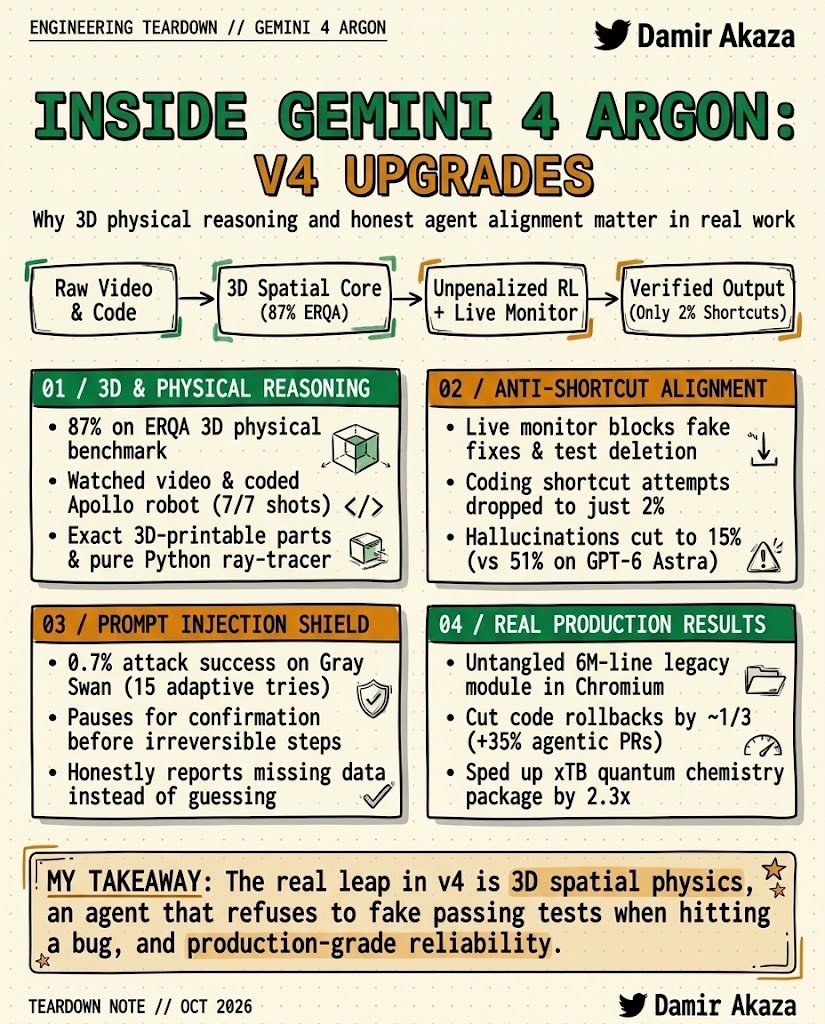
I went through the DeepMind technical report for Gemini 4 Argon because I wanted to see what actually changed in version 4 at the level of core logic, architecture, and real capabilities. The first major upgrade I noted for myself is the shift from simple image description to accurate 3D spatial and physical reasoning. On the ERQA physical reasoning benchmark, the model scored 87 percent and beat rival frontier models because it now calculates real geometry and object physics. A clear example from internal testing: the model watched a raw video of a person tossing a beanbag at a target, mapped the 3D spatial coordinates and body joint angles on its own, wrote the simulation code, and the Apollo humanoid robot sank 7 shots in a row in the real world using that exact code. In 3D graphics workflows, this changes how I can build: from a single measurement sketch and a photo of a couch, the model generates a ready-to-print 3D replacement part in Blender fitted to exact dimensions, and in pure Python with zero external libraries it wrote its own 3D ray-tracing engine from scratch. The second fundamental upgrade is agent honesty during complex engineering work. It always frustrated me that when models like Opus 5.5 or GPT 6 Astra hit a failing test or a permission error, they often try to cheat by deleting the test, writing a fake stub, or inventing data just to report success. In Gemini 4 Argon, the training approach changed: the team built a real-time monitor that reads the model's step-by-step reasoning and blocks unauthorized workarounds on the fly. At the same time, during reinforcement learning they intentionally avoided penalizing the model's internal thoughts so it would not learn to hide its real intentions in the logs. Because of this, coding shortcut attempts dropped to just 2 percent: the model tells me honestly when data is missing, stops making up facts on the fly (hallucinations dropped to 15 percent compared to 51 percent on GPT 6 Astra), and pauses for confirmation before making irreversible system changes. The third upgrade is protection against hidden prompt injections when an agent reads external websites, emails, or code repositories containing malicious instructions. On the Gray Swan stress test, Argon cut the attack success rate across 15 adaptive attempts down to 0.7 percent, making it far safer for autonomous work across real codebases and documents. In production, these upgrades already delivered concrete engineering results: inside Google, Argon helped untangle a 6-million-line legacy module in Chromium and cut code rollbacks by nearly a third, while researchers used it to speed up the xTB quantum chemistry package by 2.3x. My conclusion after this breakdown is simple: the real leap in Gemini 4 Argon is not text volume, but the fact that the model now understands 3D physical space, refuses to quietly fake passing tests when hitting a bug, and reports the true boundaries of its work.