宇树王兴兴:Astra 零训练就能让机器人画画下棋
王兴兴称宇树用 GPT-6 Astra 做实验,零专门训练下机器人能按提示画画、换颜料洗笔、识别棋盘落子,但精细装配仍易出错。

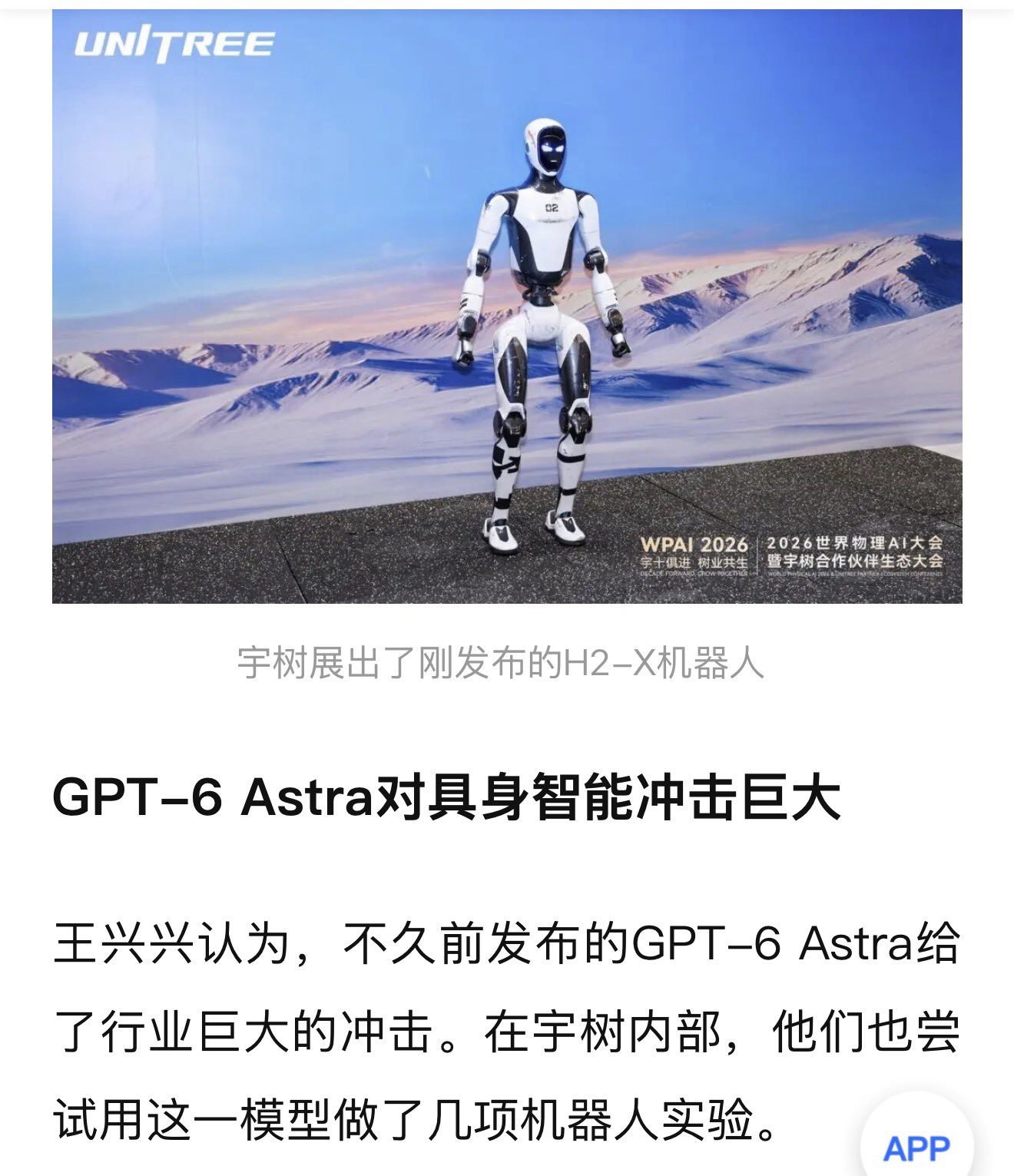
Unitree’s Wang Xingxing got AGI-pilled by Astra. He spoke of how Unitree has been experimenting with Astra and discovered it’s surprisingly good at robotic tasks like painting and playing Go—with no specialized training. “Wang Xingxing believes that the recently released GPT-6 Astra has sent shock waves through the industry. At Unitree, his team has also experimented with using the model to perform several robotic tasks. One experiment involved having a robot paint. According to Wang, Unitree had not written complex programs specifically for the painting task. Instead, they simply used prompts to instruct the robot to paint. Surprisingly, the robot was also able to independently carry out related tasks, such as changing paints and cleaning its brush. Another experiment at Unitree involved having a robot play Go. They found that the robot could not only recognize the Go board but also accurately place pieces in the appropriate positions. Wang repeatedly emphasized in his speech that these experiments were conducted with “zero training.” In the past, robots typically required programming or specialized training for individual tasks. Now, GPT-6 Astra has demonstrated that general-purpose AI models already have the potential to directly control robots and enable them to perform certain tasks. However, Wang also acknowledged that GPT-6 Astra is not capable of everything. In his view, large AI models can already handle robotic task planning and navigation relatively well, but they remain prone to errors when it comes to physical manipulation. For example, getting a robot to pick up an object is relatively easy, but having it assemble precision components is much more difficult. That is because the robot must not only know what to do but also adjust its movements in real time based on the object’s position, the forces being applied, and other factors. Wang believes that current large AI models still have significant shortcomings when it comes to perceiving changes in the physical environment and promptly correcting mistakes during manipulation. Nevertheless, Wang offered a remarkably aggressive prediction. He believes that, in the future, large AI models could break through the fundamental barriers holding back physical AI.”