数学家借 ChatGPT 6 Astra Pro 攻克 Erdős–Szemerédi 向日葵猜想
三位数学家的 16 页论文声称证明 1970 年代提出的向日葵猜想,并称核心定理的证明由 ChatGPT 6 Astra Pro 在推广三集合情形时给出。
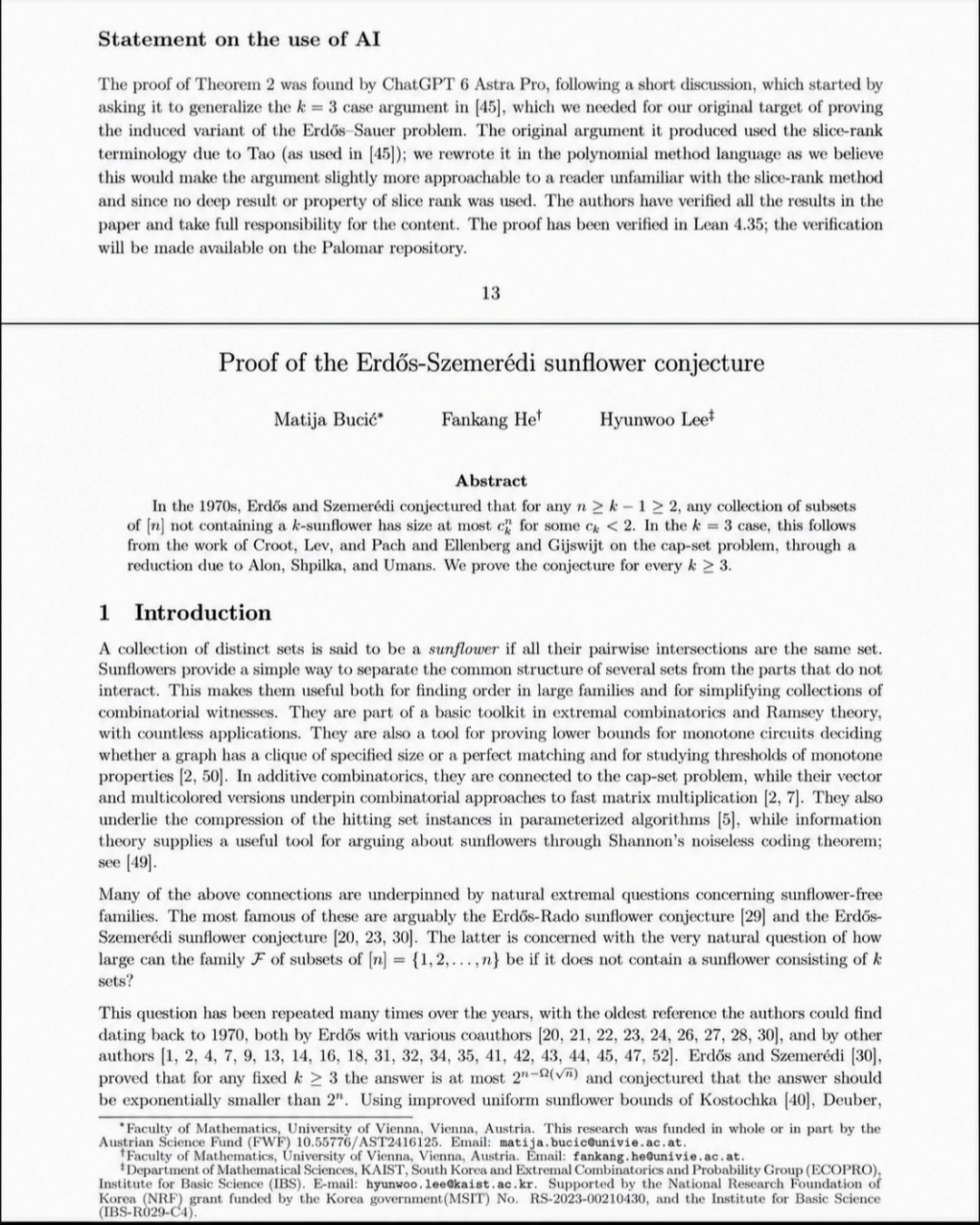
A 50-Year-Old Erdős–Szemerédi Conjecture May Finally Be Solved, using AI. Three mathematicians, Matija Bucić, Fankang He, and Hyunwoo Lee, have published a 16-page paper presenting a claimed proof of the Erdős–Szemerédi sunflower conjecture, a longstanding problem in extremal combinatorics dating back to the 1970s. What makes the development particularly interesting is the role of artificial intelligence. The authors credit ChatGPT 6 Astra Pro with discovering the proof of their central theorem. A sunflower is a collection of sets in which every pair has exactly the same intersection. For example, {1, 2, 3}, {1, 4, 5}, and {1, 6, 7} form a sunflower because each pair intersects in precisely {1}. The Erdős–Szemerédi conjecture concerns how large a family of subsets of an n-element set can be without containing a sunflower consisting of k sets. Erdős and Szemerédi proposed that, for every fixed k ≥ 3, such a family has size at most |ℱ| ≤ cₖⁿ, where cₖ < 2. The crucial requirement is that the exponential base be strictly smaller than 2. Earlier breakthroughs involving the polynomial method and the cap-set problem had established the conjecture for k = 3, but the general case remained unsolved. The new paper claims to settle the conjecture for every k ≥ 3 by establishing the explicit bound |ℱ| ≤ 3(2 − 1/(16k³))ⁿ. Since 2 − 1/(16k³) < 2, this gives the required exponential improvement over 2ⁿ. According to the researchers, the breakthrough began when they asked ChatGPT 6 Astra Pro to generalize an existing argument for the three-set case. Instead, the model produced a proof of a stronger result concerning vector sunflowers that applies to arbitrary k. The mathematicians subsequently reformulated the argument using the polynomial method and established its connection to the original Erdős–Szemerédi conjecture. The authors report that they independently checked the mathematical arguments and that the proof has also been formally verified in Lean 4.35, a proof assistant designed to check mathematical reasoning. However, an important distinction remains. Although the manuscript is publicly available, the promised Lean verification files have not yet been released, and independent peer-reviewed confirmation is still pending. If confirmed, the result would resolve a conjecture that has resisted mathematicians for approximately half a century. It would also provide a striking example of AI contributing not merely to the verification or formalization of an existing mathematical argument, but to the discovery of a central proof itself. The Erdős–Szemerédi sunflower conjecture should not be confused with the separate Erdős–Rado sunflower conjecture, which remains open.