Jev-Mem 论文:Jev 接管 agent 记忆的小决策
第三方论文在 LoCoMo 上测 Jev 管记忆写入/检索/停止决策:建库 158 秒对 1044 秒,查询 1.47→0.93 秒,得分 0.777 对 0.700。

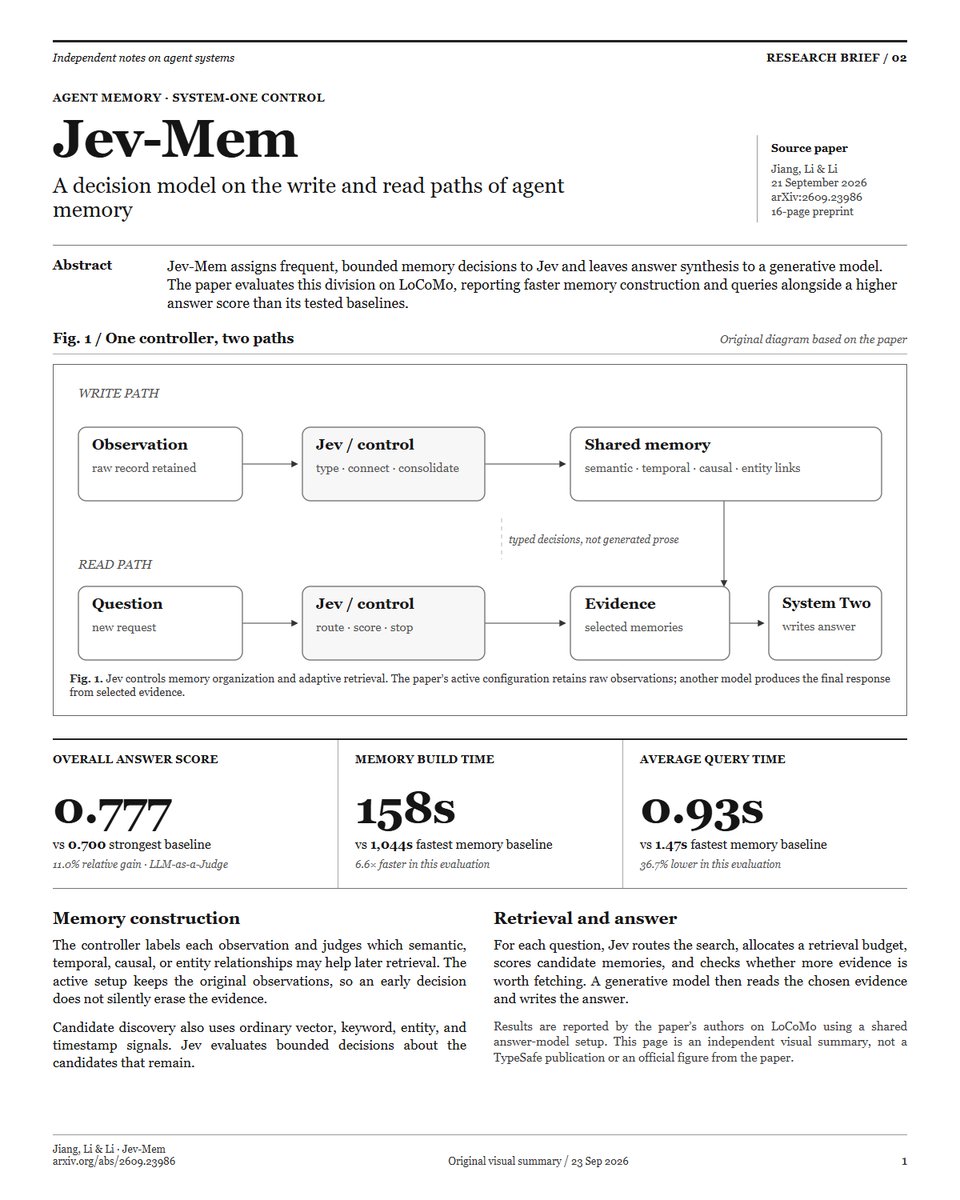
TypeSafe founder Diogo Almeida launched Jev on September 15 On September 21, a separate research team published Jev-Mem, a 16-page paper showing what happens when Jev controls the small decisions inside an agent’s memory system The numbers from their LoCoMo evaluation caught my eye: → memory built in 158 seconds, versus 1,044 for the fastest competing memory system → average query time fell from 1.47 seconds to 0.93 → the overall answer score reached 0.777, versus 0.700 for the strongest baseline That is a 6.6× faster memory build and an 11% relative improvement in the reported answer score, within the authors’ test setup The architecture has three jobs: > When writing memory, Jev labels observations and helps connect related facts, events, entities and dates. The original observations stay in the record > When retrieving, it decides which relationships matter to the question, scores candidate memories and checks whether the system has enough evidence to stop searching > When answering, a generative model reads the selected evidence and writes the response. Jev never writes that final sentence Appendix B is unusually useful: the authors show the typed questions they sent to Jev for memory labels, relationships, retrieval and stopping. This is a system you can inspect beyond the architecture diagram The result I’d take from the paper is the division of labour. An agent’s memory makes hundreds of small decisions before it produces one answer Jev handles those bounded decisions; the writing model gets the evidence that survived them The article below shows how to make its decisions usable in code ↓
这条是引用着另一条写的:x.com/morpphhhaw/status/2102740313953439950