Oracle7 4.9:用可验证部件组装的 swarm
Oracle7 发布 4.9 版,新增 swarm 模式:给定目标和示例后自动调研、构建带单位与来源的部件、用未见案例检验并组合成可追溯的答案。

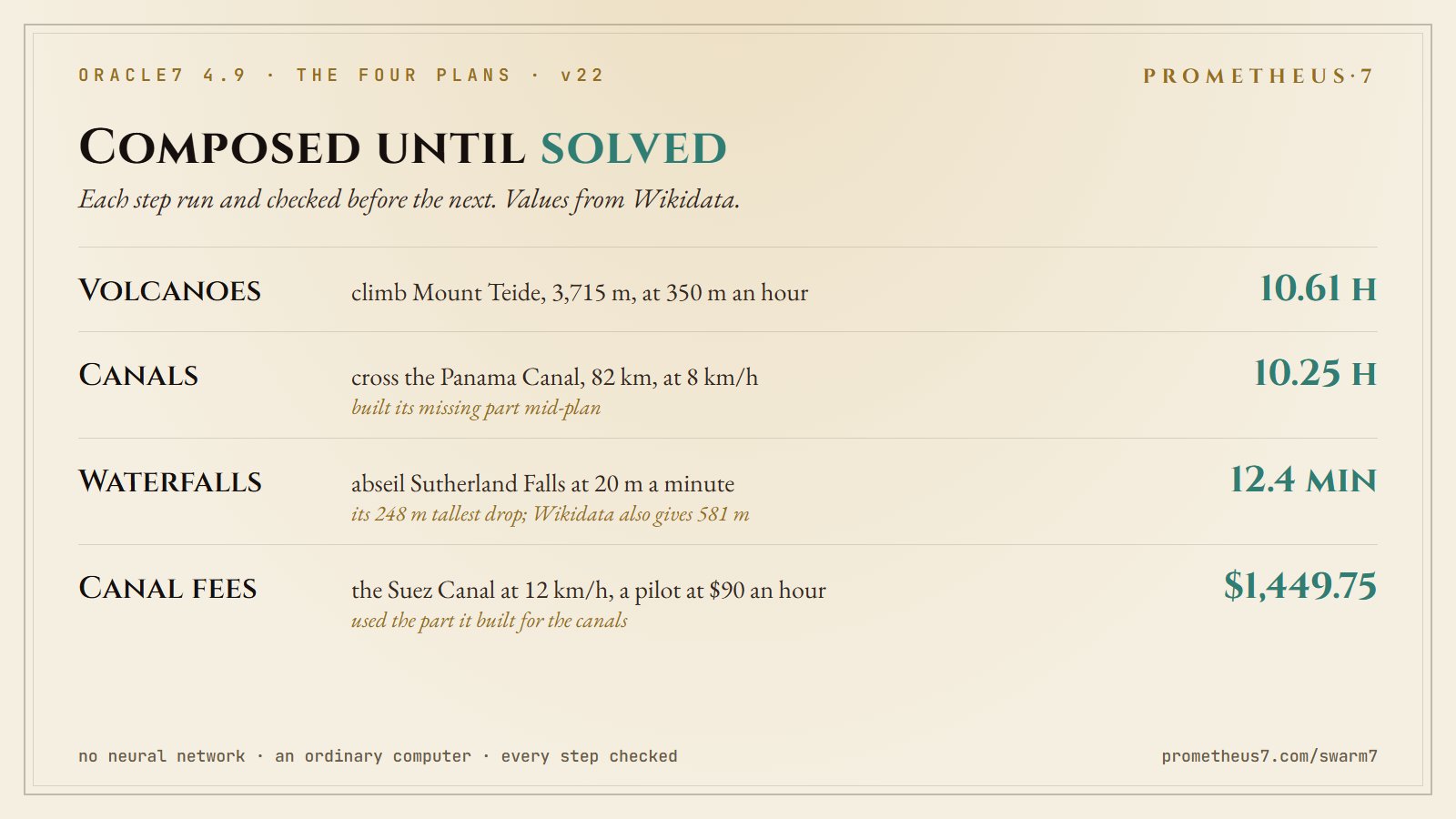
Oracle7 4.9: a swarm that builds what a problem needs Most AI that does general work today, from coding assistants to research agents and agent swarms, runs on a trained neural network. What it knows lives in weights nobody can read. What it produces is generated, so a wrong step looks the same as a right one. Learning something new means retraining. Oracle7 has never had a neural network in it. Every answer it gives comes from a stored record, a computation it runs and checks, or a proof, and every answer carries the path that produced it. Version 4.9, released on 23 October 2026, adds a swarm: a way to hand Oracle7 a problem and have it work. What it does You give it a target: a few example questions about a subject, some worked examples of a calculation, and the work you want done. python http://oracle7.py swarm point target.json then runs on its own: It surveys. Oracle7’s coordinator asks every installed specialist about the examples and names what is missing. It builds. For “How long is the Erie Canal?” it finds Wikidata’s length property and builds a table of every canal with a length, units and sources included. From ten worked examples of length and speed giving time, it composes the program, with units as types. It examines every new part on cases it has never seen. A part that adds wrong answers, answers things that do not exist, or wanders outside its lane is refused. It combines. Parts connect wherever one part’s output, with its unit, is another part’s input. It works.Research: answers come from its parts, each with a citation. Plans: it chains parts from what you have to what you want. When no chain exists, it names the missing piece by type, builds it, examines it, and tries again. Code: it writes the formulas it built as a library, with tests, and runs them. It reports every result with the path that produced it. When it cannot answer, a decline specialist reads why. If the question’s form was not understood, it rereads it. If a table does not hold the thing named, it reads that value at the table’s own source, with its unit. If nothing covers the question, it names the gap. If the thing does not exist, the decline stands. How it was tested Before the release, the targets and pass bars were written down and sealed with a hash, and the code was frozen. The swarm was then pointed once at four problems it had never seen, with no person involved: volcanoes, canals, waterfalls and canal fees. The four plans and their answers are on the card. In the canals problem it had to build its missing part mid-plan. In the canal-fees problem it used a part it had built for the canals. Every plan was right, and so were all three research questions. None of the four questions about things that do not exist was answered. All 40 generated tests passed. It took four attempts. Versions v19, v20 and v21 of the test failed: one wrong answer came from reading “1.6 m/s²” badly; a plan stalled because “How long is X?” was not read as a question about length; a table confused ships that share a name; the exam itself was counting the core’s own mistakes against a new part. Each failure got a general fix, and each fix was tested on a fresh sealed set. The failures are in the changelog. Why it matters A neural network learns by retraining, and an update can quietly damage what it already did. The swarm learns by adding a part: a table with a source, a formula with an exam record, each one a separate file you can read, trace and delete. Every new part also joins every combination with the parts already there, so the swarm’s reach grows faster than its number of parts. In the sealed test, a part built for one problem was used to solve the next. Every step is checked before the next runs, so a mistake does not travel silently down a long chain. The chain stops at the step that failed, and that step is named. It runs offline on an ordinary processor. Each part is filed as a key, a place on Oracle7’s Tree of Life and a typed signature, a few kilobytes in all. What it cannot do yet The swarm works where a problem breaks into facts and calculations: its parts are fact tables and formulas; its plans chain up to four calculations; it reads questions in a few plain forms; it needs Wikidata for its tables and worked examples for its formulas. Larger programs, solving systems of equations, reading documents into facts, and drawing are the organs planned for 5.0, each with its own sealed test. 4.9 also brings python http://oracle7.py update and an update button in the Workbench. Future releases arrive as checked, anchored updates that never touch your own specialists or conversations. Download: http://huggingface.co/psiloceyeben/oracle7-slim · more: http://prometheus7.com/swarm7