Muse 在 agent 基准拿 9.3 分,用例已覆盖购物出行理财
作者认为关键不是分数领先 Instinct,而是 Muse 用例已横跨比价、订票、砍账单、报销等真实工作流,能变成习惯。

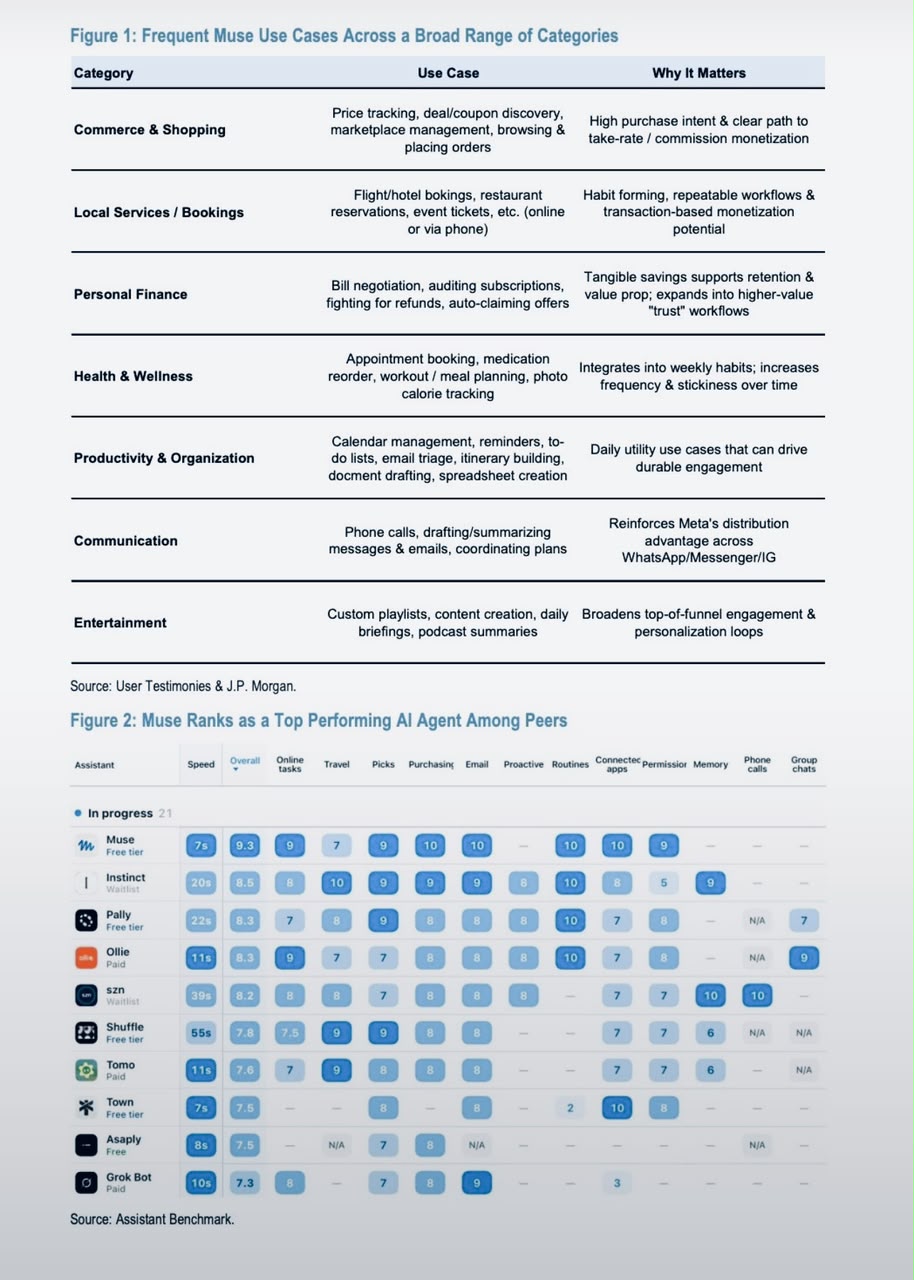
This is probably one of the more important pieces of evidence supporting the $META AI thesis because the interesting part is not simply that Muse ranks first in this benchmark with an overall score of 9.3, ahead of Instinct at 8.5 and the rest of the field, but that its use cases already span commerce, travel, bookings, personal finance, productivity, communication and entertainment, suggesting that the consumer agent is beginning to evolve from something people occasionally ask questions to something that can actually perform economic work on their behalf, and that distinction matters enormously because a chatbot answers while an agent acts, and once AI starts acting, the monetization opportunity changes completely. The first table is actually more important to me than the benchmark itself because it shows how broad the emerging use-case surface already is, with Muse users reportedly relying on it for price tracking, coupon discovery, marketplace management and purchases, flight and hotel bookings, restaurant reservations, bill negotiation, subscription audits, refunds, appointment scheduling, email triage, calendar management, document drafting, spreadsheet creation and communication, and those are not novelty prompts but workflows, which means they can become habits, and that is where consumer AI becomes economically interesting because the most valuable agent is probably not the one that wins a benchmark by three points but the one users trust enough to repeatedly delegate real tasks involving their money, time, communication and personal data. This is why I continue to think Meta’s distribution advantage is massively underappreciated because while OpenAI may have one of the strongest consumer AI brands, Google has Android, Search and Gemini, and Apple controls the device, Meta has something almost nobody else possesses: billions of users already living inside the communication and social environments where many of these tasks naturally begin, which means that someone messaging a friend on WhatsApp about dinner could potentially ask Muse to find the restaurant, compare availability and make the reservation, someone seeing a product on Instagram could ask Muse to compare prices, find a coupon and eventually complete the transaction, someone receiving an email about a flight could have Muse update the calendar, arrange transportation and remind them when to leave, and someone discussing a trip inside a Messenger group could eventually have the agent turn that conversation into an itinerary and execute the bookings. That is a completely different distribution model from asking consumers to download another standalone AI application and build a new behavioral habit from zero because Meta can bring the agent to the workflow instead of forcing the workflow to move to the agent, and that is why the communication layer could become strategically powerful, particularly because communication is where intent frequently becomes visible before a transaction occurs, as people message each other before choosing a restaurant, share products before buying them, discuss flights before booking them, coordinate events before purchasing tickets and send photos before asking for recommendations. If Meta’s AI can understand that context with appropriate permissions and privacy controls, the company potentially sits much closer to consumer intent than traditional advertising alone ever could, because historically Meta monetized attention, while the agent opportunity allows Meta to start monetizing action, creating an economic chain that could eventually look something like Discovery → recommendation → intent → agent execution → transaction → payment → customer service, with Meta already owning discovery and recommendation at enormous scale while Muse potentially moves the company further down the funnel. That is why commerce and shopping may ultimately become one of the largest opportunities, because if Muse helps somebody discover the cheapest flight, purchase a product or book a hotel, Meta does not necessarily need to charge the consumer directly for every interaction when the merchant can pay, the travel provider can pay, the marketplace can pay, and Meta can potentially collect referral fees, transaction commissions, promoted placement and payments economics, or simply use higher conversion rates to make its existing advertising inventory more valuable. This is also why I would not evaluate Muse solely through the lens of subscription revenue, because the agent could be worth considerably more indirectly, and if an Instagram advertisement allowed the user to simply say, “Muse, buy this in my size,” instead of clicking through a website, the funnel would shorten enormously, with every additional step between advertising and purchase historically creating leakage while AI agents can remove those steps, and if Meta controls both the advertisement and the agent completing the transaction, advertising attribution improves dramatically because Meta can potentially observe the journey from impression to purchase rather than losing visibility after the user leaves its platform, which could make Meta’s core advertising business even stronger. The personal-finance category is particularly interesting because it moves the agent from convenience toward measurable economic value, and if an AI agent saves someone $200 by renegotiating a bill, identifies an unused subscription, successfully claims a refund or finds a materially cheaper insurance offer, the willingness to pay becomes much easier to establish, because people may hesitate to pay $20 per month for a chatbot that writes poems but may happily pay $20 per month for an agent that consistently saves them $100, and that is an important difference. The same applies to productivity because email triage, calendar management, reminders, itinerary building, document drafting and spreadsheet creation are mundane tasks, but mundane tasks are exactly where persistent usage develops, meaning that the winner in consumer AI does not necessarily need to generate a “wow” moment every day but instead needs to quietly eliminate twenty small annoyances, because that creates retention and retention creates subscriptions. This is why the previous assumption that only 6% of Muse weekly users eventually convert into paying subscribers still looks conservative to me if product reception remains strong, because while a 6% conversion rate may be entirely reasonable for a generic AI chatbot, if Muse increasingly becomes a personal operating layer that manages communications, bookings, shopping, productivity and personal administration, then the product begins to resemble a digital employee rather than another subscription application, and the willingness to pay can therefore increase alongside the amount of work delegated to it. The benchmark also strengthens the product argument because Muse scores 9.3 overall with a 7-second response time, while receiving a 10 in purchasing, email, routines and connected apps, alongside strong scores in online tasks, recommendations and permissions, which is exactly where I would want an agent to be strong, since I care less whether it writes the most beautiful essay and more whether it can reliably complete a purchase, manage an inbox, interact with applications and follow recurring instructions, because those are economically useful capabilities. There are still obvious gaps, as the benchmark appears to show Muse lacking some of the deeper memory, phone-call and group-chat capabilities available in certain competitors, while a third-party benchmark based on selected tasks is obviously not equivalent to real-world retention, trust or reliability, and that distinction matters because the biggest consumer-agent bottleneck may ultimately not be intelligence but trust. Will users allow an AI to access their email, let it purchase something autonomously, allow it to call a restaurant, trust it with financial information or permit it to remember personal preferences indefinitely, especially when one high-profile mistake can destroy years of trust building, which means Meta needs extremely strong permission systems, auditability and user control, particularly given the company’s historical privacy controversies, and while the chart’s strong score for permissions is encouraging, this needs to remain a core product priority. There is another reason Meta’s position is unusually attractive: consumer AI can improve Meta’s economics even if Muse itself never becomes a massive subscription business, because if the agent increases time spent across WhatsApp and Instagram, Meta benefits, if it produces better recommendations, Meta benefits, if it improves advertising conversion, Meta benefits, if it pushes more transactions through Meta surfaces, Meta benefits, if businesses pay to make their products discoverable to agents, Meta benefits, if merchants deploy Business Agents on WhatsApp, Meta benefits, and if the consumer subscription business succeeds, Meta benefits again. There are therefore multiple monetization paths sitting on top of essentially the same AI infrastructure, which is why I continue to think the market spends too much time looking at Meta’s enormous AI capex and not enough time asking how many businesses can ultimately monetize the same compute, because the company is effectively building an intelligence layer underneath a social and communication network serving billions of people, and that is extraordinarily powerful if the product works. It also reinforces my broader view that the consumer AI battle will increasingly be determined by distribution, context and execution rather than model benchmarks alone, because models will continue improving, the performance gap between frontier models may compress, inference costs will keep falling, and what becomes harder to replicate is the surrounding ecosystem, with Meta owning communication graphs, Google owning enormous amounts of informational intent and Apple owning the device and operating system, meaning that those assets may ultimately matter more than a temporary five-point lead on a benchmark. Muse’s early performance therefore matters because Meta does not need to build distribution after achieving a good product, since the distribution is already there, and if Meta can place a genuinely useful personal agent inside WhatsApp, Instagram, Facebook and Messenger and expose it to billions of users with effectively zero customer-acquisition cost, then even modest adoption can become enormous very quickly, while if those agents start handling commerce, bookings, productivity and communication, the economics become much larger than today’s consumer AI subscription market suggests. This is why I remain LONG Meta, because the market still seems to think Meta is spending hundreds of billions of dollars building AI infrastructure around an advertising company, while I increasingly think Meta is using the advertising company to finance the construction of something much larger, and an AI agent sitting on top of billions of users, billions of conversations, millions of businesses and one of the world’s largest advertising systems could eventually become one of the most valuable consumer distribution layers in technology. If Muse continues receiving this kind of product reception, my concern is increasingly not whether Meta can monetize AI but whether current estimates are dramatically underestimating how many different ways Meta eventually will.
这条是引用着另一条写的:x.com/rickyho_1989/status/2102230429877297186