GPT-6 Astra 参与推导混沌网络 Lyapunov 谱
研究者称 Astra 约 100 分钟给出初始推导,配合 Claude Opus 5.5 完成混沌循环神经网络完整 Lyapunov 谱的解析结果。

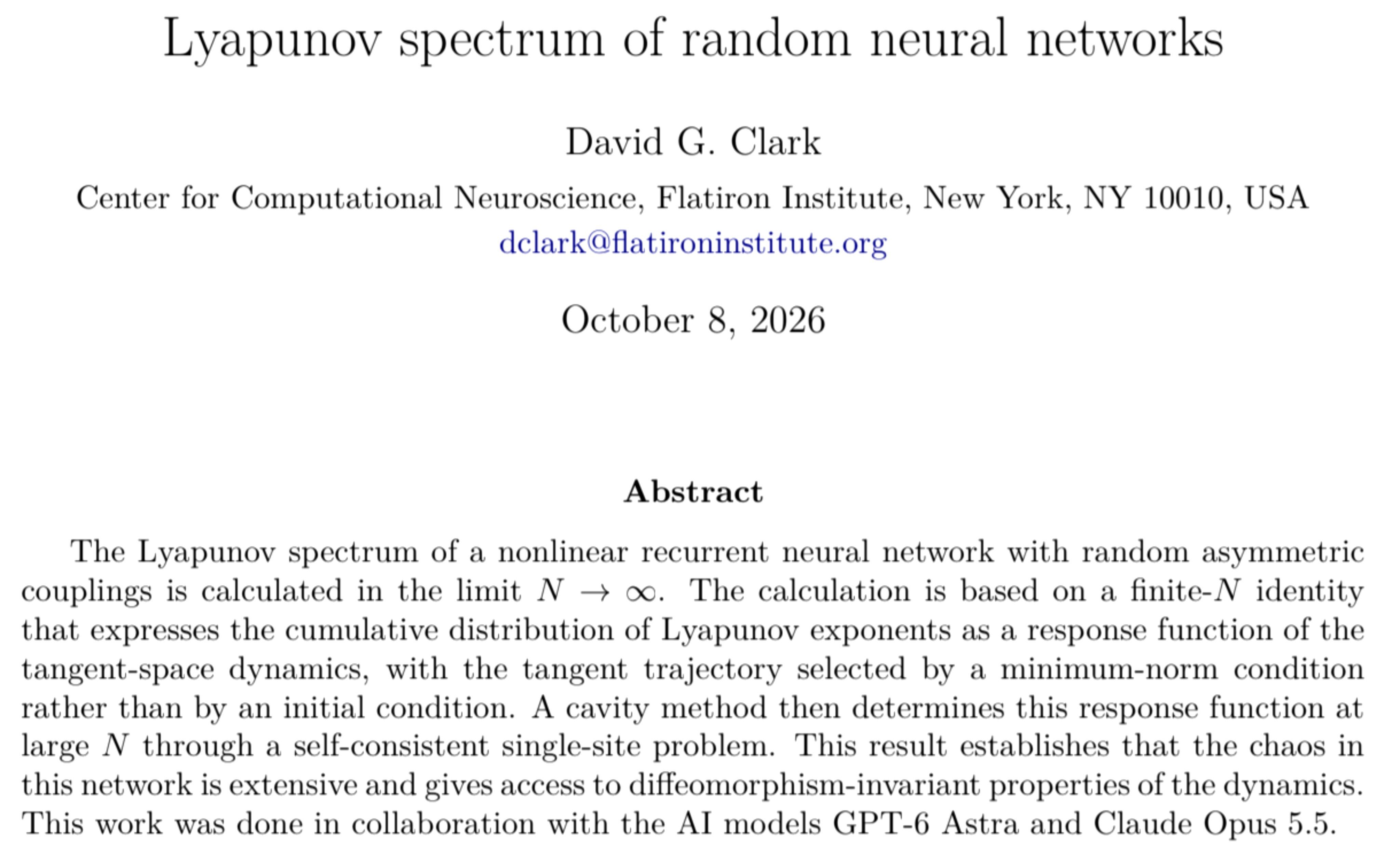
That's a fascinating direction for scientific discovery. AI models are starting to help researchers tackle mathematical problems that have resisted analytical solutions for decades. 🤯 David G. Clark reports deriving the full Lyapunov spectrum of chaotic recurrent neural networks with help from GPT-6 Astra and Claude Opus 5.5. Here's why this matters. In 1988, Sompolinsky, Crisanti, and Sommers developed a foundational theory of chaos in randomly connected neural networks. But calculating the complete Lyapunov spectrum analytically remained a challenge. The Lyapunov spectrum describes how perturbations grow or shrink across different directions in a dynamical system. It helps characterize chaos, attractor dimensionality and dynamical information generation. Clark's new preprint introduces a self consistent single-site framework that derives the full spectrum in the large network limit. This theory agrees closely with simulations and recovers established results for the largest Lyapunov exponent. It also establishes analytically that the attractor dimension and entropy rate scale proportionally with network size in the studied model. The fascinating part? Clark reports that GPT-6 Astra produced the initial derivation after approximately 100 minutes of work. Further investigation with AI models led to a more physically transparent derivation.👀 neXt next frontier could be applying similar approaches to trained neural networks and other high-dimensional systems, including AI models themselves. We're literally living in a new era of scientific acceleration.
这条是引用着另一条写的:x.com/d_g_clark/status/2108574780957905073