Jev 工程手册:LLM 推理、Jev 决策、代码执行
一份把 Jev 当决策层写进 agent 架构的实践指南,讲 Choice/Score/Noul 三个原语如何接管路由、审批与安全门。

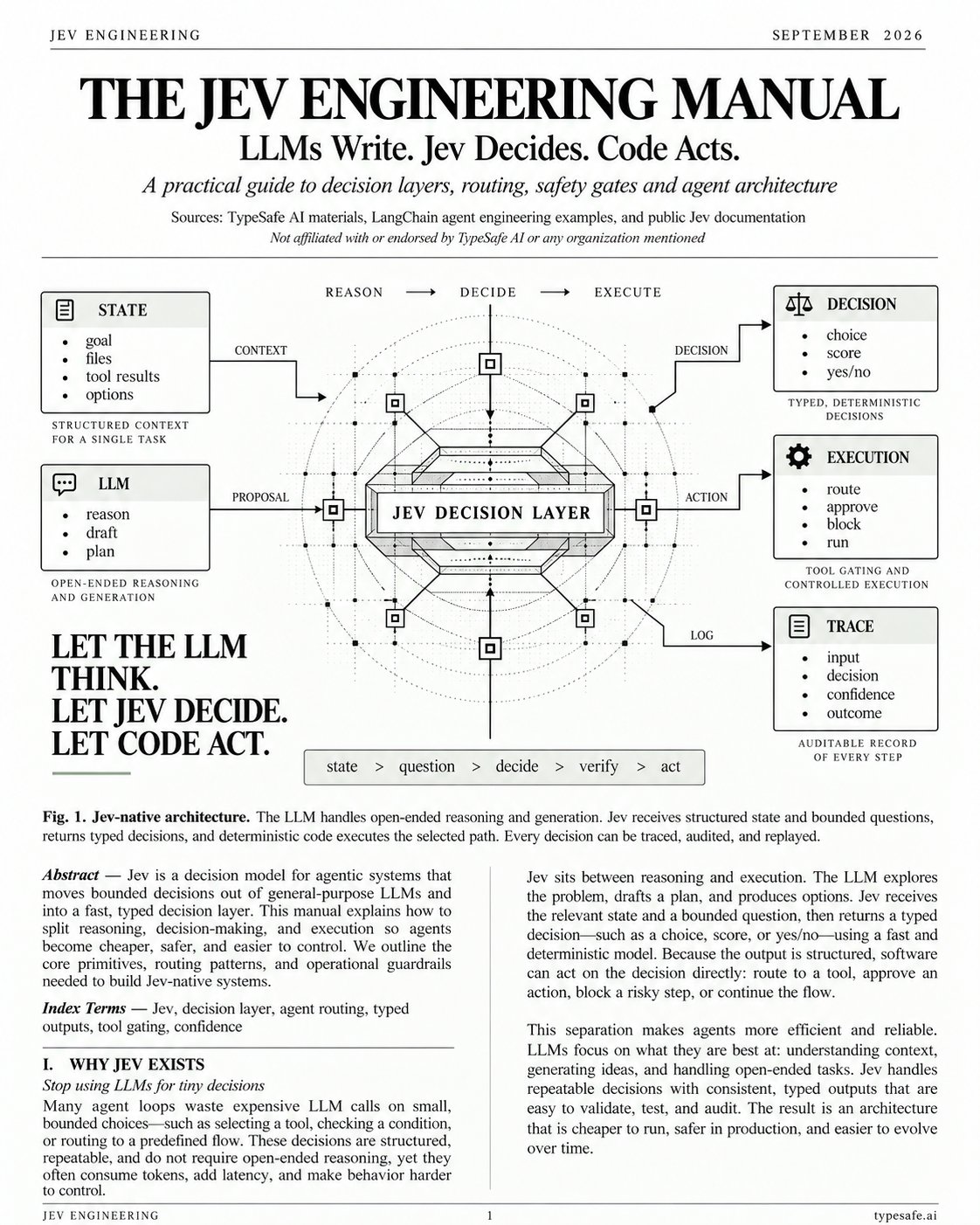
THE JEV ENGINEERING MANUAL LLMs Write. Jev Decides. Code Acts. A practical guide to decision layers, routing, safety gates and agent architecture Fig. 1. Jev-native architecture. In a Jev-native system, the LLM handles reasoning, planning and generation, Jev makes fast typed decisions, and code executes the selected path. This creates a cleaner split between thinking, deciding and acting Abstract Jev is not a traditional language model for free-form generation. It is a decision model built for fast, well-scoped questions with structured outputs. Inside an agent stack, this makes Jev useful for routing, classification, approval checks and other bounded decisions that software needs to make continuously Why Jev Exists Many agent systems still use an LLM for every small decision. That adds cost, latency and unnecessary complexity. Jev moves those small decisions into a faster and more controlled layer inside the harness, so the expensive model can stay focused on reasoning and writing Core Pattern LLM reasons → Jev decides → Code acts Jev exposes three core primitives: Choice selects one option, Score evaluates a state on a scale, and Noul estimates whether something is true. Together, these turn vague agent behavior into decisions that code can use directly Main Idea The goal of a Jev-native architecture is simple: stop using a general LLM for every branch in the loop. Let the LLM think, let Jev decide what happens next, and let code execute the result in a predictable way
这条是引用着另一条写的:x.com/serantych/status/2103281680165253489