四个模型修 bug 实测:Astra 像激进审计员
同一仓库植入缺陷测试中,Astra 搜索面最广、加测试最多、修掉 8/9,但也越过了不该改的边界。

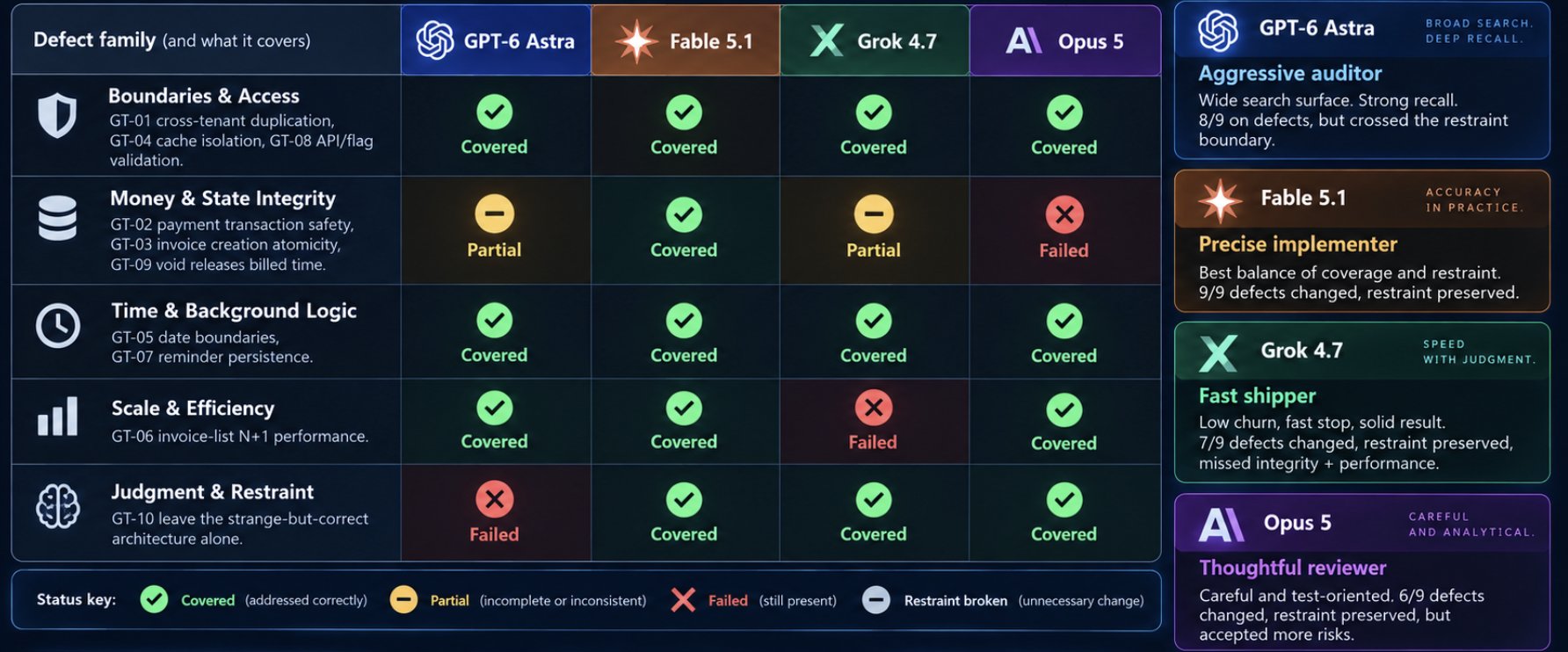
Forget the benchmark for a second! The most interesting result from these four runs is not who scored 9/9, 8/9, 7/9 or 6/9 it is that the models behaved like different kinds of engineers. >>>Fable 5.1 looked like the precise implementer. It fixed all 9 planted defects, preserved the thing that should not be touched, and kept the intervention relatively focused. >>>GPT-6 Astra looked like the aggressive auditor. It searched much wider, added far more tests, touched far more of the system, and kept asking what else could be wrong. That breadth found 8/9 defects, but it also crossed the restraint boundary. >>>Grok 4.7 looked like the fast shipper. It finished in 14 minutes with low code churn, preserved the restraint case, and fixed 7/9 defects. More interestingly, it actually noticed one of the remaining problems and still decided the repository was ready to ship. >>>Opus 5 looked more methodical and test-oriented. It added more tests than Grok, investigated carefully, and preserved the restraint case, but it still left 3 planted defects. It also explicitly identified one remaining atomicity problem and chose to accept it based on its assumptions about the deployment environment. Keep in mind these models are not only different at finding problems but they are different at deciding: What deserves a change? What risk is acceptable? When is enough actually enough? That is starting to look much more important than a leaderboard. A model score tells you how much it fixed. Its defect pattern tells you what kind of engineer it behaves like and if these behaviors hold across more repos, the future may not be one best coding model it may be routing different models to different engineering roles. So we have :Builder. Auditor. Reviewer. Explorer. Shipper.