用 Jev 做邮件分类、线索打分等小决策的入门指南
作者建议把流程里频繁发生的小判断交给 Jev 而非每次调用大模型,并给出实操:把邮件当 state,加分类、紧急度、是否需回复三个问题,先跑 20 封样本验证。

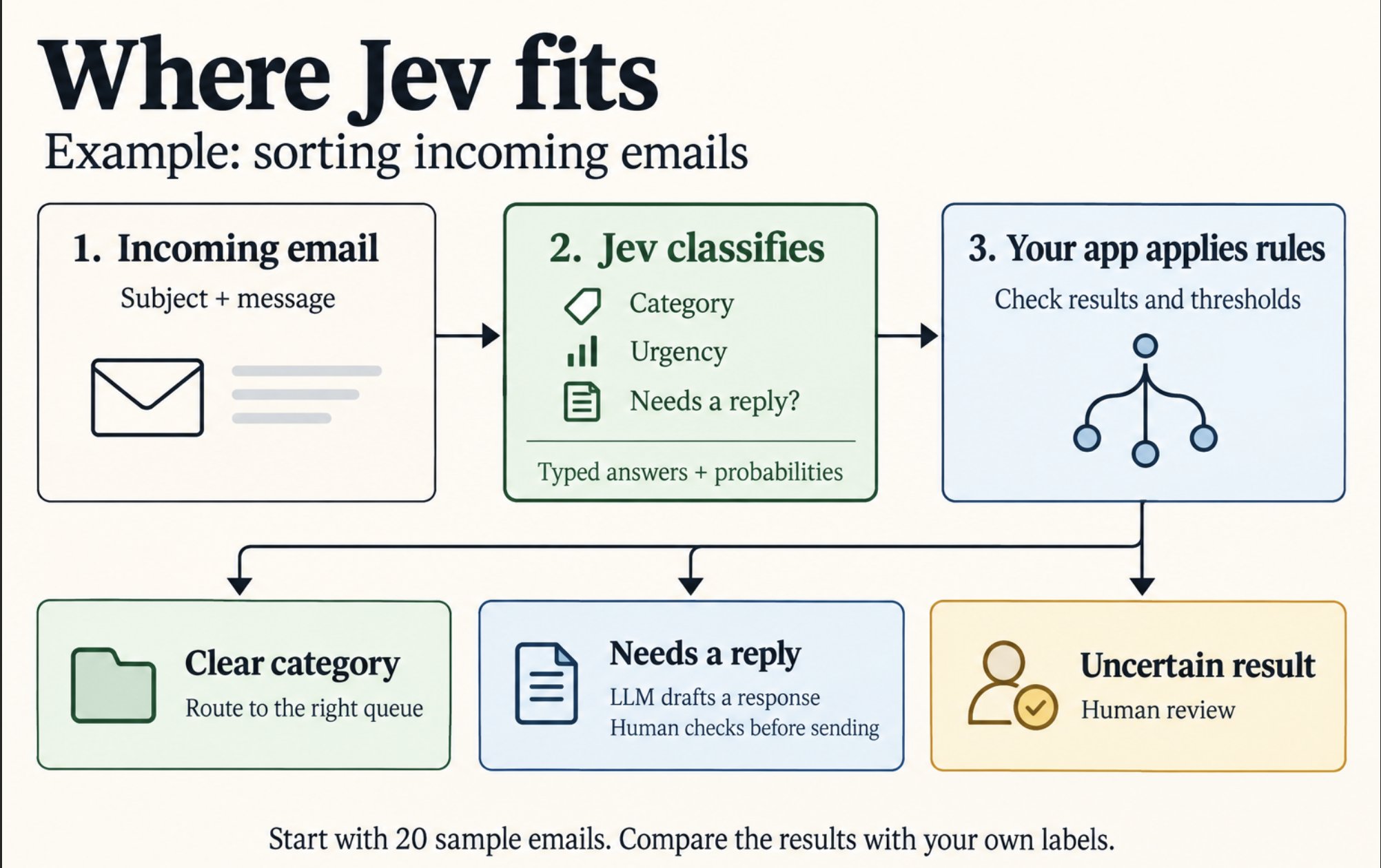
Jev is worth experimenting with if you keep asking a large AI model to sort emails, score incoming leads, or decide where a request should go. Those are small decisions, but they happen throughout an automated workflow. Paying for a full reasoning call every time can make a simple process slow and expensive. Jev is TypeSafe AI’s model for fast, structured decisions. You give it the information to assess and define the questions you want answered. It returns choices, scores, and probabilities that your code can use directly. For a support email, you could ask which team should handle it, how urgent it is, and whether it needs a reply. Jev can evaluate those questions together in one request. Your app then decides what to do with the results. In Greg Isenberg’s video, Ryan Vogel reports classifying 1,700 emails for about $0.18 total. His demo sorts them by category and priority, while also assessing spam and whether a reply is needed. That’s one reported run, but it gives you a concrete example of the work Jev can do. TypeSafe currently lists direct API pricing at $0.042 per million input tokens, with no charge for output tokens. Small tests become cheap enough that you can try a few different ways of asking the question. I’d start with an inbox sorter. Open the TypeSafe Playground and paste a sample email as the “state,” meaning the information Jev will assess. Add a category question with clear options, such as billing, technical support, or sales. Add separate questions for urgency and whether a reply is needed. Repeat with 20 sample emails, including a few awkward ones. Compare the results with labels you chose yourself. The TypeSafe quickstart walks through this. You can also access Jev through Vercel AI Gateway. Once the classifications look useful, connect them to a small workflow. Clear cases go to the right queue. Messages needing a response can go to an LLM to draft one. Uncertain cases go to a person. If you already use LangChain, its langchain-typesafe package lets you pass the state and questions to TypeSafeClassifier. That gives you a way to add Jev to an existing app. There’s still work to do around the model. You have to define useful categories, check mistakes, and decide how much uncertainty your workflow can tolerate. A response can match the required format perfectly and still contain the wrong decision. TypeSafe documents limits with arithmetic, complicated instructions, and irrelevant context. Keep calculations in code and use a generative model for writing. What I find promising is being able to put a quick first pass in front of work that currently needs manual sorting. A small business could route support requests. A creator could organize incoming messages. An agent could choose which model handles the next task. I’d pick one queue I already spend time sorting and test Jev there. Check the results, keep the mistakes, and adjust the questions. A tool this cheap to test makes it easier to find out whether an automation is useful before investing much time in it.