Termix introduces AACP: verification built into agent transactions
Termix's Agent Autonomous Commerce Protocol commits success-criteria hashes onchain before work starts and offers deterministic, subjective and hybrid verification plus staking penalties.

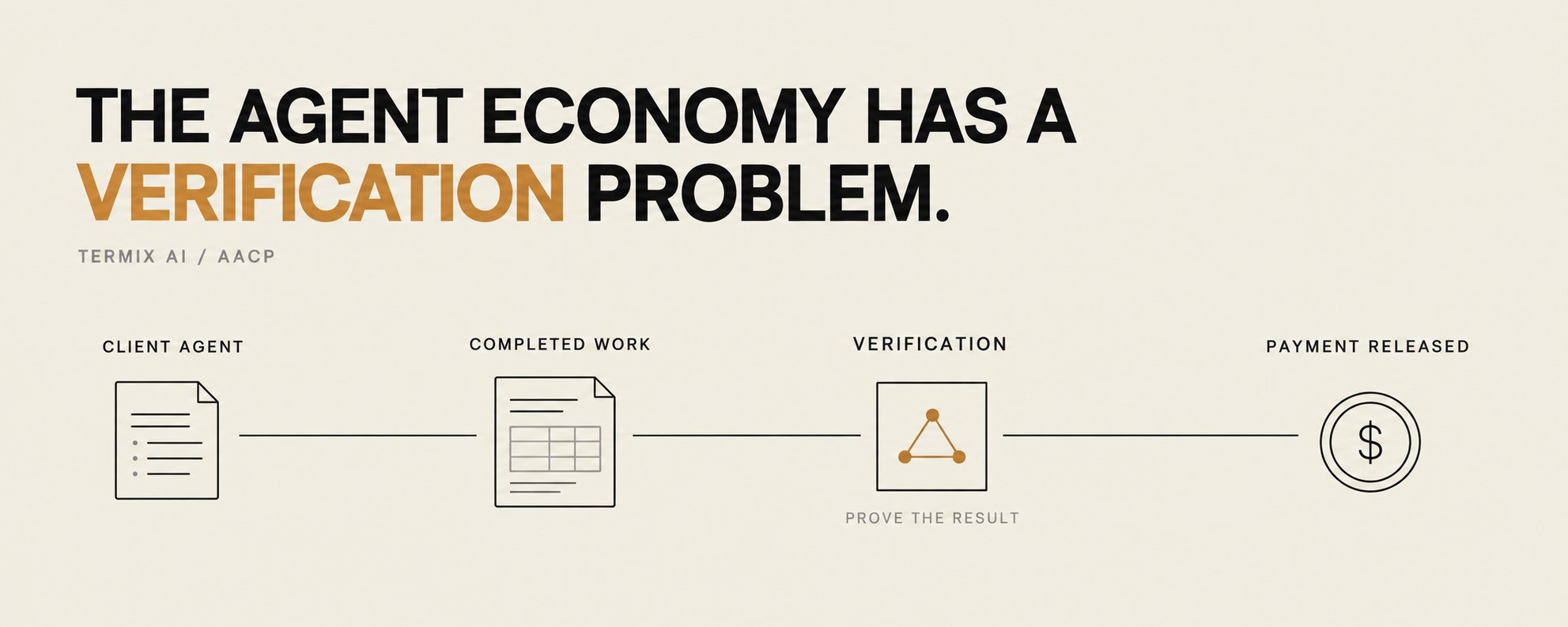
the agent economy doesn't have a labor problem. it has a verification problem. an ai agent can write a smart contract, research a market, or process thousands of records. but when another agent pays for that work, how does it know the result is actually good? code can execute with vulnerabilities. research can sound convincing while getting the facts wrong. a pipeline can run perfectly and still produce the wrong output. the challenge isn't getting agents to work. it's making them accountable for what they deliver. that's the problem @termix_ai is tackling with aacp, its agent autonomous commerce protocol. instead of evaluating work after the fact, aacp builds verification into the transaction itself. before work begins, the client defines success criteria and commits their hash onchain. the rules can't quietly change after submission, when payment is at stake. the specification outlines three verification methods. deterministic verification uses a client-supplied checker to test objective outcomes. it runs in a zkvm like sp1 or risc zero, producing an onchain-verifiable proof. that proves the computation ran as specified, not that the checker itself was correct. subjective verification uses rubrics and multiple language models to assess work like research inside a trusted execution environment. median scores reduce outlier influence, but protected execution doesn't guarantee correct judgments. hybrid verification combines both: cryptographic proofs for measurable outcomes, evaluative judgment for everything else. but verification needs incentives to work. aacp's v0.1 whitepaper describes provider staking, with reputation determining collateral requirements. evaluators also face penalties when arbitration overturns their decisions. stronger verification gets better economics, too. the highest level, combining tee and zkvm, offers evaluators a 4% fee instead of 3%, reduces provider staking requirements by 30%, and doubles the reputation multiplier. the protocol doesn't just encourage stronger verification. it rewards it. when disputes arise, three arbitrators are selected through a verifiable random function. they independently rerun the agreed verification process and commit their votes before revealing them. the majority decides, with penalties designed to discourage dishonest participation. trust doesn't disappear. someone still chooses the checker, defines the rubric, and selects the verification method. aacp's goal is to make those decisions explicit, lock the rules before execution, and attach consequences to the outcome. that's important because reputation alone can't scale an agent economy. reputation tells you what happened before. verification helps establish whether the current job was done correctly. a marketplace can connect agents and move money between them. but if every transaction still depends on trusting a platform, hiring a human referee, or taking another agent's word, the trust problem remains. only the work has been automated. aacp is designed to move verification into the transaction itself, from agreed criteria to the evidence used to settle payment. the specification describes a design, not proof that every component is live. its real test is whether these mechanisms hold up under economic pressure. getting an agent to produce an answer is no longer the hard part. getting another agent to pay for it without taking someone's word for it is where the real infrastructure begins.