Gemini 4 Argon review: benchmarks, pricing and real-world tests
Gemini 4 Argon is fast and cheap per token and shines at 3D and visual coding, but in users' concrete same-task comparisons Claude Opus 5.5 was judged better about twice as often, while heavy token consumption and tight subscription limits remain the primary complaints. This analysis covers 4,824 posts on X collected between September 16 and October 17, 2026, including 746 classified post-launch hands-on tests, alongside official Google documentation and benchmark data from Plotly.
Whether it is worth switching to Gemini 4 Argon depends heavily on the specific workload, with 3D and visual code as its strongest showing, while users more often judged Claude Opus 5.5 better on the same tasks. Across the classified hands-on reports, positive verdicts outnumbered negative ones 399 to 79, with 3D, voxel, and physics simulations forming the largest single testing category at 219 of 746 posts. However, in 94 direct head-to-head comparisons against Claude Opus 5.5, users favored Opus 45 times compared to 21 for Argon. While Argon was reported as faster and cheaper in 61 of 85 cost-focused posts, its high token consumption means that per-task costs do not always reflect its low per-token pricing.
Before its official release, the model circulated widely under the rumored name Gemini 4 Pro, though Google ultimately launched it as Gemini 4 Argon. The findings presented here are derived from a collection of X posts classified using automated analysis alongside manual spot checks, reflecting user-reported experiences rather than an author-conducted benchmark.
Browse every original post in the Gemini 4 Argon collection (its title still uses the rumor-era name Gemini 4 Pro / Flash), and compare with GPT-6 Astra tests and use cases and video projects made with Claude Opus 5.5.
Release date, where to use it and what it costs
Google made Gemini 4 Argon generally available on October 13, 2026, following a restricted preview announced by Sundar Pichai on September 30.
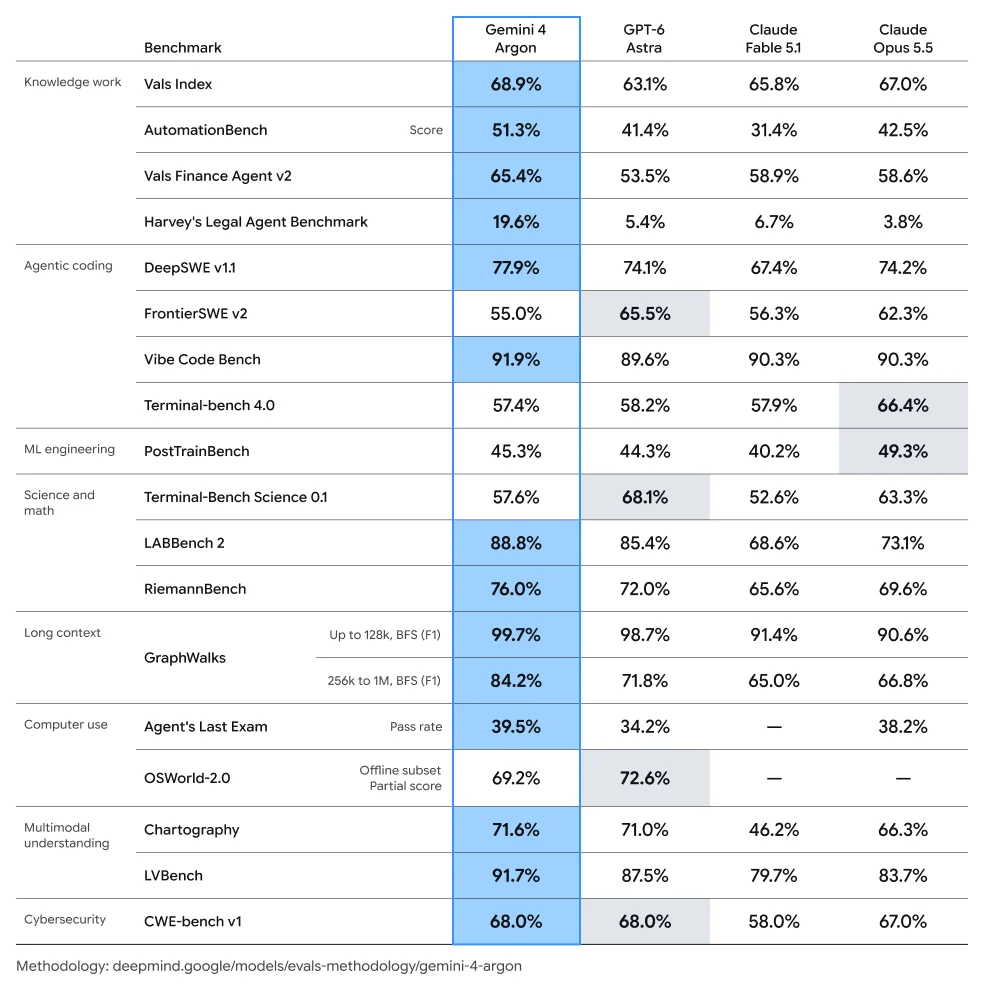
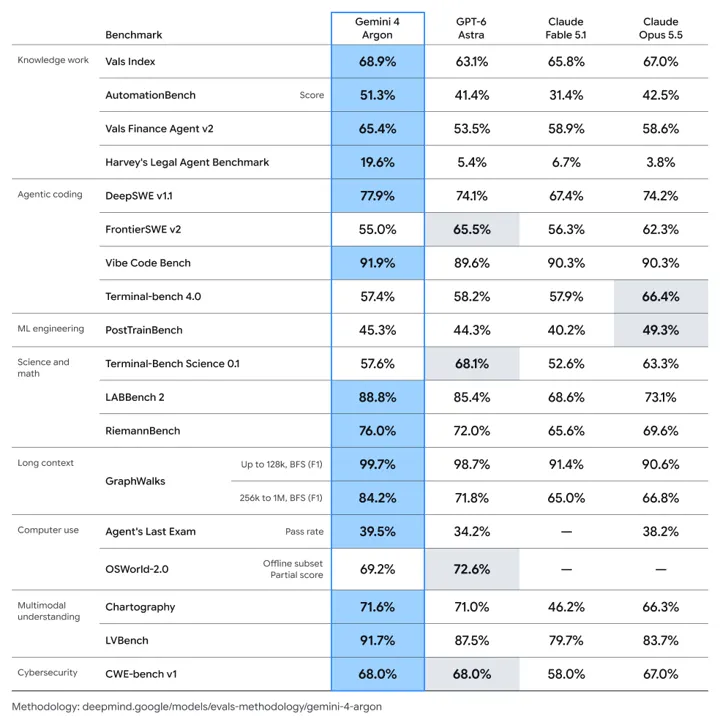
Sundar Pichai (@sundarpichai) shared an early benchmark table on September 30, 2026, comparing Gemini 4 Argon against GPT-6 Astra, Claude Fable 5.1, and Claude Opus 5.5 across 19 evaluation suites. (Item: Pichai gives early look at Gemini 4 Argon and its benchmarks)
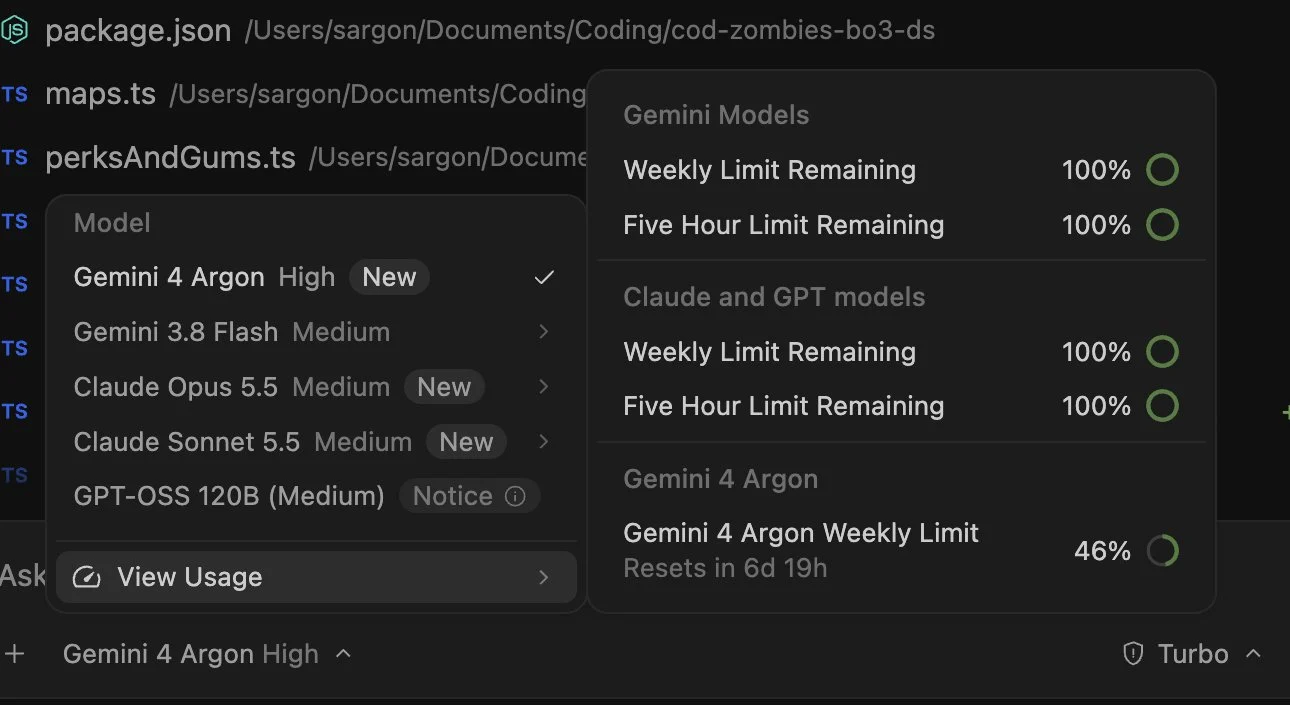
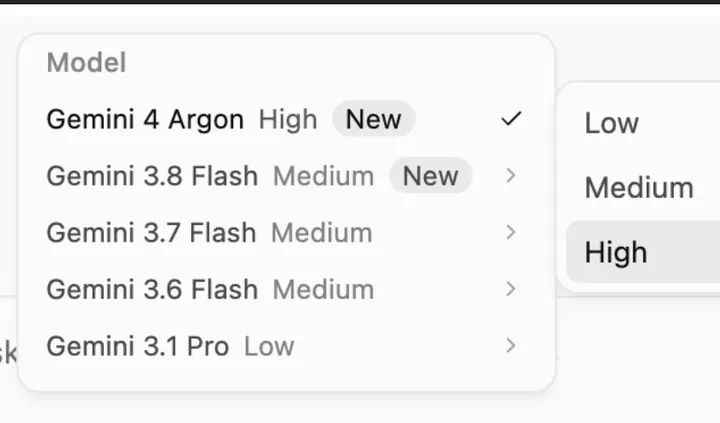
Google initially limited access to an early cohort of cybersecurity defenders participating in its Fairwind Program. On October 13, access expanded via the Gemini API under the model identifier gemini-4-argon across AI Studio and the Gemini developer platform. The model was simultaneously introduced into the Gemini consumer application and AI Mode for Google AI Pro and Google AI Ultra subscribers, while Antigravity availability was restricted at launch to Ultra plan holders. On October 16, users reported that access within Antigravity began rolling out to paid Google AI Pro members, though this expansion was not confirmed on any official Google page checked for this review.
Through November 30, 2026, Google offers an introductory API rate of $2 per million input tokens and $10 per million output tokens, with cached context discounted by 95 percent. After November 30, the price rises to $4 per million input tokens and $20 per million output tokens. The API supports a unified 1-million-token input and output limit.
Vendor benchmarks published on Google DeepMind's model card show Gemini 4 Argon leading competitors on the Vals Index, DeepSWE, LVBench, and long-context GraphWalks evaluations. Conversely, Google's reported figures place Argon behind Claude Opus 5.5 on Terminal-bench 4.0, and behind both Opus 5.5 and GPT-6 Astra on FrontierSWE v2.
Table: Selected benchmark scores from Google's model card (%)
| Benchmark | Gemini 4 Argon | GPT-6 Astra | Claude Opus 5.5 |
|---|---|---|---|
| Vals Index | 68.9 | 63.1 | 67.0 |
| DeepSWE v1.1 | 77.9 | 74.1 | 74.2 |
| FrontierSWE v2 | 55.0 | 65.5 | 62.3 |
| Terminal-bench 4.0 | 57.4 | 58.2 | 66.4 |
| GraphWalks 256k–1M | 84.2 | 71.8 | 66.8 |
| LVBench | 91.7 | 87.5 | 83.7 |
Sample/method: Google DeepMind's Gemini 4 Argon model card (published 2026-10-13); vendor-reported figures, 6 rows selected.
Public discussion shifted rapidly from speculation to practical evaluation after launch. Rumors made up 56 percent of the 2,550 posts recorded before October 13, whereas post-launch traffic was dominated by user testing and head-to-head comparisons, peaking at 1,233 posts on October 14 (UTC+8).
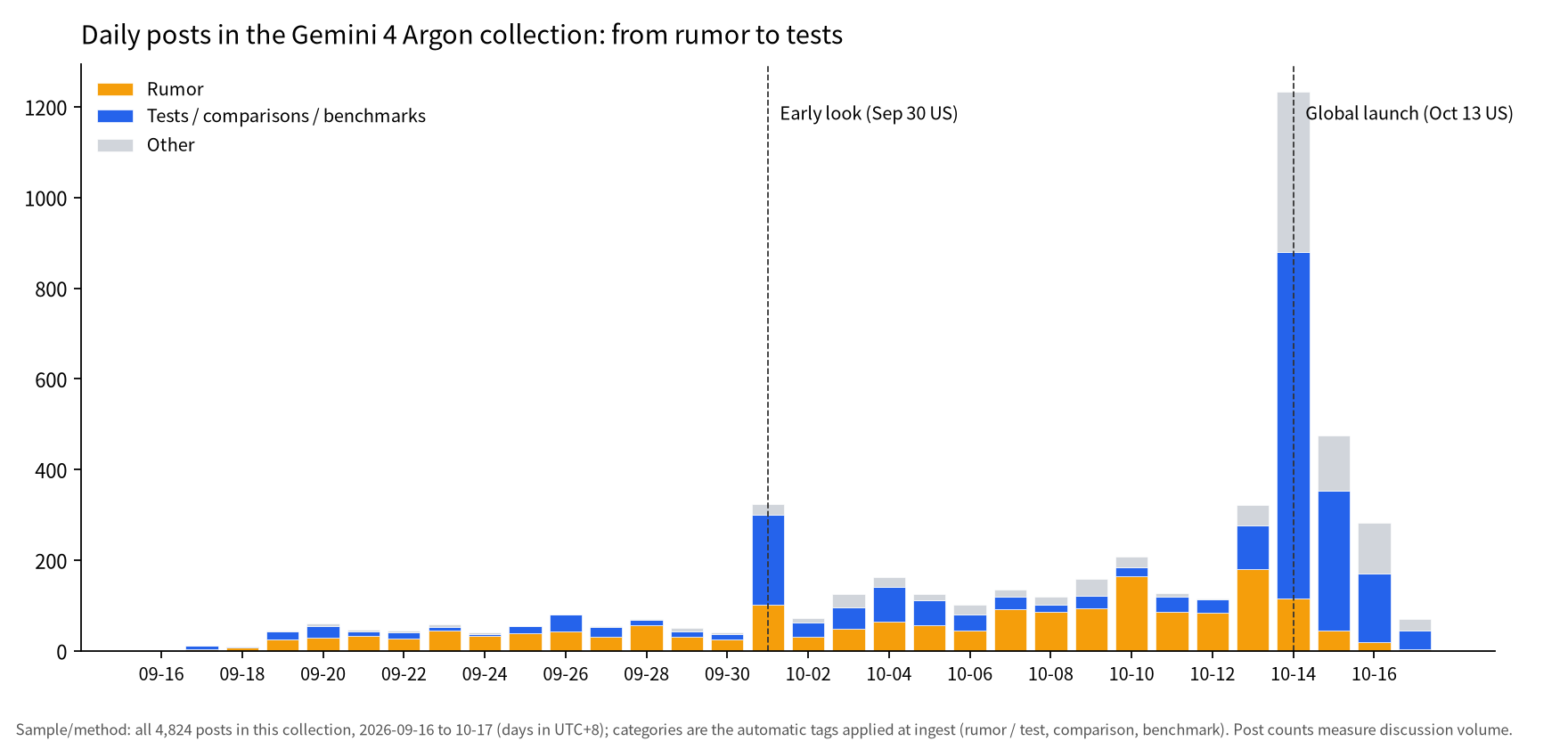
Sample/method: all 4,824 posts in this collection, 2026-09-16 to 10-17 (days in UTC+8); categories from automatic ingest tags. Post counts measure discussion volume.
What people test it on: 3D and visual code first
Users focused heavily on procedural 3D graphics, voxel generation, and physics engines, which together formed the single largest group of hands-on evaluations.
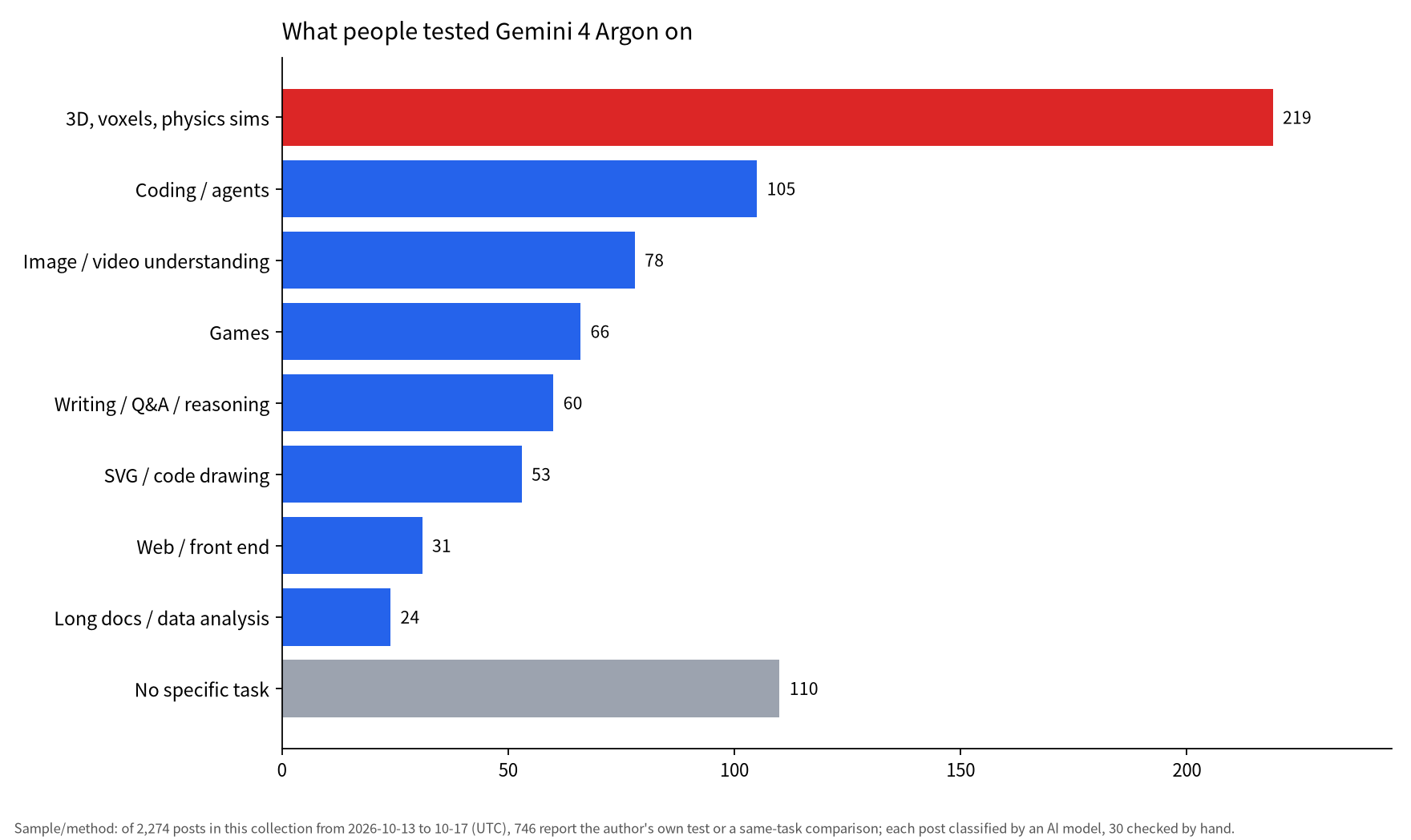
Sample/method: 746 own-test or same-task comparison posts among 2,274 posts in this collection, 2026-10-13 to 10-17 (UTC); AI classification with 30 hand checks.
Out of 746 classified posts reporting direct tests, 219 posts (29 percent) involved 3D graphics, voxels, or simulation code, surpassing general coding and agent tasks (105 posts) and multimodal image or video tasks (78 posts). This concentration aligns directly with Google's marketing focus on spatial reasoning and browser-rendered visual code.
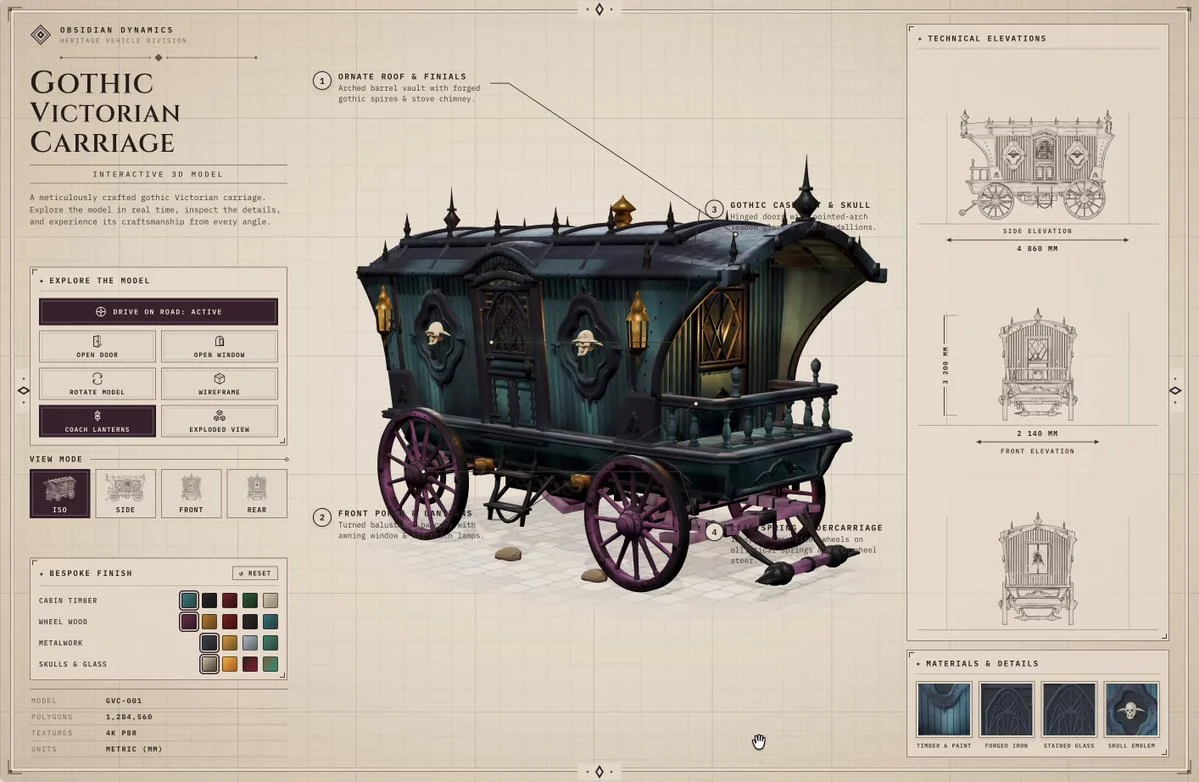
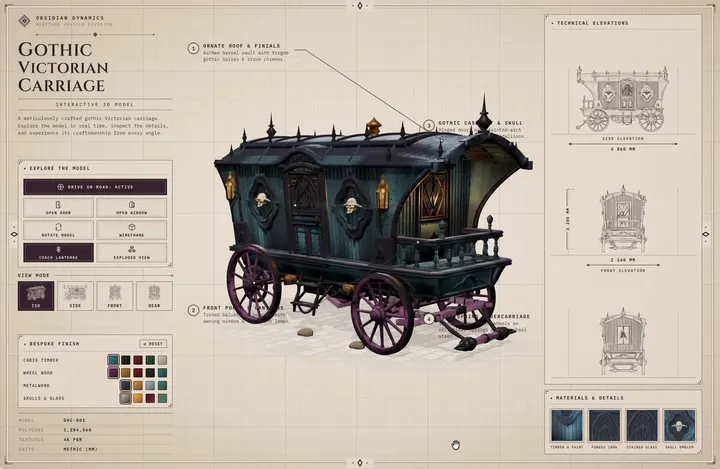
On October 14, 2026, 知识猫AI实验室 (@GeekCatX) relayed another creator's demo: an interactive WebGL Victorian carriage that, according to the post, Argon built in code from a single 2D image, with opening doors, hinges and wheel suspension. It is a secondhand relay, and the face count it quotes does not match the on-screen figure, so we do not cite it. (Item: Gemini 4 Argon generates a 174k-face WebGL 3D carriage from code alone)
Official showcases highlighted similar capabilities. Google DeepMind (@GoogleDeepMind) reported that four coordinated Argon agents completed Minecraft from scratch within 27 hours by generating 2,783 programs inside a sandboxed environment using only code and text, with no human help. In a podcast episode sponsored by Google, after seven days of early access, Greg Isenberg (@gregisenberg) said Argon is perhaps the best AI copywriter and that it needs visual references to produce good creative work.
Overall sentiments across the 746 hands-on posts leaned heavily favorable in the opening days, recording 399 positive verdicts, 97 mixed reviews, 79 negative evaluations, and 171 reports without an explicit assessment. As is common in early launch windows, public posts skewed naturally toward successful and visually engaging demonstrations.
Against Claude Opus 5.5 and GPT-6 Astra: Opus wins more same-task comparisons
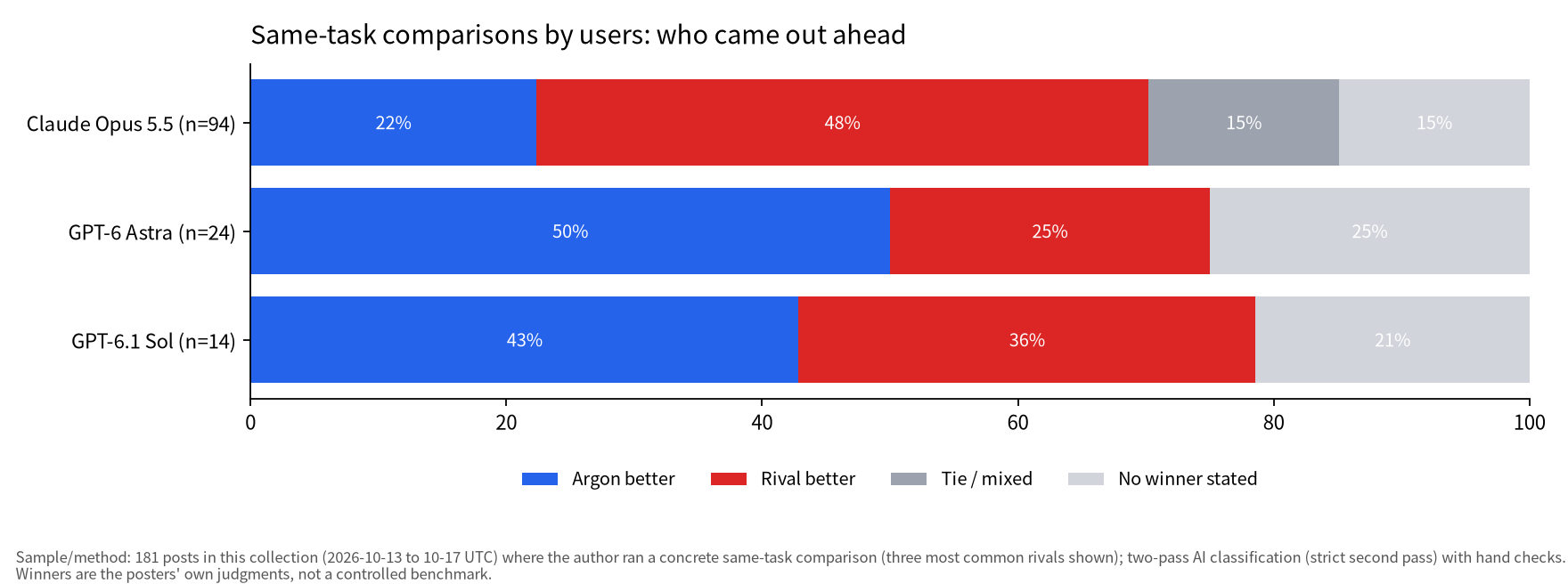
Direct comparisons on identical prompts saw Claude Opus 5.5 take the lead in overall output quality, despite Argon maintaining an advantage in execution speed and operating costs.
Sample/method: 181 posts in this collection (2026-10-13 to 10-17 UTC) where the author ran a concrete same-task comparison, three most common rivals shown; two-pass AI classification with a strict second pass and hand checks. Not a controlled benchmark.
Among 181 posts running side-by-side evaluations against competing models, 94 involved Claude Opus 5.5. Users judged Opus 5.5 as superior in 45 instances, favored Argon in 21 cases, reported a tie or mixed outcome in 14 cases, and left 14 comparisons undecided. In 24 comparisons against GPT-6 Astra, users favored Argon 12 times versus 6 for Astra, with 6 undecided. Comparisons against GPT-6.1 Sol across 14 posts resulted in an even distribution of 6 favoring Argon and 5 favoring Sol.
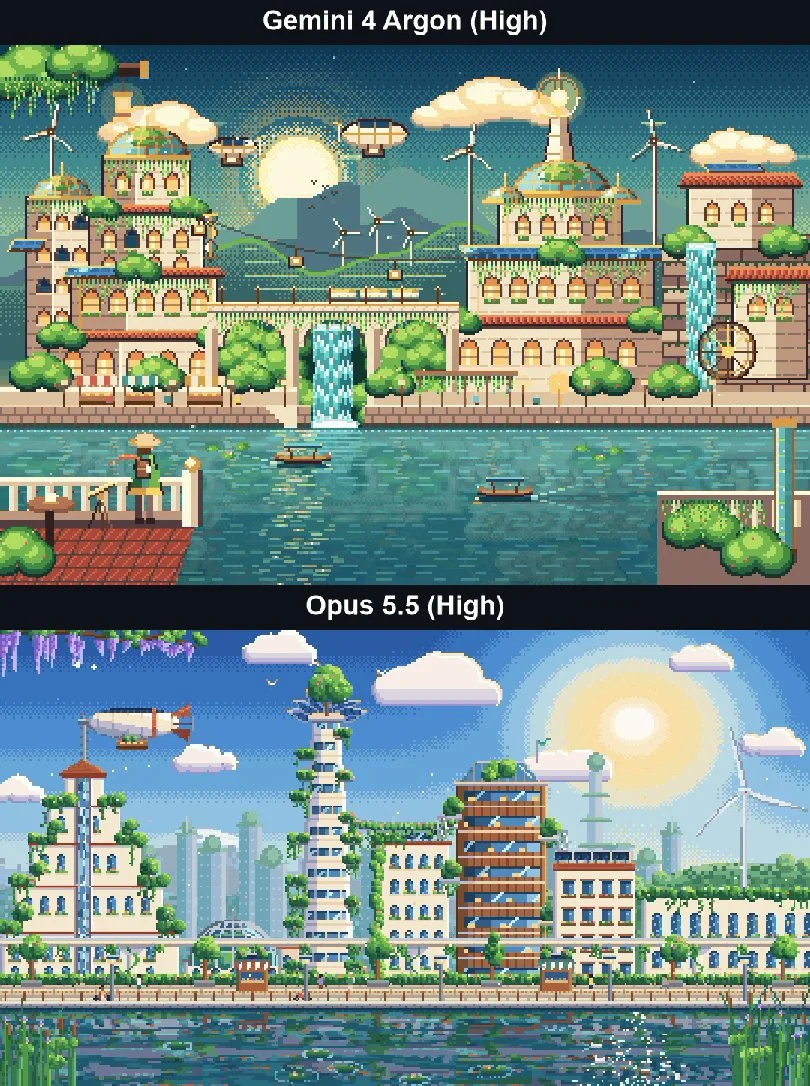
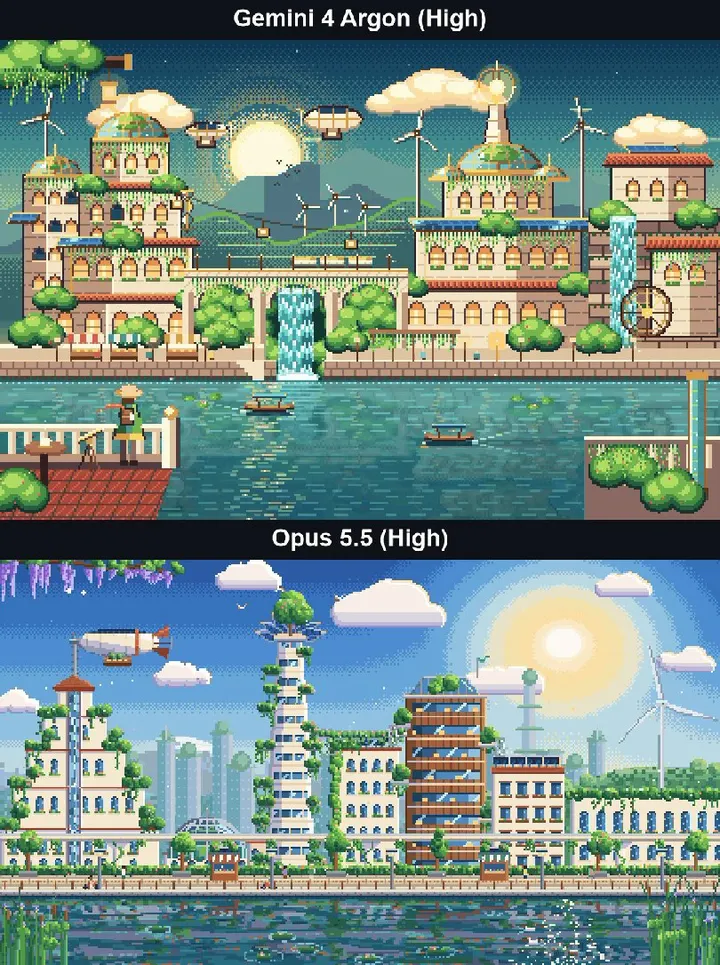
On October 13, 2026, J A Z I I (@notjazii) posted a video comparing pixel-art cities generated from the same prompt at the highest reasoning setting, reporting that the results came out almost the same: Argon took 13 minutes and $1.2 via Devin CLI, Opus 15 minutes and $8.2 via Claude Code CLI. (Item: Gemini 4 Argon costs 7x less than Opus 5.5 in same-prompt test, user says)
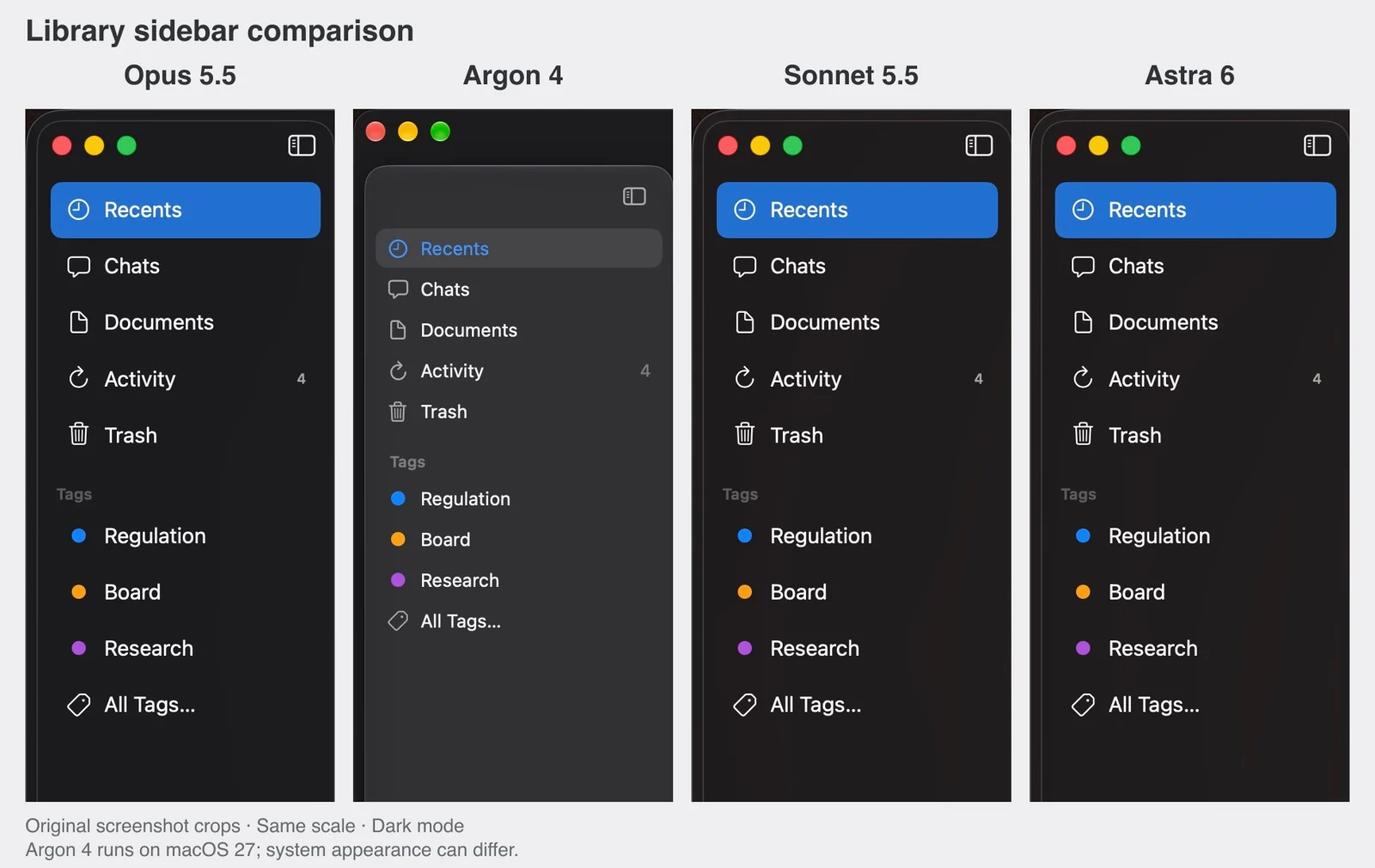
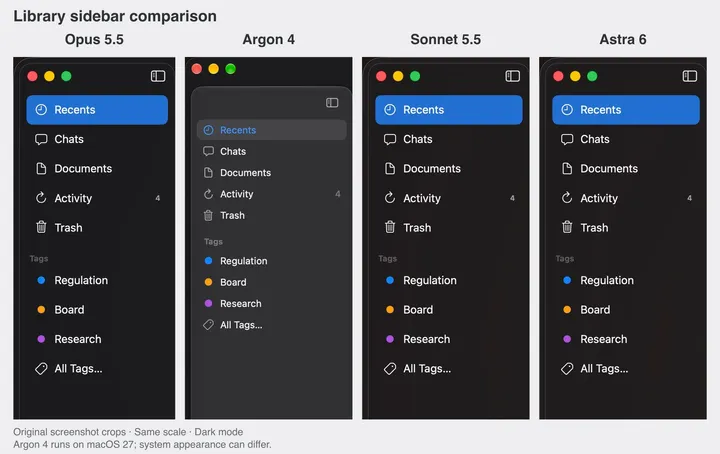
Evaluating an identical macOS application task on October 13, 2026, Daniel Nguyen (@daniel_nguyenx) gave Opus 5.5 a score of 9.1 at $14.21, Sonnet 5.5 an 8.5 at $8.55, Argon an 8.4 at $3.42, and GPT-6 Astra an 8.0 at $29.81. (Item: Gemini 4 Argon scores 8.4, behind Opus 5.5 but about 4x cheaper)
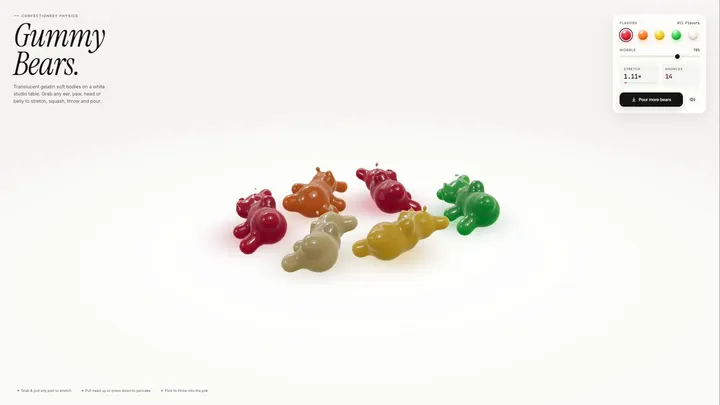
Other multi-model tests echoed this dynamic. After dozens of hours of testing, Melih Çat (@melih_cat) concluded that Argon on its high reasoning setting roughly matches Opus 5.5 on medium reasoning for programming, noting that Argon's deep research mode stood out as its most capable feature. Similarly, Mia (@MiaAI_lab) said a viral Argon gummy-bear video was fake and, after rerunning the prompt herself, concluded that Opus is still better but Argon is not bad at all. These figures reflect subjective user judgments rather than standardized evaluations, and sample sizes for Astra and Sol remain small.
Cheap and fast, but not always cheaper per task
Argon's lower token price frequently lowers job expenses, yet higher token volume on certain analytical workloads can erase that discount entirely.
Table: Time and cost in same-task runs (as reported)
| Source | Task | Gemini 4 Argon | Rival |
|---|---|---|---|
| J A Z I I (@notjazii) | Same prompt, highest reasoning | 13 min, $1.2 | Opus 5.5: 15 min, $8.2 |
| AIHubmix (@AiHubMix) | Same prompt | 3 min, $0.50 | GPT-6 Astra: 25 min, $11 |
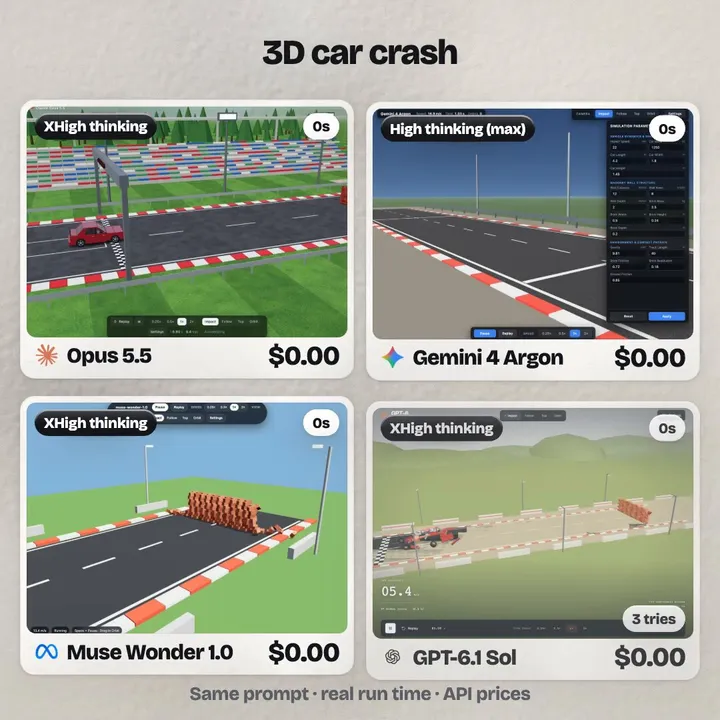
| Melvyn (@melvynx) | 3D car crash scene | 8 min, $0.51 | Opus 5.5: 1 h 27 min, $8.79; GPT-6.1 Sol: 39 min, $0.96+ |
| Daniel Nguyen (@daniel_nguyenx) | Same coding task (scored) | 8.4, $3.42 | Opus 5.5: 9.1, $14.21; GPT-6 Astra: 8.0, $29.81 |
| Plotly (company blog) | 43-question data analysis exam | 41/43, $13.47 | Opus 5.5: 41/43, $13.31; GPT-6.1 Sol: 43/43, $2.61 |
Sample/method: X posts are self-reported (2026-10-13 to 10-16) with different tools and settings, so rows are not comparable with each other; Plotly figures from its 2026-10-13 blog post.
Out of 181 comparison posts, 85 discussed operational speed or billing expenses. Sixty-one posts noted that Argon ran faster, cheaper, or both, while 24 reported higher costs or slower speeds. Demonstrating the low end of expenses, API provider AIHubmix (@AiHubMix) reported completing a prompt in 3 minutes for $0.50 with Argon, compared to 25 minutes and $11 with GPT-6 Astra. On a 3D car crash simulation prompt, Melvyn (@melvynx) recorded an 8-minute completion for $0.51 on Argon, contrasted with 1 hour 27 minutes and $8.79 on Opus 5.5.
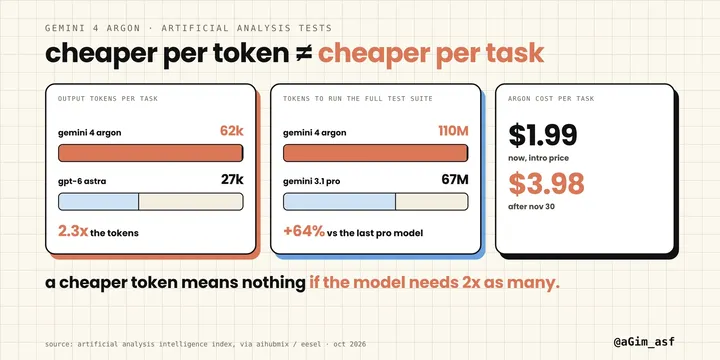
A lower cost per million tokens does not guarantee a cheaper run across full workflows. In a standardized 43-question data analytics benchmark conducted by Plotly, Argon answered 41 of 43 questions correctly, matching the 41 of 43 scored by Opus 5.5, while trailing GPT-6.1 Sol at 43 of 43. Argon consumed roughly 510,000 tokens per question compared to 183,000 for Sol and 215,000 for Opus 5.5, bringing Argon's total run expense to $13.47, virtually identical to Opus 5.5 ($13.31) and well above Sol ($2.61). Relaying third-party metrics from Artificial Analysis, X user agim𓍯 (@aGim_asf) noted that Argon produced 62,000 output tokens per task compared to 27,000 for Astra. Users should measure total spending per task rather than headline token rates, especially with intro pricing set to double after November 30.
Main complaints: limits run out and confident false claims
Rate limit exhaustion and factual inaccuracies in codebase comprehension constitute the bulk of user dissatisfaction.
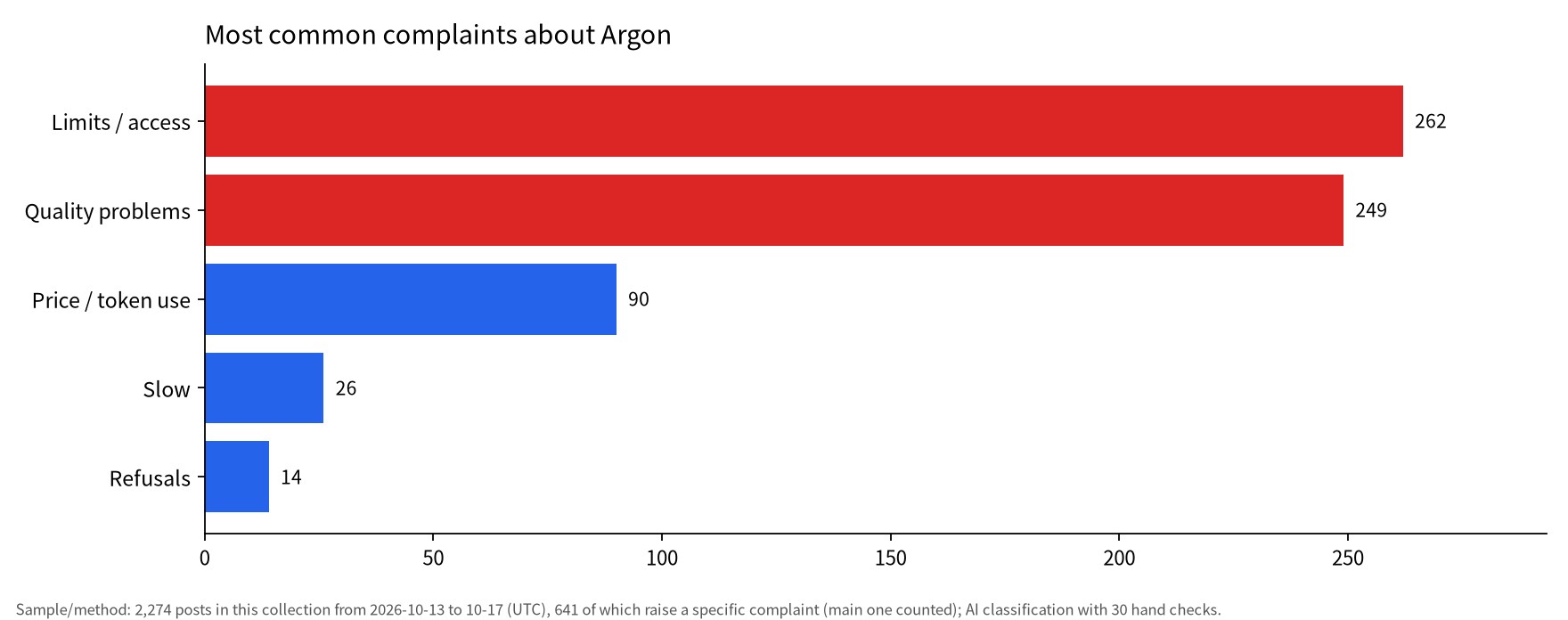
Sample/method: 2,274 posts in this collection, 2026-10-13 to 10-17 (UTC); 641 raise a specific complaint (main one counted); AI classification with 30 hand checks.
Of the 2,274 post-launch entries, 641 registered an explicit complaint. Quota ceilings and platform access restrictions accounted for 262 complaints, output quality issues made up 249, overall price or token volume drove 90, execution delays totaled 26, and model refusals made up 14.
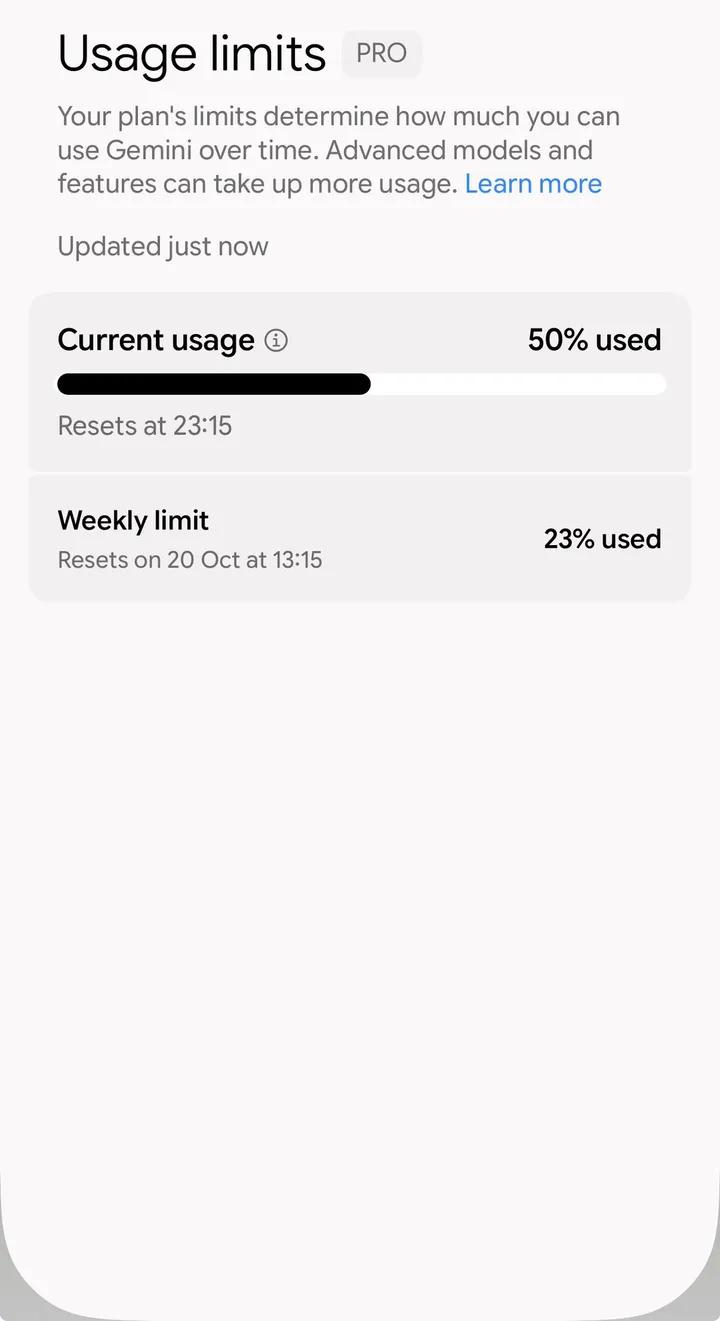
User frustration clustered heavily around rapid quota consumption under consumer plans. Noah Moss (@leafland5090) reported that submitting just two questions consumed 50 percent of his active allotment on a paid Pro subscription. Arun (@hiarun02) questioned why a $20-per-month Google AI Pro subscription did not permit Argon usage inside Antigravity, while Kai (@hqmank) reported that Antigravity access for Pro subscribers relies on a standalone weekly quota without a 5-hour refresh window.
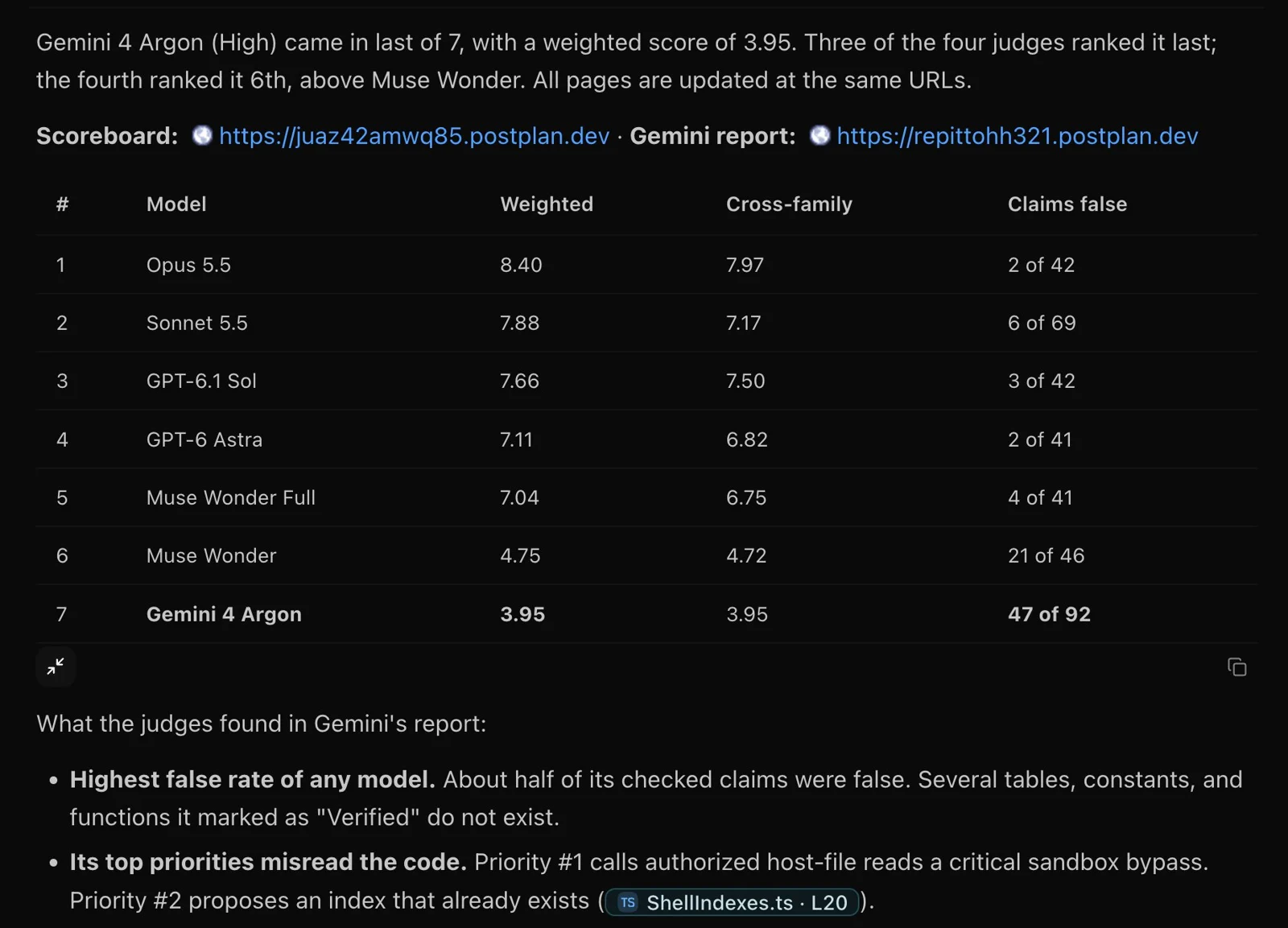
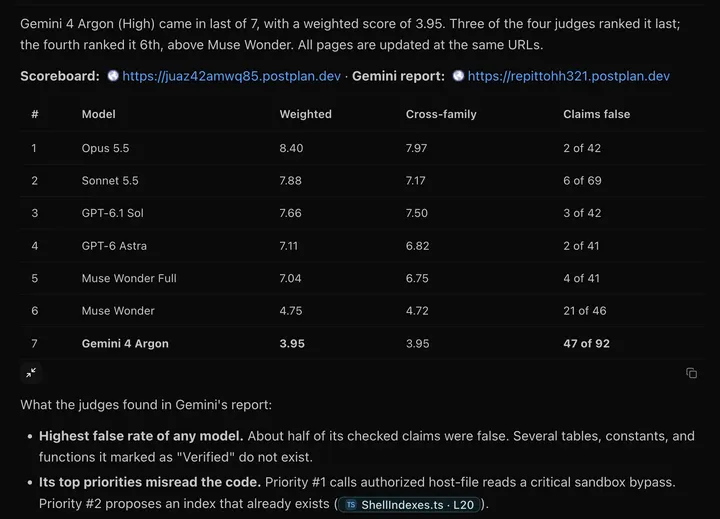
Theo - t3.gg (@theo) evaluated Gemini 4 Argon on his codebase analysis benchmark on October 13, 2026, placing it last among seven models after it generated false statements on 47 out of 92 evaluated claims. (Item: Argon is the only model above 50% false claims on Theo's codebase analysis bench)
Following that benchmark run, Theo said that despite some good parts, generally speaking the model should be avoided. These practical findings correspond with Google DeepMind's own model card documentation, which explicitly lists hallucination along with periodic latency and timeouts as recognized operational limitations.
Is it worth using? Pick by task
Gemini 4 Argon functions best as a specialized engine for visual software, interactive prototypes, and cost-sensitive secondary runs rather than an outright replacement for top-tier reasoning models.
Based on the aggregated evidence, the model is an excellent candidate for developers building 3D graphics, WebGL canvases, browser games, and visual animations via direct code generation. Its benchmark performance also indicates strong capabilities for long-document context processing, video parsing, and research workflows. For high-volume development environments where the quality of Claude Opus 5.5 is not strictly required, Argon provides a significantly cheaper and faster alternative.
Users should exercise caution when deploying Argon on automated codebase audits, critical code reviews, or architectural inspections where incorrect assertions create technical debt. Agentic workflows that issue repeated, open-ended tool queries also demand scrutiny, as Argon's high token use can quickly inflate per-task costs. For subscribers relying on fixed monthly consumer tiers, rapid quota depletion remains an active barrier. Teams currently paying for Claude Opus 5.5 for high-difficulty engineering should treat Argon as an affordable secondary option to test on matched tasks rather than an immediate primary substitute.
Questions and answers
Can paid Google AI Pro subscribers use Argon in Antigravity?
At launch, Google's documentation restricted Antigravity access for Argon exclusively to Google AI Ultra subscribers, while Pro tier users were limited to the Gemini application and Search AI Mode. On October 16, accounts on X reported that access was extending to paid Google AI Pro accounts under a dedicated weekly quota, excluding trial and Plus accounts. This change has not been verified on an official Google product page, so individual account holders should verify current access inside their own interface.
Why does Argon use up limits so fast?
Quota limits and access gating represent the most frequent grievance among users, totaling 262 posts in the collected data. One likely factor is the model's high token generation and reading volume per task, with Plotly recording roughly 510,000 tokens read per question compared to 183,000 on GPT-6.1 Sol, alongside separate user-relayed benchmark metrics citing 62,000 output tokens per run. Google has not publicly shared the underlying formulas used to balance token usage against subscription quota meters.
Is Argon better than Claude Opus 5.5?
Google's published benchmark tables show Argon leading Claude Opus 5.5 on the Vals Index and DeepSWE v1.1, while trailing behind Opus on Terminal-bench 4.0 and FrontierSWE v2. In user-conducted same-task evaluations across 94 posts, posters judged Claude Opus 5.5 as superior 45 times compared to 21 favoring Argon, though Argon was consistently reported as the faster and less expensive model to execute.
Is there a free way to use Argon?
Official access paths require either a paid subscription to Google AI Pro or Ultra for web interfaces or pay-as-you-go billing through the Gemini API. While numerous social media promotions highlight a one-month Google AI Pro trial as a workaround to access Argon at no cost, one user report says Pro trials are excluded from developer environments like Antigravity. Users should approach third-party promotional claims regarding free access with skepticism.
Sources
Selected examples
“Four Gemini 4 Argon agents beat Minecraft from scratch in 27 hou…”