Can Kimi K3.1 Pro replace Opus 5.5? Same-task tests, cost per task and usage limits
Kimi K3.1 Pro cannot serve as a drop-in replacement for Claude Opus 5.5 across general software engineering and knowledge work, even though its API token rates are half those of Opus 5.5 and users' paired receipts showed Opus costing 3.0x to 14.4x more per finished task. This review evaluates official documentation from Moonshot, benchmark evaluations from Artificial Analysis and Atomic Agent checked on 24 October 2026, and 50 first-hand run reports posted by 46 independent X users between 23 and 24 October 2026.
Developers looking for a replacement should keep their workflows separated by task type.
Kimi K3.1 Pro is best suited for API-driven procedural 3D generation, Three.js scenes, and rapid visual front-end drafting where developers need multiple low-cost iterations. Teams should keep Claude Opus 5.5 for full-repository coding, multi-file bug hunting, and white-collar analytical tasks. For developers where raw cost reduction is the sole priority, DeepSeek V4.1 Flash-1017 is significantly cheaper than both models and outperformed Kimi K3.1 Pro in multiple direct code-repair evaluations.
Moonshot set standard API pricing for Kimi K3.1 Pro at $2.00 per million input tokens and $10.00 per million output tokens, exactly half of the $4.00 input and $20.00 output pricing for Opus 5.5. Both models price cached input reads at $0.20 per million tokens. The Highspeed variant doubles the base API pricing to $4.00 and $20.00, and Kimi Code says Highspeed uses about twice the quota.
Across all 7 paired receipts posted by independent testers comparing completed tasks on both models, Opus 5.5 cost between 3.0x and 14.4x more, with a median cost difference of 4.3x. In independent testing by Artificial Analysis, the synthetic benchmark task cost came to $2.11 for Kimi versus $5.98 for Opus 5.5 with Kimi writing about 55k output tokens per task against about 119k for Opus.
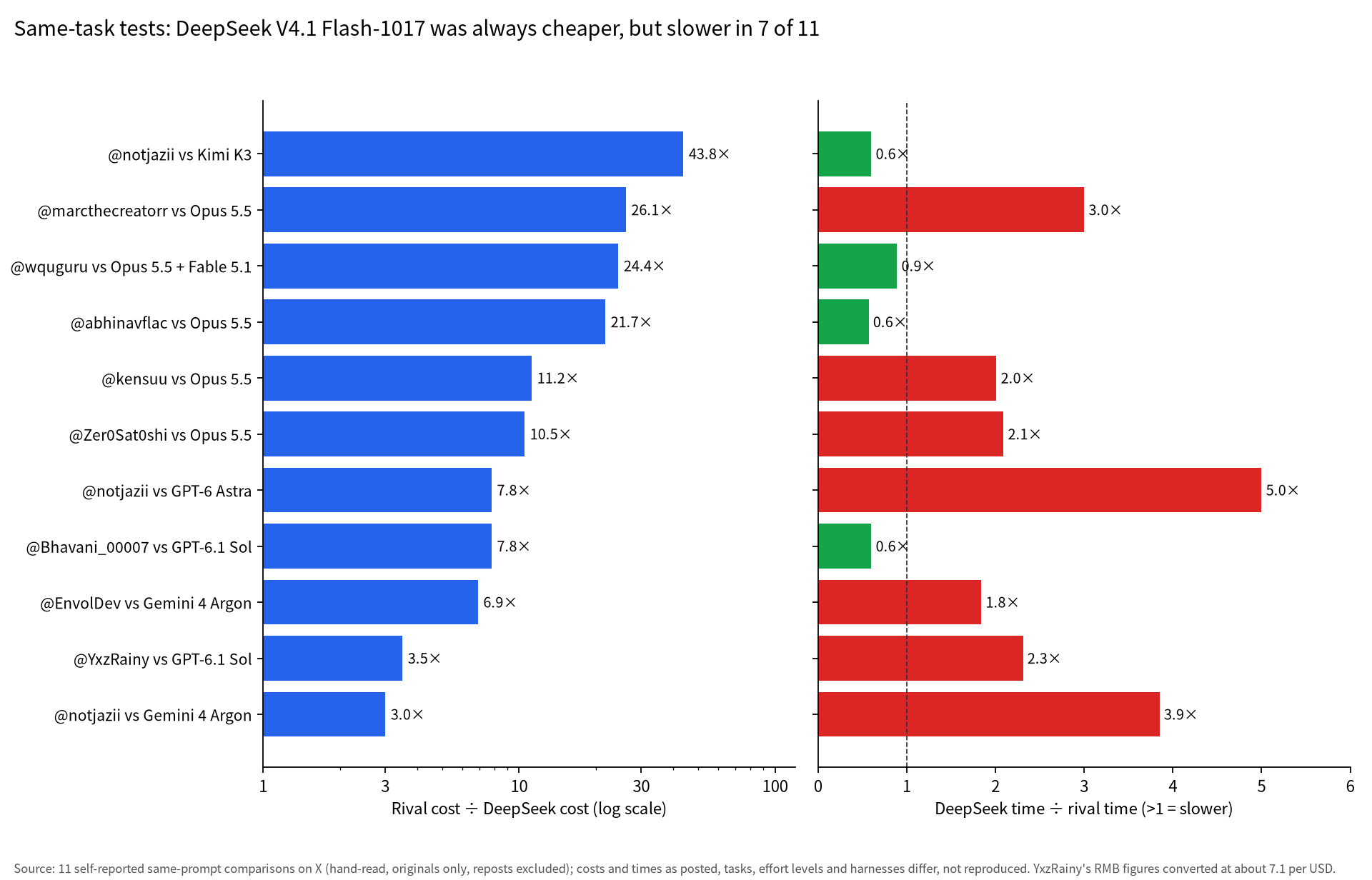
When measured against DeepSeek V4.1 Flash-1017, however, Kimi cost 7.5x to 17.4x more in the three paired receipts we found.
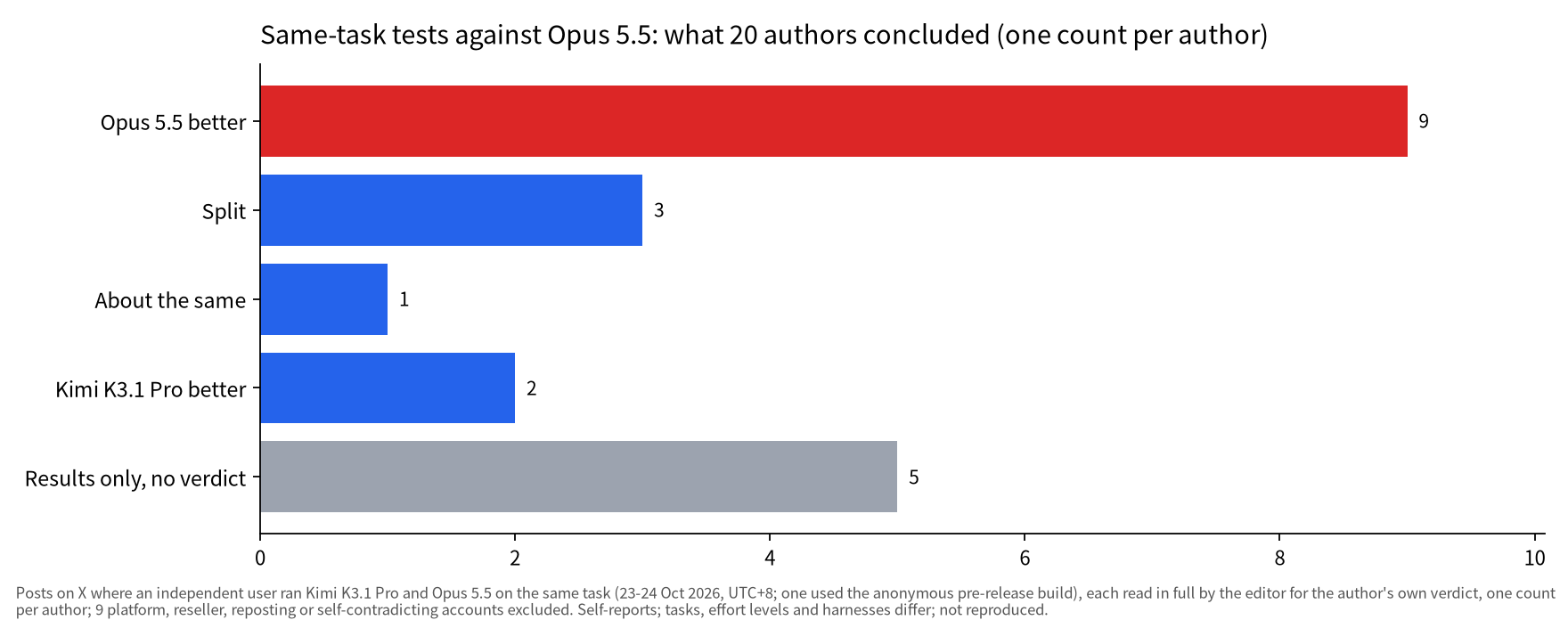
Although high-engagement social media posts highlighted visual successes for Kimi, counting one verdict per author, 9 of the 15 authors who named a winner preferred Opus 5.5, while only 2 preferred Kimi and 4 judged the results split or level.
On Moonshot's own reported Terminal-Bench 4.0 evaluation, Kimi K3.1 Pro trailed Opus 5.5 by 0.7 percentage points, while Artificial Analysis recorded an overall intelligence index score of 55 for Kimi against 58 for Opus 5.5.
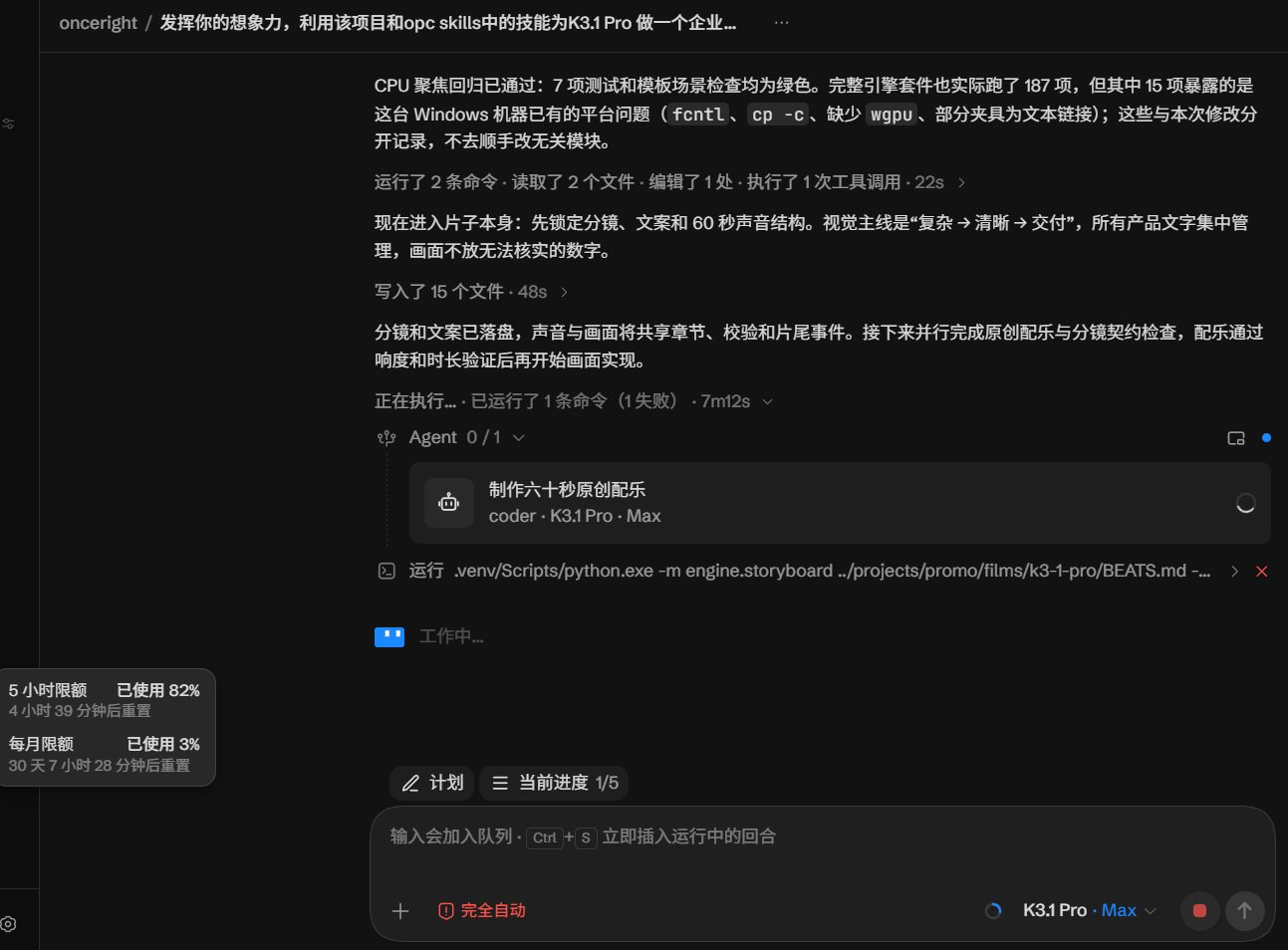
On subscriptions, 7 first-hand authors complained about quota or price. Kimi Code runs K3.1 Pro with thinking always on and max effort by default, and one tester said a single run used up his five-hour window in 20 minutes.
Moonshot announced Kimi K3.1 Pro on 23 October 2026, followed by a formal launch thread on X at 01:15 UTC+8 on 24 October. The underlying model weights are scheduled for public release by 4 November 2026.
More same-task tests are in the Opus 5.5 collection, the GPT-6 Astra collection and the DeepSeek V4.1 Flash collection; see also our DeepSeek V4.1 Flash review and Opus, Sonnet and Haiku 5.5 compared.
What Kimi K3.1 Pro is: price, specs and official scores
Kimi K3.1 Pro is a 2.8-trillion-parameter mixture-of-experts model with 104 billion active parameters per token, positioned by Moonshot against Claude Opus 5.5 and GPT-6 Astra at half of Anthropic's API token rates.
Official technical documentation confirms that K3.1 Pro is the first entry in the K3.1 series, post-trained from the earlier K3 base model. The model supports a 1-million-token context window and handles text, image, and video inputs.
Alongside the base model, Moonshot deployed a K3.1 Pro Highspeed variant designed to operate two to three times faster at twice the base unit rate. Access has been opened across the consumer Kimi web and mobile applications, Kimi Work desktop version 3.1.0 or higher, the Kimi Code environment, the official Moonshot developer API, and OpenRouter.
Moonshot committed to releasing open weights for the 2.8-trillion-parameter architecture by 4 November 2026.
Table: Official API prices and specs (checked 24 October 2026)
| Item | Kimi K3.1 Pro | Kimi K3.1 Pro Highspeed | Claude Opus 5.5 |
|---|---|---|---|
| Input (per 1M tokens) | $2.00 | $4.00 | $4.00 |
| Output (per 1M tokens) | $10.00 | $20.00 | $20.00 |
| Cached input | $0.20 | $0.20 | $0.20 (0.05x base input) |
| Cache write | $2.00 (5-minute tier) | $4.00 | billed separately |
| Speed | standard; about 77 tokens/s per Artificial Analysis | 2-3x standard, per Moonshot | about 96 tokens/s per Artificial Analysis |
| Context | 1M | 1M | 1M |
| Reasoning | always on; low / high / max, default max | same | adaptive thinking, default medium |
| Weights | due by 4 November per Moonshot; not out as of 24 Oct | same | closed |
Sample/method: Sources: Kimi API platform and K3.1 Pro quickstart, Kimi Code model configuration page, Kimi tech blog; Claude pricing page (checked by us on 18 Oct); speeds from Artificial Analysis. Unit prices only, not cost per task.
Moonshot's own numbers put Kimi K3.1 Pro close to Opus 5.5 on terminal work.
On Terminal-Bench 4.0, Moonshot reported a score of 65.7% for K3.1 Pro compared to 66.4% for Opus 5.5 tested inside Claude Code at maximum effort, and 58.2% for GPT-6 Astra. On the BenchCAD evaluation with external tool calling enabled, Moonshot reported 92.7% for Kimi versus 96.2% for Opus 5.5 and 95.9% for GPT-6 Astra.
Moonshot also reported a long-horizon coding score of 61.2 on Kimi Code Bench 3.0, up from 55.95 on K3, and an OfficeQA Pro v2 score of 64.4. On its internal Kimi Hallu Bench Hard stress test, the vendor claimed that claim-level error rates dropped from 23.4% down to 8.3%.
Independent testing provides a more nuanced picture of real-world efficiency and performance.
Artificial Analysis assigned Kimi K3.1 Pro an overall Intelligence Index of 55, placing it behind Opus 5.5 at 58 but ahead of GPT-6 Astra at 53. On Artificial Analysis's separate execution of Terminal-Bench 4.0, Kimi achieved 67%, surpassing Opus 5.5 at 60% and Astra at 59%.
However, Artificial Analysis noted that Kimi generated 150 million output tokens across its full index evaluation, describing the model as very verbose compared to the benchmark median of 87 million tokens, while clocking an output generation speed of 77.1 tokens per second against 96 tokens per second for Opus 5.5.
Table: Official and third-party tests with numbers for all three models
| Test (who ran it) | Kimi K3.1 Pro | Claude Opus 5.5 | GPT-6 Astra |
|---|---|---|---|
| Terminal-Bench 4.0 (Moonshot, self-reported) | 65.7% | 66.4% | 58.2% |
| BenchCAD with tools (Moonshot, self-reported) | 92.7% | 96.2% | 95.9% |
| Artificial Analysis Intelligence Index | 55 | 58 | 53 |
| Artificial Analysis cost per index task | $2.11 | $5.98 | $3.26 |
| Artificial Analysis output tokens per task | about 55k | about 119k | about 27k |
| Bug Hunt Bench, 105 planted bugs (PawelHuryn, max effort) | 36 | 41.7 | 45 |
Sample/method: Moonshot rows from the Kimi K3.1 Pro tech blog (Opus 5.5 run in Claude Code at max effort); Artificial Analysis rows from its model and comparison pages, opened 24 Oct 2026 (Opus and Astra at Max); Bug Hunt from the leaderboard PawelHuryn posted on 23 Oct, max effort, averaged over runs. Different setups; do not combine.
Same task against Opus 5.5: most testers still picked Opus
While viral posts on social media celebrated individual visual breakthroughs for Kimi K3.1 Pro, a complete manual review of independent testers comparing identical prompts shows that 9 out of 15 reviewers who expressed a definitive preference selected Opus 5.5.
Sample/method: Posts on X where an independent user ran Kimi K3.1 Pro and Opus 5.5 on the same task (23-24 Oct 2026, UTC+8; one used the anonymous pre-release build), each read in full by the editor for the author's own verdict, one count per author; 9 platform, reseller, reposting or self-contradicting accounts excluded. Self-reports; tasks, effort levels and harnesses differ; not reproduced.
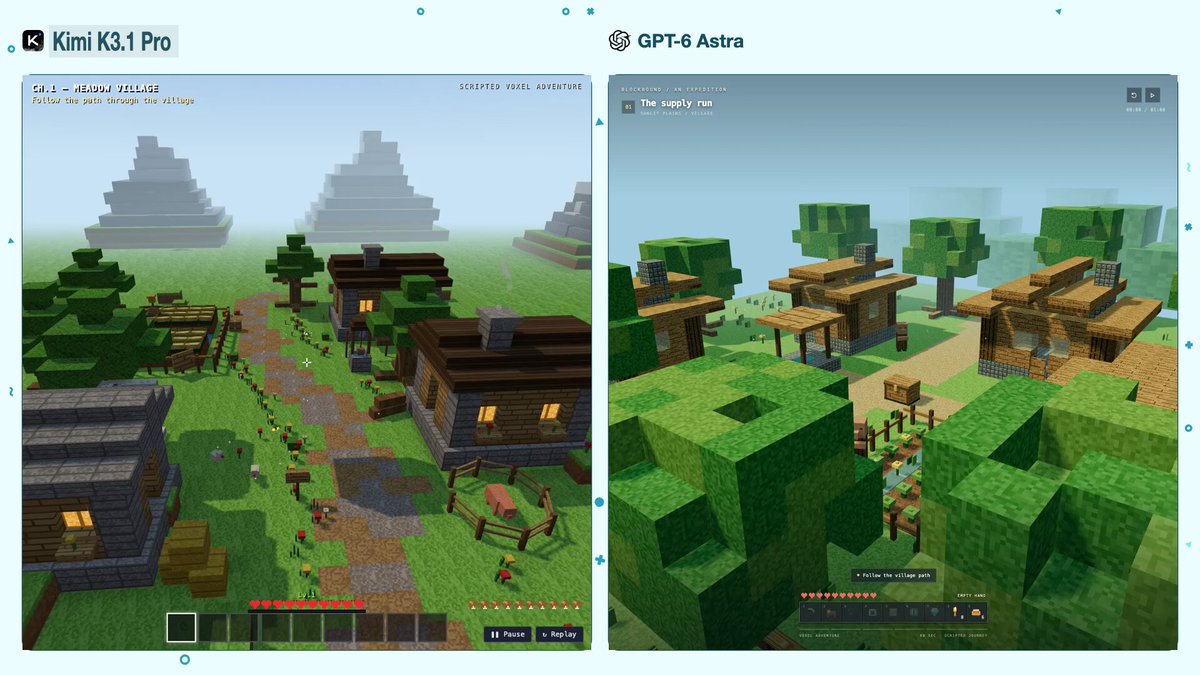
The clearest qualitative victories for Kimi occurred in self-contained procedural graphics prompts.
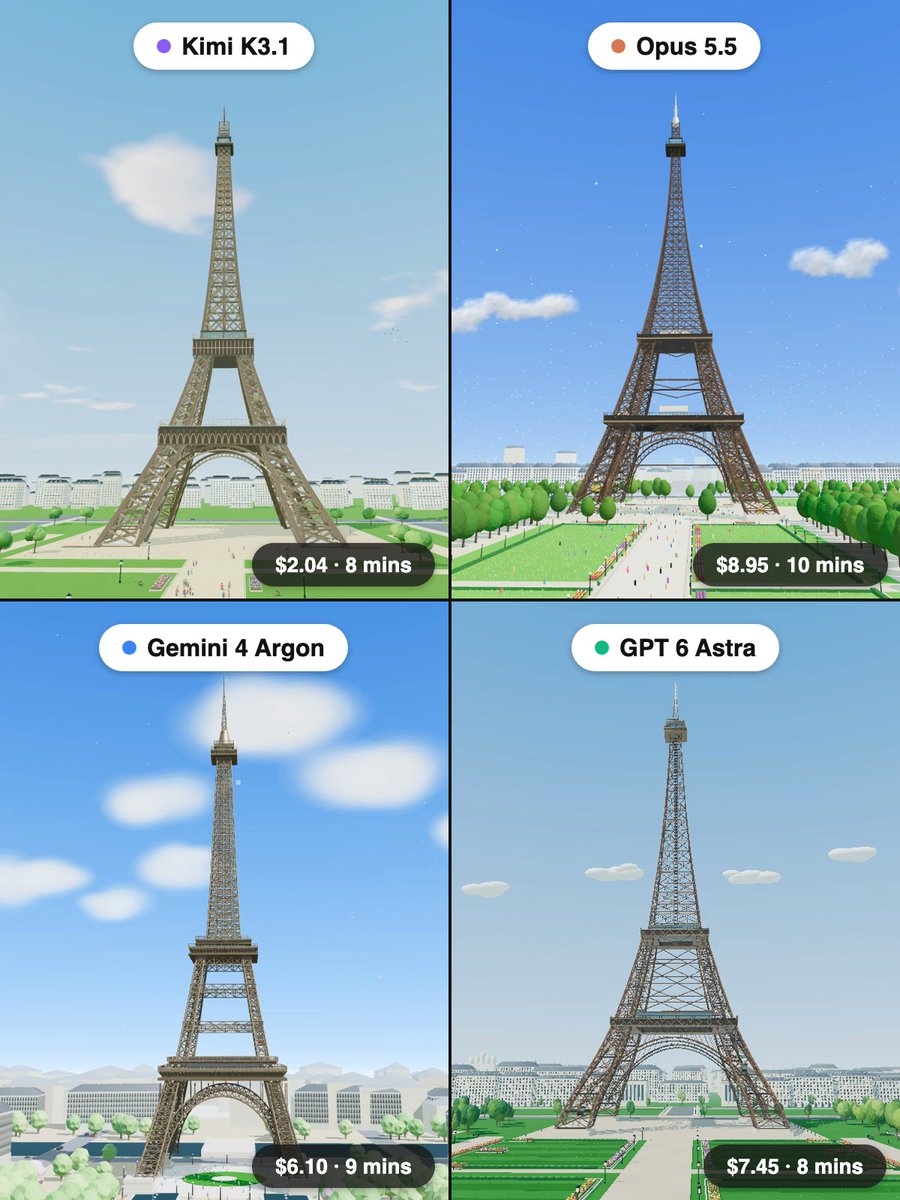
X user Bhavy☄️ (@Bhavani_00007) generated a rocket launch scene and said Kimi "mogged Opus 5.5 in output quality, cost, and speed" in a post with 1,027 likes. The same user subsequently tested an Eiffel Tower reconstruction, stating that Kimi's structure looked the most accurate of the four models he tried.
X user ivanainai (@ivanainai) reported that Kimi outperformed Opus 5.5 on an interactive 3D stained-glass butterfly, noting superior glass rendering, lighting, and fine gold details.
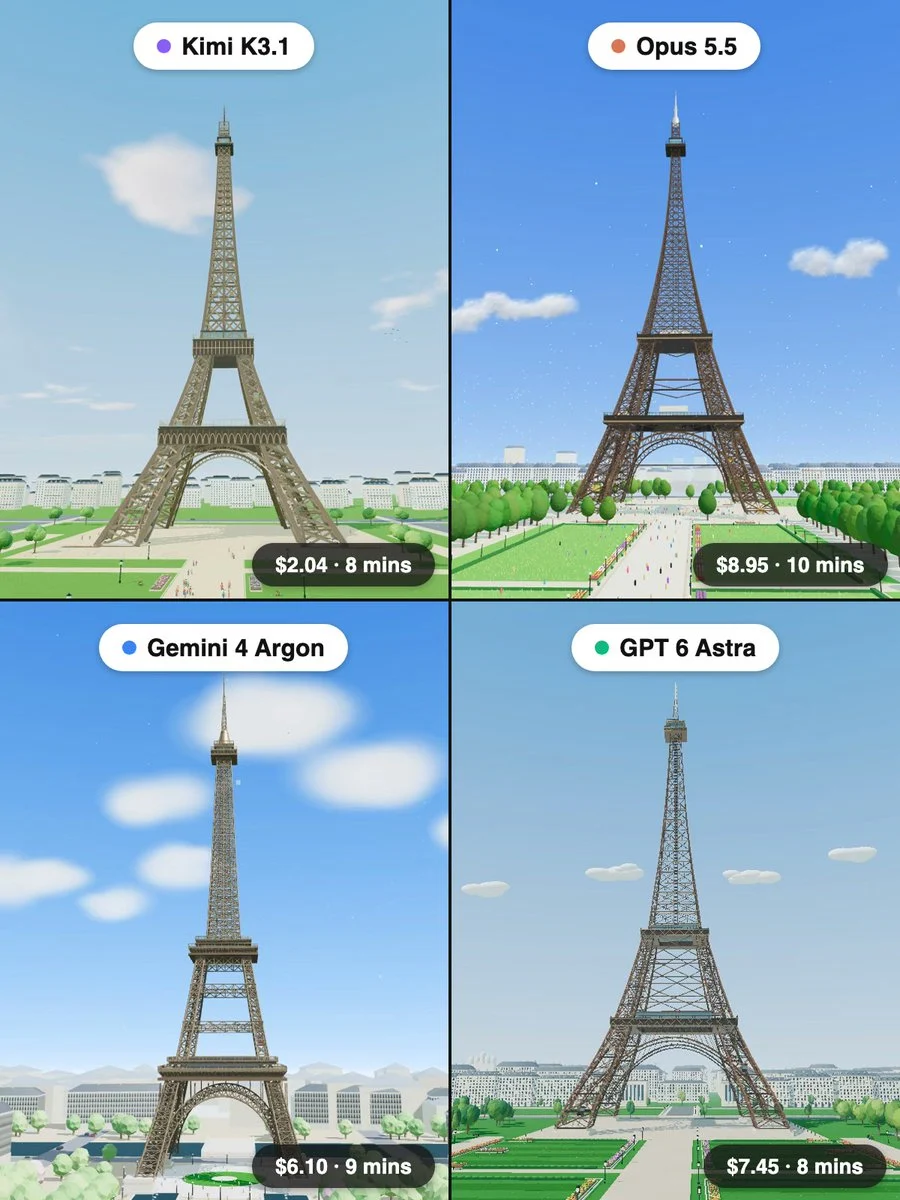
X user Bhavy☄️ (@Bhavani_00007) tested an Eiffel Tower prompt on 24 October 2026, posting video frames showing Kimi K3.1 completing the scene in 8 minutes for $2.04 versus $8.95 and 10 minutes for Opus 5.5, $6.10 for Gemini 4 Argon, and $7.45 for GPT-6 Astra. The post demonstrates substantial cost savings on this procedural task but represents a single user-selected render. (Item: Eiffel Tower build-off: Kimi K3.1 vs Opus 5.5 vs Gemini 4 Argon vs GPT-6 Astra)
Four developers rated the models as evenly matched or found that each excelled in different aspects of the same scene.
X user aditya (@adxtyahq) tested an animated voxel pagoda island, describing the resulting assets as comparable while Kimi finished twice as fast at one-third the API expense. X user pipeline_os (@pipeline_os) tested a bird riding a bike on a fighter jet: Kimi made the most detailed jet, missiles and all, while Opus 5.5 got the bike and the exhaust flames best.
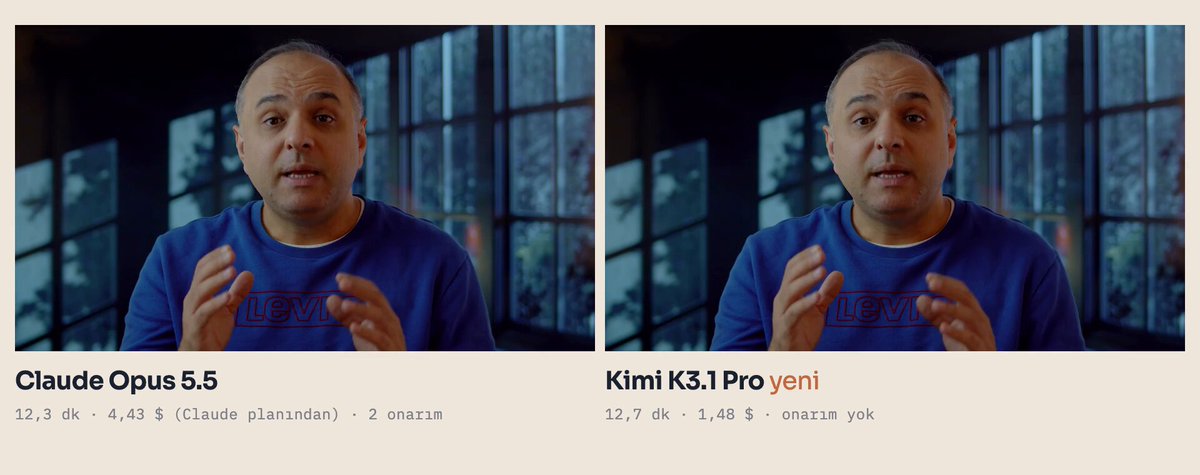
X user Erhan Meydan (@erhanmeydan) noted that Opus 5.5 created a slightly richer 3D environment in Kilnframe, but highlighted that Kimi succeeded on its first try without repair rounds at one-third the price. X user ChrisGPT (@ChrisGPT) generated a promotional video trailer for Claude Code, observing that while Kimi produced slightly superior visuals, Opus 5.5 remained the more dependable system for broader white-collar and general engineering work.
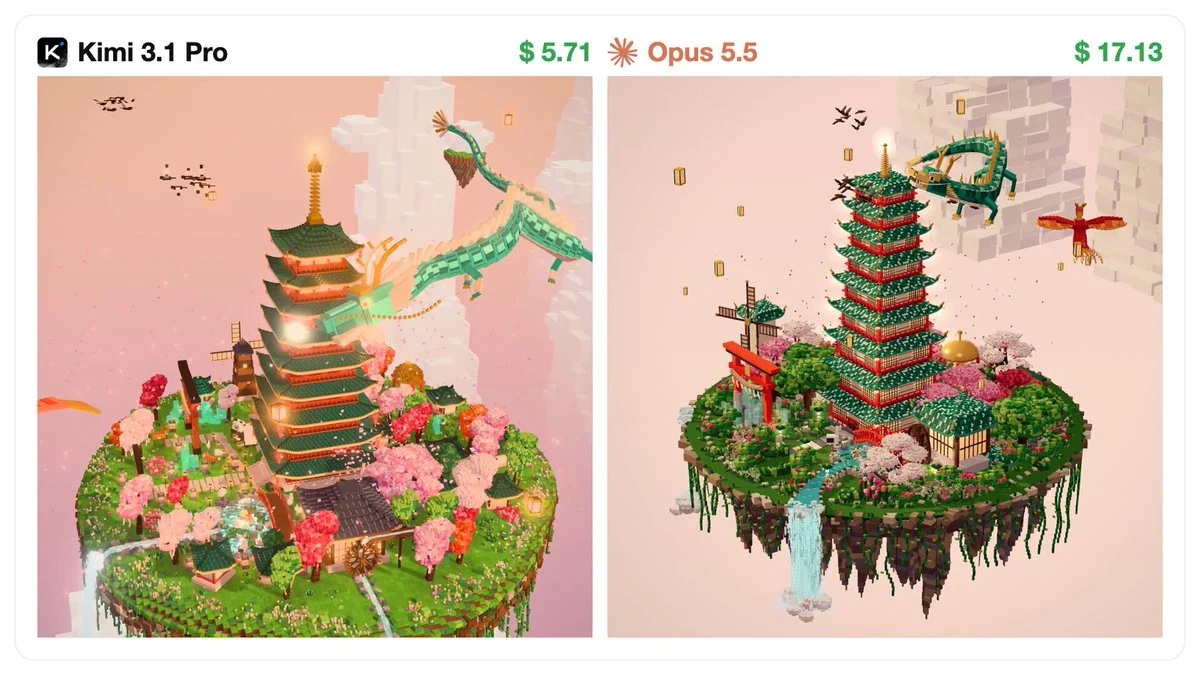
X user aditya (@adxtyahq) shared side-by-side video footage on 24 October 2026 of an animated voxel pagoda island where Kimi K3.1 Pro cost $5.71 across 15 minutes compared to $17.13 across 32 minutes on Opus 5.5. The poster called the two results comparable; one prompt, not reproduced. (Item: Kimi K3.1 Pro vs Opus 5.5: animated voxel pagoda island)
Opus 5.5 maintained an edge across multiple visual assessments and complex interactive layouts.
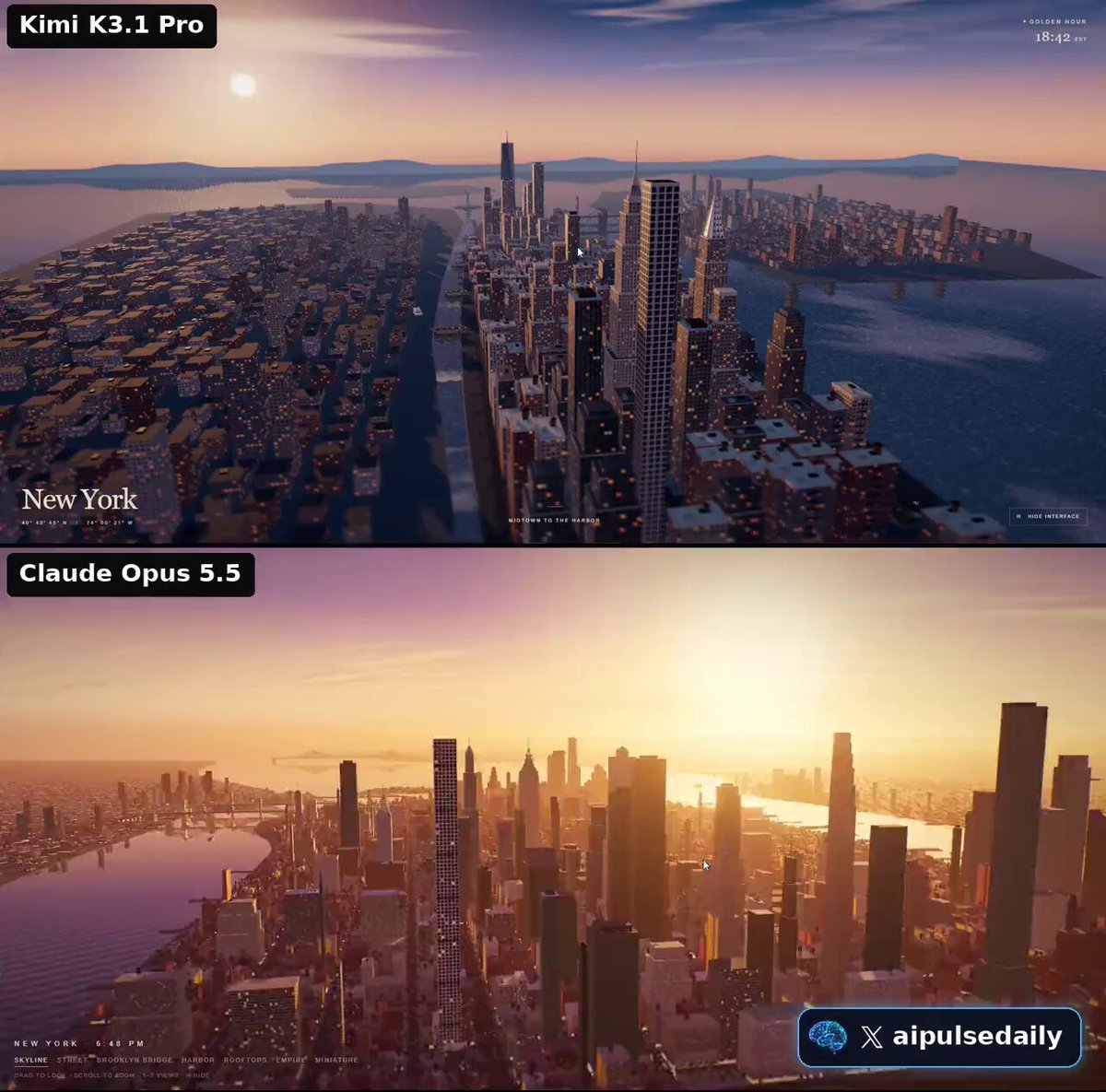
X user sakatayasha (@sakatayasha) ran the same real-time Three.js prompt of a castle above the clouds; Opus 5.5 finished in 35 minutes against 44 for Kimi, and he judged Opus faster with the better UI. X user aipulsedaily (@aipulseda1ly) tested an aerial flythrough of New York City during golden hour and noted that Kimi's rendition lacked the depth and maximum effort displayed by Opus and Sonnet models.
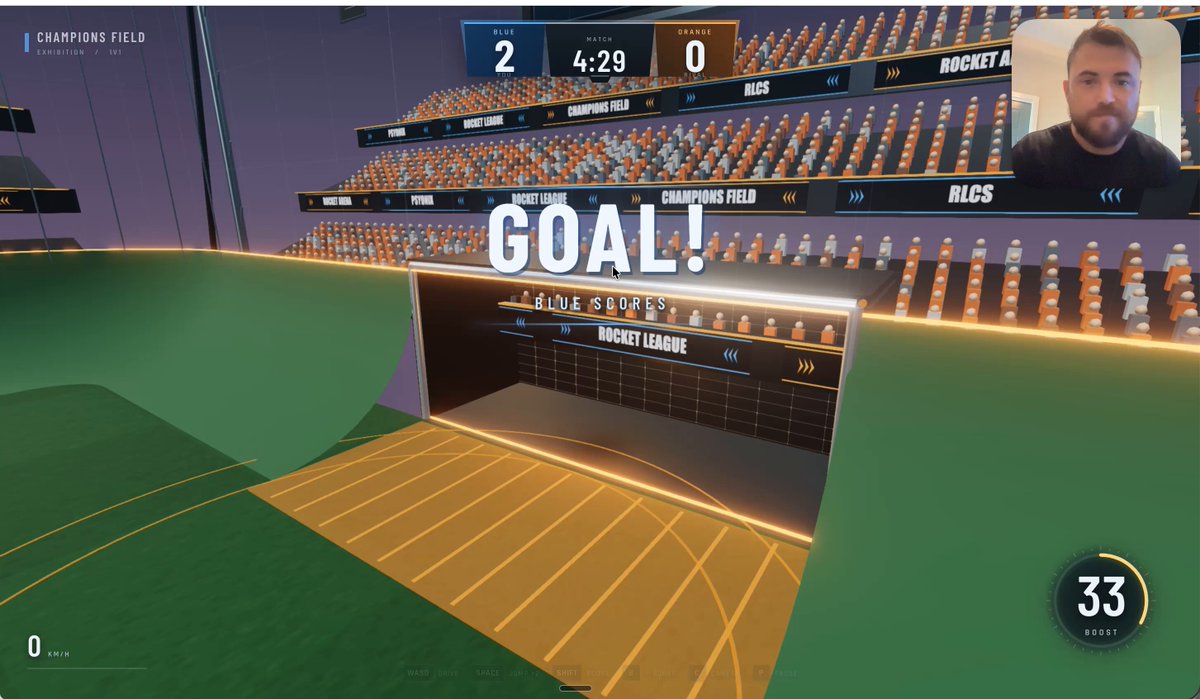
X user am.will (@LLMJunky) called Kimi the best open model he had tested on Rocket League Bench, but "a full generation behind the frontier on 3D modeling", at least on that one test.
Developer Dev Ed (@developedbyed) reported difficulties in getting Kimi to adhere strictly to instructions during procedural pixel art generation, while Sad AlbertX (@SadAlbert10), Ivan Fioravanti (@ivanfioravanti), and Olezhka (@olezhavich) also favored Opus 5.5 in direct comparisons.
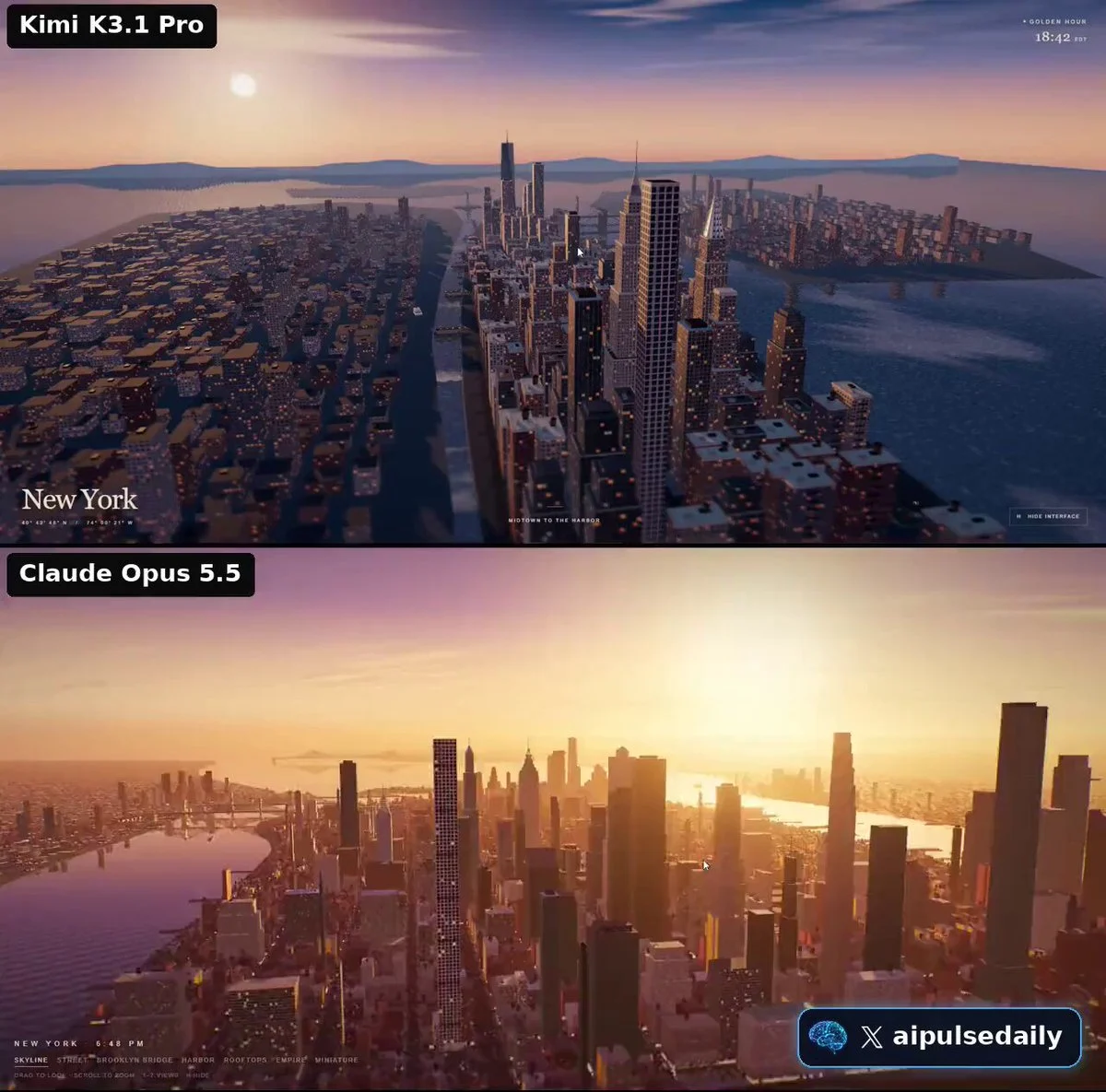
X user aipulsedaily (@aipulseda1ly) posted comparison captures on 24 October 2026 of a golden hour New York City flythrough, contrasting Kimi K3.1 Pro on top against Claude Opus 5.5 below. The poster said Kimi's version was "not as in depth and effort maxxing" as Opus's; one prompt, not reproduced. (Item: Kimi K3.1 Pro vs Opus 5.5: NYC golden-hour flythrough)
Against GPT-6 Astra, Kimi achieved stronger head-to-head outcomes.
X user AI_Screening (@AI_Screening) reported that Kimi cooked Astra on a single-file Three.js test. X user Aman (@Amank1412) and X user starmex (@starmexxx) reported comparable results at 2.6x and 5.8x lower cost than Astra.
Conversely, X user Max For AI (@MaxForAI) found Astra visibly superior on a 3D White House web reconstruction.
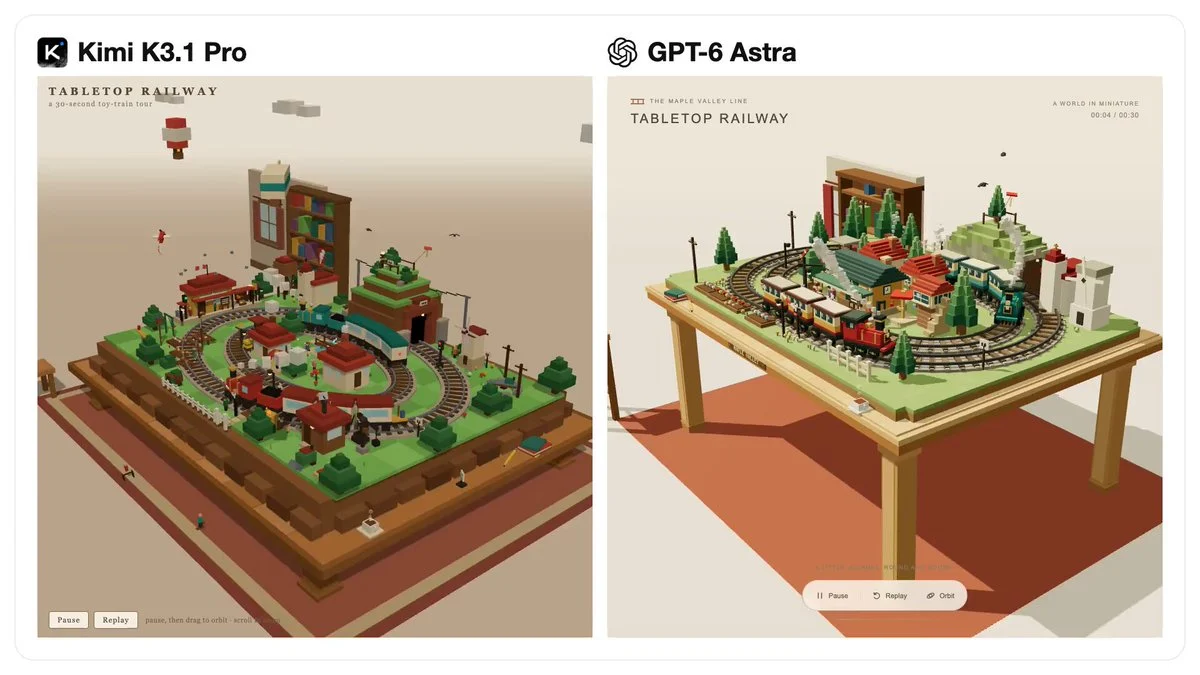
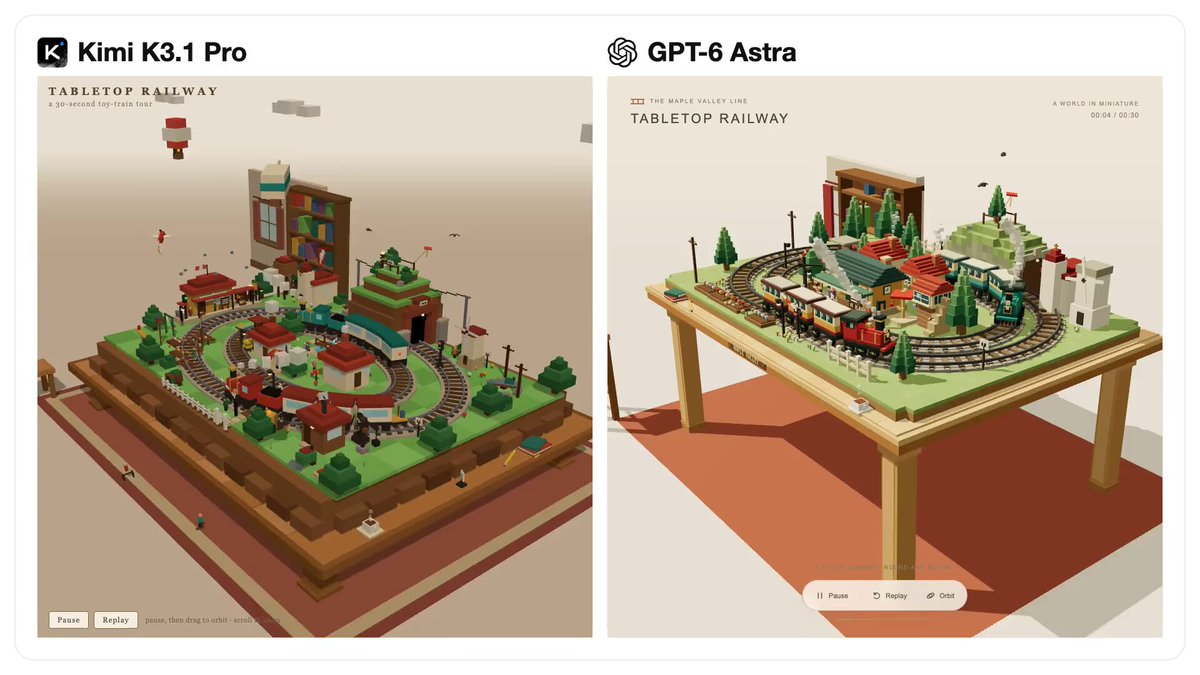
X user Aman (@Amank1412) evaluated a tabletop animated railway on 24 October 2026, posting video frames showing Kimi K3.1 Pro completing the environment in 18 minutes for $6.20 against GPT-6 Astra requiring 29 minutes and $16.40. The poster called the results comparable; Astra's bill was about 2.6x Kimi's. (Item: Kimi K3.1 Pro vs GPT-6 Astra: animated 3D railway cost and time)
Readers should interpret these viral head-to-head posts cautiously. Several accounts posted near-identical Kimi-cost-versus-Opus-cost formats, and every number here is a self-reported first run that we did not reproduce.
How much cheaper per task: bigger gap than the price list
On raw token unit rates, Kimi K3.1 Pro is 50% cheaper than Opus 5.5, but on finished tasks Opus's bill was 3.0x to 14.4x Kimi's in users' receipts. Part of the reason is that Kimi wrote fewer output tokens per task than Opus in third-party measurements.
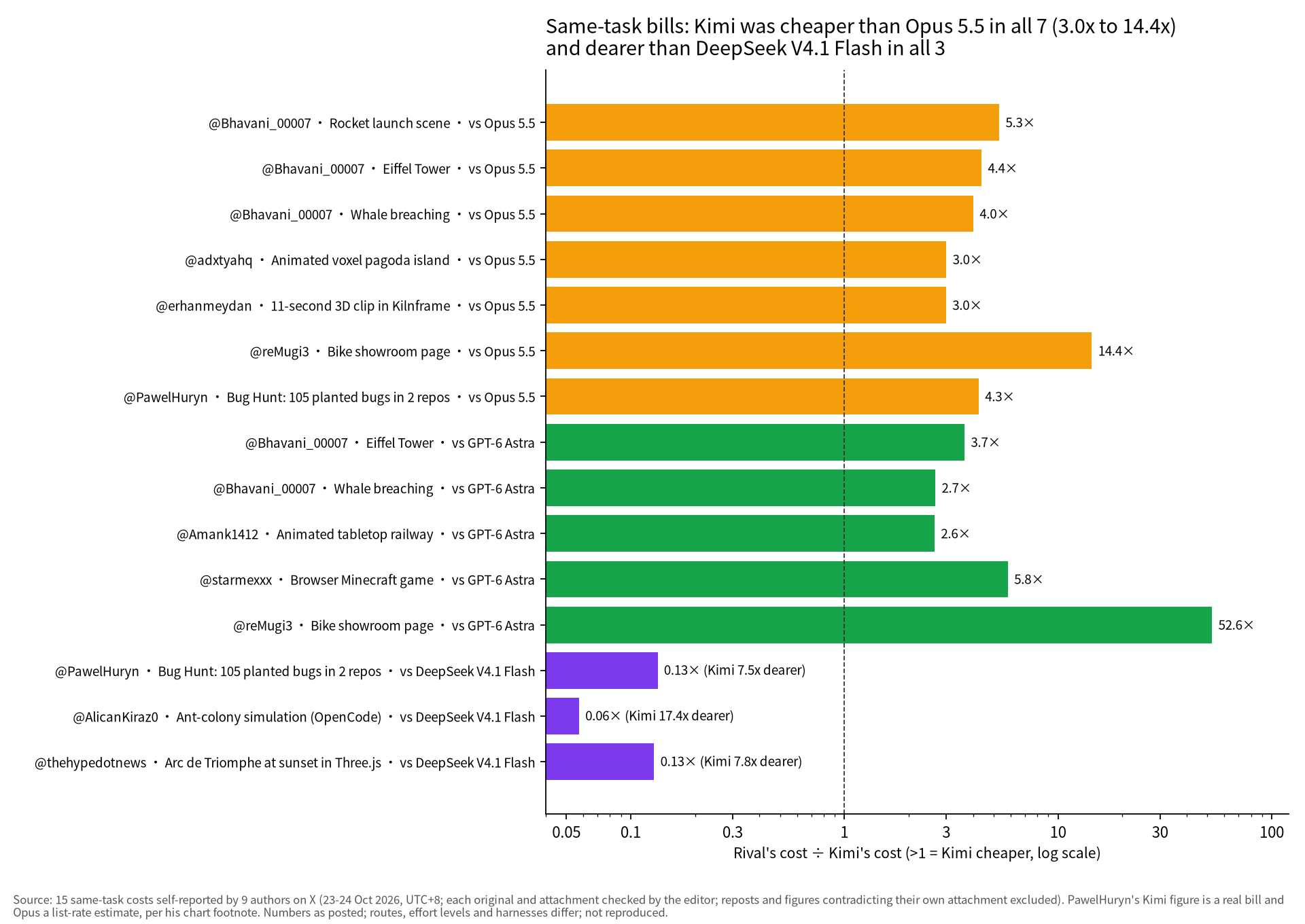
Sample/method: 15 same-task costs self-reported by 9 authors on X, each checked against the post and its attachment; self-reported, not reproduced.
In all 7 paired receipts collected from independent users comparing Kimi directly against Opus 5.5, Kimi's bill was lower. At the median, Opus cost 4.3x as much.
Table: Same-task bills against Opus 5.5 (as posted)
| Tester | Task | Cost, Kimi / Opus | Time, Kimi / Opus | Poster's take |
|---|---|---|---|---|
| @Bhavani_00007 | Rocket launch scene | $1.95 / $10.35 | 6 / 24 min | Kimi better |
| @Bhavani_00007 | Eiffel Tower | $2.04 / $8.95 | 8 / 10 min | Kimi better |
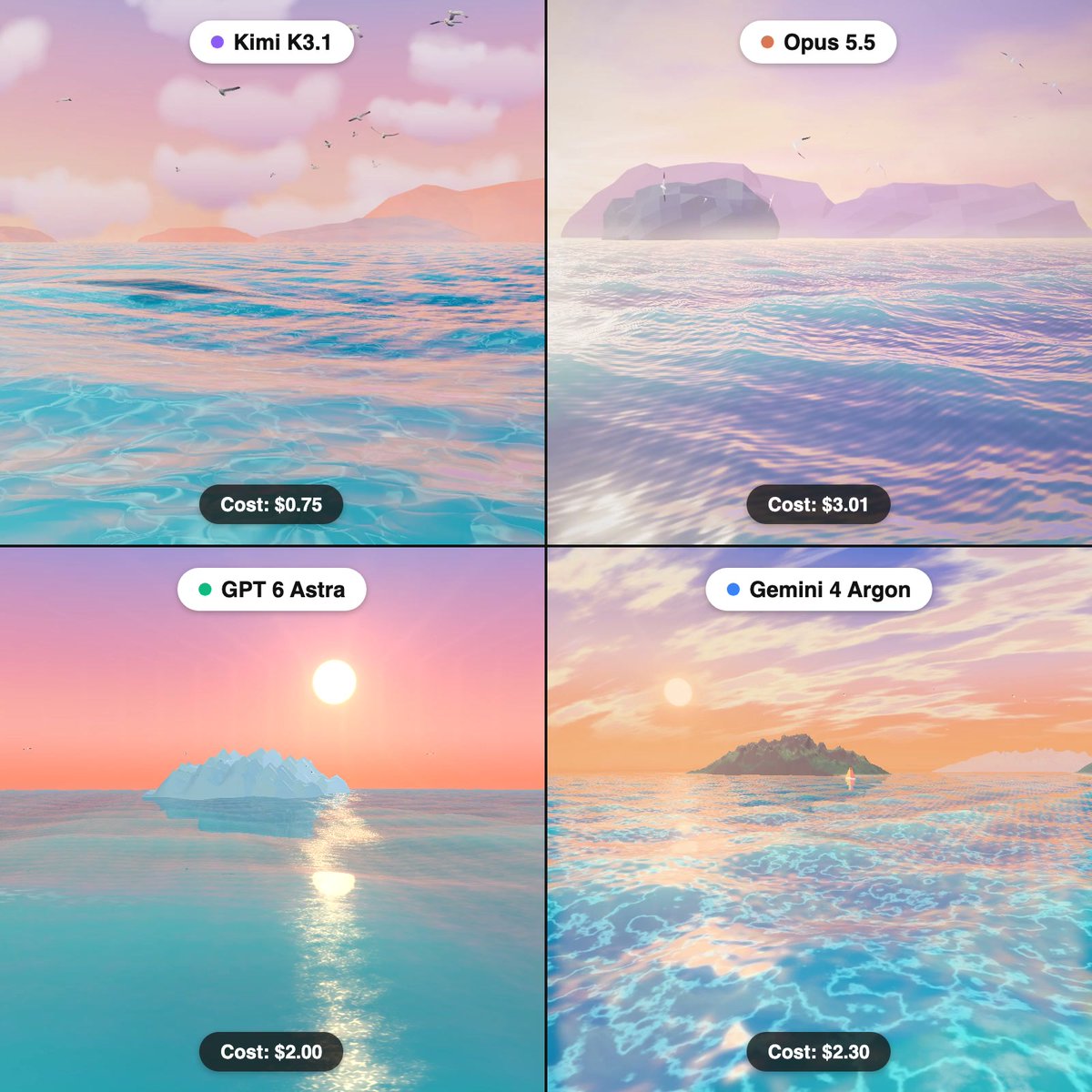
| @Bhavani_00007 | Whale breaching | $0.75 / $3.01 | not given | comparable quality |
| @adxtyahq | Animated voxel pagoda island | $5.71 / $17.13 | 15 / 32 min | comparable |
| @erhanmeydan | 11-second 3D clip in Kilnframe | $1.48 / $4.43 | 12.7 / 12.3 min | Opus slightly richer; Kimi first try, Opus needed 2 repair rounds |
| @reMugi3 | Bike showroom page | $0.05 / $0.72 | not given | no verdict |
| @PawelHuryn | Bug Hunt: 105 planted bugs in 2 repos | $13.76 / $58.53 | 64.8 / 66.9 min | Opus fixed more (41.7 vs 36) |
Sample/method: Each post and attachment read by the editor; in PawelHuryn's row Kimi is a real bill, Opus a list-rate estimate and times are averages; the rest are single runs as posted. Not reproduced.
Part of the gap is output length. Artificial Analysis measured about 55k output tokens per index task for Kimi against about 119k for Opus 5.5, so a task cost $2.11 against $5.98. GPT-6 Astra wrote even less, about 27k tokens, and came to $3.26 per task.
Atomic Agent's small coding test is the counterexample.
On a small Python package with 5 planted bugs, 2 features and 32 hidden tests, Kimi passed every test but cost between $0.35 and $0.46 per task when running at its default maximum effort, requiring 4.9 minutes to complete. Under the same harness, Opus 5.5 averaged $0.37 per task and finished in 69 seconds. Reducing Kimi's reasoning effort setting down to low lowered its task cost to between $0.16 and $0.21, but execution time remained slower at 2.2 minutes.
Atomic Agent concluded that Kimi's lower base token pricing only translates into actual operational savings if developers actively dial down the reasoning effort parameter.
Against DeepSeek V4.1 Flash-1017, Kimi was consistently the more expensive option. In three direct paired runs, DeepSeek was 7.5x to 17.4x cheaper than Kimi.
On the Bug Hunt Bench, DeepSeek cost $1.84 compared to $13.76 for Kimi. In an ant-colony simulation test, DeepSeek cost $0.172 versus $3.001 for Kimi. Similarly, on an Arc de Triomphe generation task posted by thehype. (@thehypedotnews), DeepSeek completed the scene for $0.78 compared to $6.06 for Kimi, although the author said Kimi built the best version, with sculpted reliefs and a full city skyline.
Coding and real projects: behind Opus, and behind DeepSeek
In structured programming evaluations and multi-file debugging tasks, Kimi K3.1 Pro lagged behind both Claude Opus 5.5 and DeepSeek V4.1 Flash-1017, and Moonshot's near-parity benchmark did not show up in these users' tests.
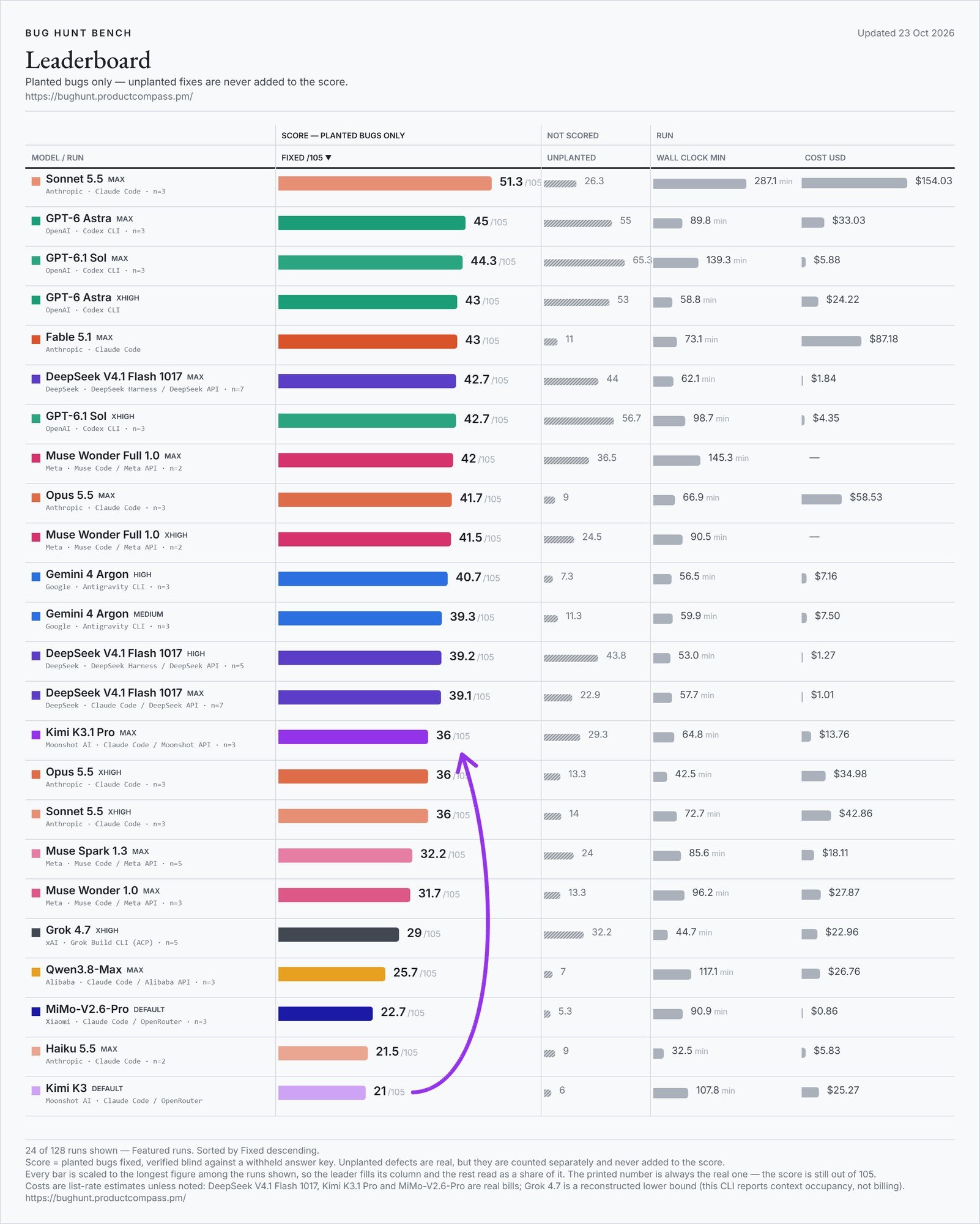
On the Bug Hunt Bench run by Paweł Huryn (@PawelHuryn), where models find and fix 105 planted bugs across two repos at max effort, Kimi K3.1 Pro resolved 36 bugs. This represented a substantial advance over the earlier Kimi K3 model, which resolved only 21 bugs. However, K3.1 Pro finished behind Opus 5.5 at 41.7 fixes, DeepSeek V4.1 Flash-1017 at 42.7 fixes, GPT-6 Astra at 45 fixes, and Claude Sonnet 5.5 at 51.3 fixes.
Huryn wrote: "Considering the cost, I see no reason to use this model."
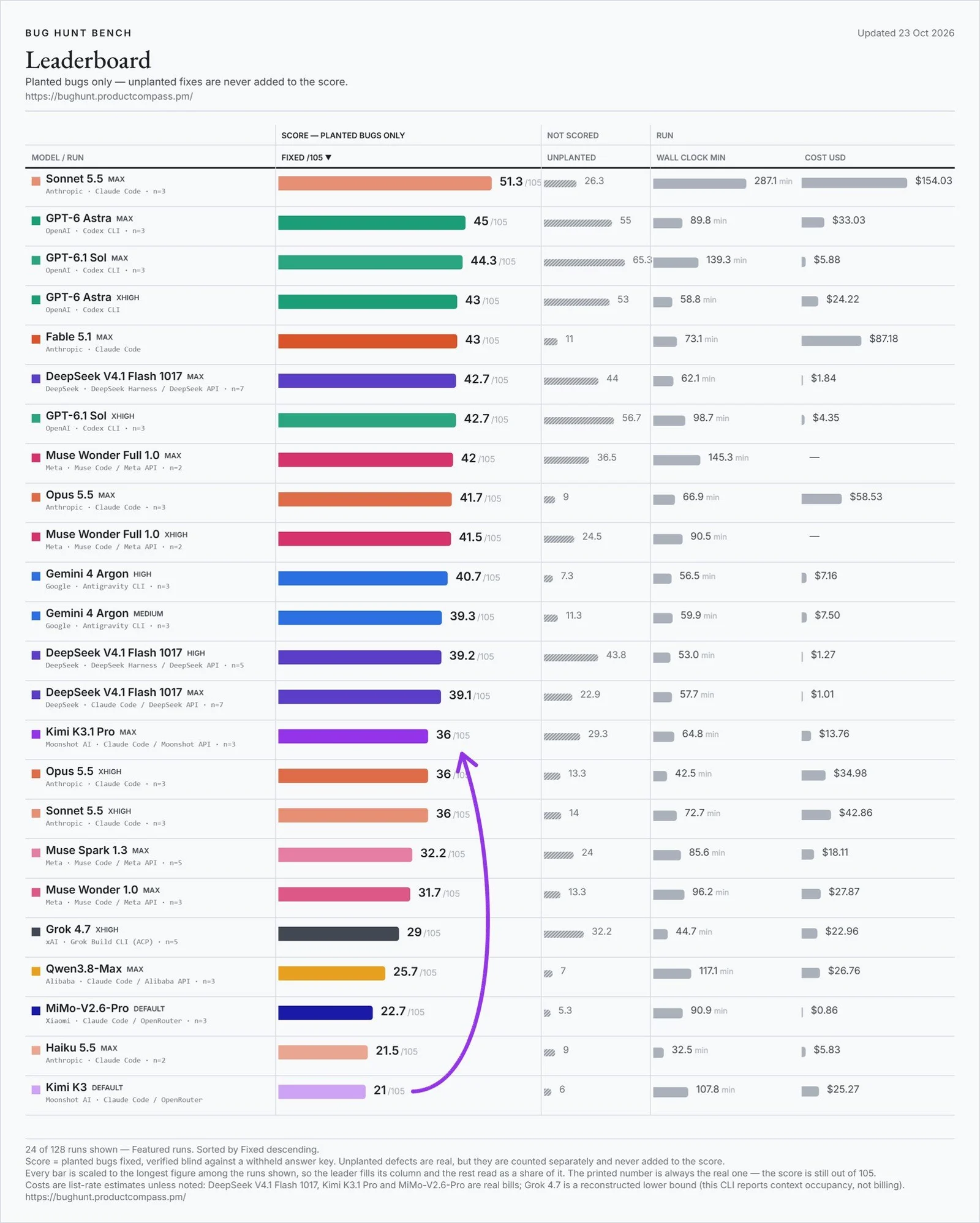
Paweł Huryn (@PawelHuryn) shared the updated Bug Hunt Bench leaderboard on 24 October 2026 showing Kimi K3.1 Pro resolving 36 out of 105 bugs at an average cost of $13.76 and 64.8 minutes, trailing Opus 5.5 at 41.7 bugs and DeepSeek V4.1 Flash-1017 at 42.7 bugs for $1.84. The leaderboard covers this one benchmark only. (Item: DeepSeek V4.1 Flash tops Opus 5.5 on a 105-bug repair test)
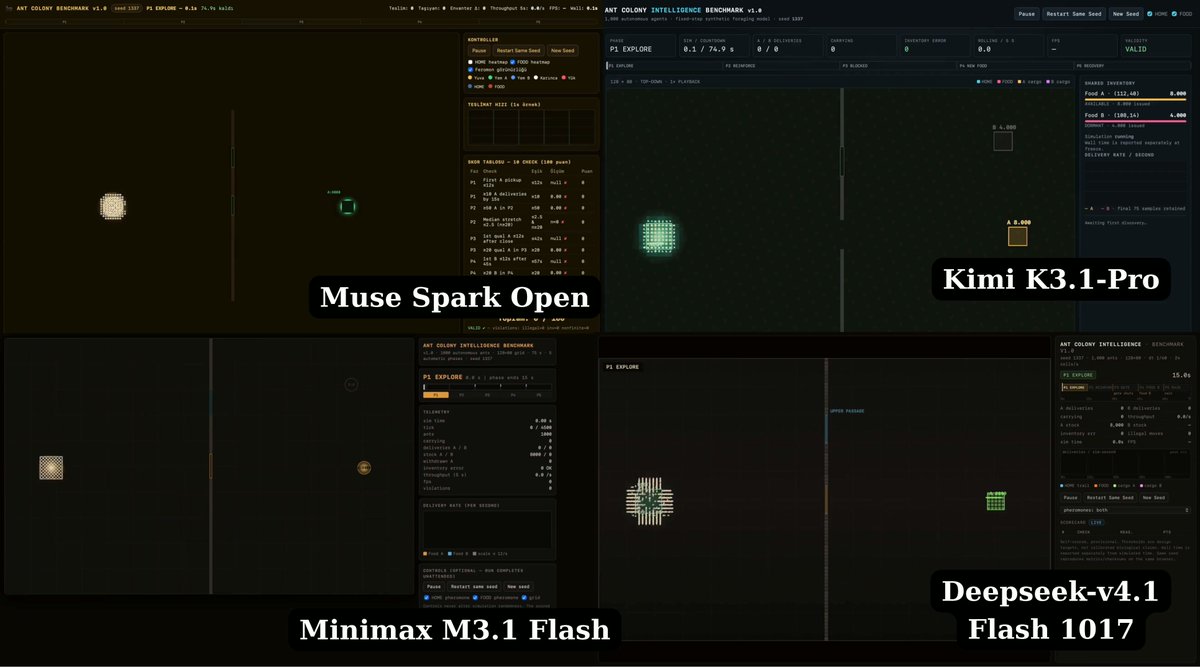
In an ant-colony foraging benchmark built by Alican Kiraz (@AlicanKiraz0), four models wrote the same simulation in OpenCode at high effort, scored with static checks and sandbox runs across four seeds.
DeepSeek V4.1 Flash-1017 led the benchmark with an overall score of 85 at an API cost of $0.172. MiniMax M3.1 Flash achieved second place with a score of 77 at $0.100. Kimi K3.1 Pro finished third with a score of 71 while incurring a significantly higher bill of $3.001. Muse Spark Open ranked fourth with 20 points.
Kimi had the most deliveries in the first exploration phase, but DeepSeek and MiniMax were the two stable across all four seeds.
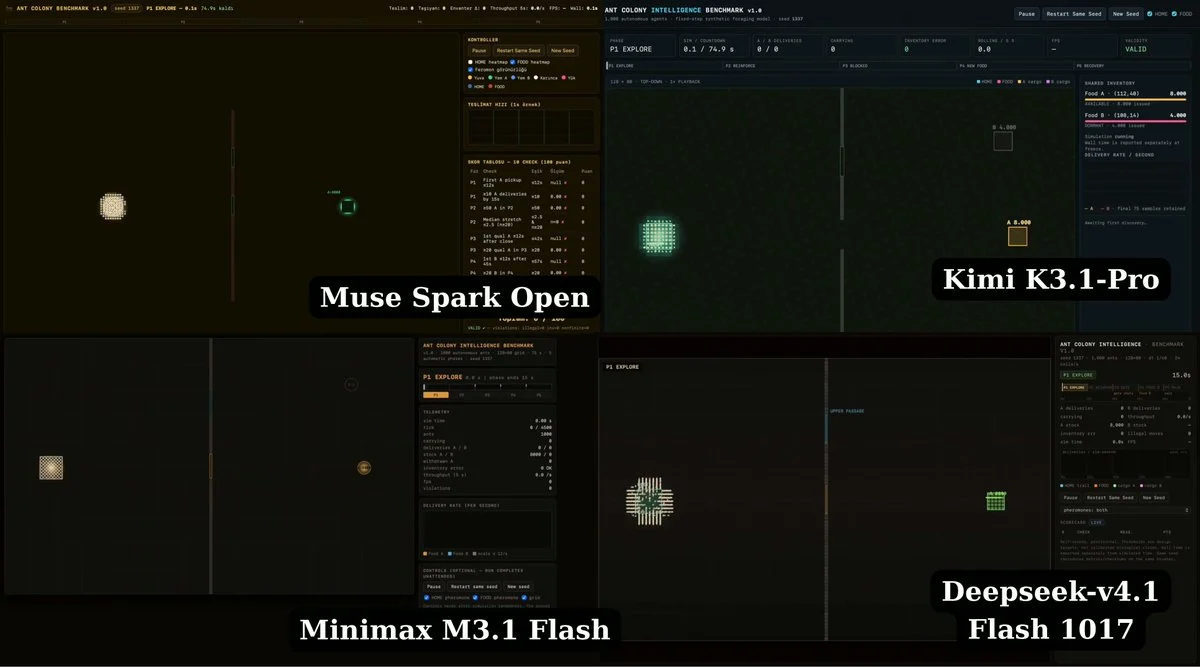
Alican Kiraz (@AlicanKiraz0) posted benchmark data on 24 October 2026 evaluating ant-colony simulation logic in OpenCode, displaying a final score of 71 for Kimi K3.1 Pro at $3.001 compared to 85 for DeepSeek V4.1 Flash-1017 at $0.172. The result covers this one benchmark setup. (Item: DeepSeek V4.1 Flash 1017 tops OpenCode ant-colony foraging benchmark)
Private tests pointed the same way. Derya Unutmaz (@DeryaTR_) said Kimi fell short of its benchmarks in his testing, clearly behind Opus 5.5, GPT-6 Astra and Gemini 4 Argon in coding, and that Opus 5.5 was cheaper via subscription for the same projects.
Developer AJ (@ItsmeAjayKV) noted after testing inside Kimi Code that DeepSeek Flash maintained an advantage in 3D scene construction. Ivan Fioravanti (@ivanfioravanti) tested both systems on a Commodore 64 game implementation and preferred DeepSeek V4.1 Flash-1017. Realguy (@anonid3430) used both to control a humanoid robot simulation and found DeepSeek faster and Kimi slower but more precise.
Certain independent benchmarks do reflect strong domain-specific capabilities for Kimi K3.1 Pro. On the Artificial Analysis Cyber Index, Kimi achieved a score of 64%, surpassing DeepSeek V4.1 Flash-1017 at 57% making it the top openly available model on agentic cyber defense, behind only the restricted-access GPT-6 Sol Daybreak Blue model at 69%. Artificial Analysis also recorded a 67% score for Kimi on its own run of Terminal-Bench 4.0.
Treat these as task-specific results; they do not cancel out the repository tests above.
Why subscription quota runs out so fast
The low token prices available on the developer API do not prevent rapid quota exhaustion on Kimi's monthly subscription tiers, where default maximum reasoning settings consume rolling allowances in short windows.
Several testers hit limits fast.
X user aipulsedaily (@aipulseda1ly) stated that a single procedural New York City flythrough exhausted the entire five-hour rolling window on the $100 plan in 20 minutes. X user AIWare (@aiwaremax) reported that one-fifth of a video built on a mature framework used 82% of the five-hour allowance on his "200" plan, questioning whether the tier offered usable everyday utility compared to Claude Pro or DeepSeek.
X user superalesha (@superalesha) called usage "a major problem" and "genuinely a terrible deal" right now. Xueyu (@xueyu1125) said the price was too high and the subscription quota too small, and nqlogs (@nqlogs) said a whole coding plan ran out on one test project without the result he wanted, so he would rather pay for Claude Code Pro.
Official product documentation for Kimi Code explains the underlying resource rules. Kimi Code shares unified membership quota across all connected user devices and personal API keys. Modern subscription tiers operate on a rolling five-hour rate window without weekly throttling, while legacy tiers maintain both five-hour and weekly boundaries.
Accessing K3.1 Pro requires a Plus plan or higher, while unlocking the full 1-million-token context window or utilizing the K3.1 Pro Highspeed engine requires a Pro tier. In addition, the Highspeed variant is explicitly documented as consuming roughly twice the quota of the standard model.
The primary operational driver behind this rapid quota depletion is model configuration. In the Kimi Code environment, K3.1 Pro is permanently locked into reasoning mode and defaults to maximum effort, whereas the previous K3 architecture defaulted to high effort. Artificial Analysis also rates it very verbose, so a run at default settings can hit the rolling window quickly.
Subscribers can take specific steps to extend their plan duration.
In non-critical development and routine syntax drafting, users should explicitly override the reasoning effort parameter down to low or high. User leo114119 (@leo114119) found in an SVG drawing test that max effort gave clearly better detail than high, so keep max for hard tasks if your quota allows.
Furthermore, subscribers should avoid the Highspeed toggle inside Kimi Code unless latency is urgent, and for heavy runs compare the cost against the pay-as-you-go API rather than the subscription alone.
Which one to use
Developers building procedural graphics, Three.js canvases, 3D WebGL scenes, and front-end interface prototypes should use Kimi K3.1 Pro via the developer API. On these isolated generative tasks, K3.1 Pro sometimes gets close to Opus 5.5's results at roughly a quarter of the bill.
Teams managing multi-file software repositories, complex bug debugging, dynamic execution harnesses, or broad white-collar reasoning should remain on Claude Opus 5.5, or consider Claude Sonnet 5.5, which achieved the highest overall score on the Bug Hunt Bench.
Kimi trailed in both scored real-project tests we found (Bug Hunt, ant colony) and in DeryaTR_'s private tests.
Engineering organizations whose primary objective is operational cost reduction should deploy DeepSeek V4.1 Flash-1017. In head-to-head testing, DeepSeek was 7.5x to 17.4x cheaper than Kimi K3.1 Pro while securing higher benchmark results in both the Bug Hunt repository evaluation and the autonomous ant-colony simulation test.
Organizations requiring on-premises self-hosted infrastructure should wait for Moonshot to publish the open weights, which are scheduled for delivery by 4 November 2026. Deploying this architecture locally will demand enterprise data-center hardware capable of serving a 2.8-trillion-parameter mixture-of-experts model with 104 billion active parameters.
These conclusions reflect developer testing collected during the launch week of Kimi K3.1 Pro. Performance baselines and subscription economics will be re-evaluated after Moonshot distributes the open model weights and updates platform usage rules.
Questions and answers
How much cheaper is Kimi K3.1 Pro than Opus 5.5?
Kimi K3.1 Pro is 50% cheaper on base API token rates at $2.00 input and $10.00 output per million tokens versus $4.00 and $20.00 for Opus 5.5. On finished tasks, independent users posted bills that were 3.0x to 14.4x lower with a median difference of 4.3x, while Artificial Analysis recorded an average cost of $2.11 per index task for Kimi compared to $5.98 for Opus. On Atomic Agent's small coding task at Kimi's default max effort, however, the two cost about the same.
Is Kimi K3.1 Pro better than Opus 5.5 at coding?
Kimi K3.1 Pro is not superior to Opus 5.5 in multi-file repository maintenance, resolving 36 out of 105 issues on the Bug Hunt Bench compared to 41.7 for Opus 5.5. One independent tester, DeryaTR_, also ranked it behind Opus, Astra and Argon in his private coding tests. Moonshot's self-reported Terminal-Bench 4.0 run placed Kimi 0.7 percentage points behind Opus, though Artificial Analysis recorded a higher score for Kimi on its own separate run.
Why does Kimi K3.1 Pro use up quota so fast?
Kimi K3.1 Pro operates with reasoning mode permanently enabled and defaults to maximum effort in Kimi Code, and Artificial Analysis rates it very verbose, so default runs eat subscription quota quickly. The Highspeed variant further accelerates this drain by consuming approximately twice the standard quota per interaction. One subscriber said a run used up his five-hour window in 20 minutes.
Are Kimi K3.1 Pro weights open?
The model weights are not publicly available as of 24 October 2026. Moonshot has stated that complete open weights for the 2.8-trillion-parameter architecture will be released by 4 November 2026.
Kimi K3.1 Pro or DeepSeek V4.1 Flash?
DeepSeek V4.1 Flash-1017 is the better pick on price and in the two coding tests we found, running 7.5x to 17.4x cheaper in paired evaluations while outscoring Kimi on both the Bug Hunt repository bench (42.7 versus 36) and an algorithmic ant-colony simulation (85 versus 71). Kimi sometimes produced more detailed 3D scenes, as in thehypedotnews's Arc de Triomphe test.
Sources
Selected examples

“In my private testing, Kimi K3.1 unfortunately falls short of it…”