Claude Opus 5.5 vs Sonnet 5.5 vs Haiku 5.5: quality, time and cost in same-prompt tests
For most one-shot builds, start with Claude Sonnet 5.5. In 25 user-reported same-prompt runs, Claude Opus 5.5 cost a median 2.0 times as much as Sonnet and took about 1.6 times as long, and testers who picked a side split only 16 to 13 in Opus's favour. Claude Haiku 5.5 cost a median of about one twenty-ninth of Opus across nine runs, but it was not always faster. This guide combines Anthropic's developer docs (checked 18 October 2026) with 71 hand-checked same-prompt tests from 54 authors. Most tests are 3D scenes and animations, and all figures are self-reported.
Anthropic's own guidance gives the three models the same roles: Opus for complex, long-running agentic work, Sonnet for everyday work, and Haiku for high-volume and sub-agent tasks. It also says that tuning effort is often a better lever than switching models. That matters, because Sonnet 5.5 is not always the cheaper model per task: on the API it defaults to high effort while Opus 5.5 defaults to medium, and several testers saw Sonnet use more tokens or more turns.
The 71 tests were kept after reading 692 posts that named two or more Claude 5.5 tiers, published up to 18 October 2026. Because most of them are one-shot visual builds, treat the results as a guide for that kind of work rather than a general ranking.
More Claude 5.5 head-to-heads and animations are collected in the Opus 5.5 video collection; to make videos with Opus, see Make videos with Claude Opus.
How Anthropic positions the three: price, speed and default effort
At list price Opus 5.5 costs twice as much as Sonnet 5.5 and 40 times as much as Haiku 5.5 (for prompts up to 100,000 tokens).
Table: Anthropic's official specs (checked 18 October 2026)
| Model | Released | API price (per 1M tokens, in/out) | Official speed label | Default API effort | Official positioning |
|---|---|---|---|---|---|
| Opus 5.5 | 22 Sep 2026 | $4 / $20 | Moderate | medium | Complex agentic coding and enterprise work, multi-hour autonomous coding, large refactors |
| Sonnet 5.5 | 28 Sep 2026 | $2 / $10 | Fast | high | Everyday coding, data analysis, content creation, agentic tool use |
| Haiku 5.5 | 7 Oct 2026 | $0.10 / $0.50 ($0.50 / $2.50 for prompts over 100k tokens) | Fastest | medium | Real-time apps, high-volume processing, classification/extraction/routing, sub-agents |
Sample/method: Sources: the model overview, pricing and model-selection pages in Anthropic's developer docs, opened 18 October 2026. All three have a 1M-token context window and 128k max output; the Batch API is 50% off.
The easiest detail to miss is default effort: high for Sonnet 5.5, medium for Opus 5.5 and Haiku 5.5. Two more official points affect the bill. Haiku 5.5's per-token price rises fivefold once a prompt passes 100,000 tokens, which hits agents that carry long context. And Haiku 5.5 uses a newer tokenizer, so the same text comes to about 30% more tokens than on Haiku 4.5.
Anthropic does not simply make Sonnet the default either. Its model selection guide says most workloads start with Claude Opus 5.5, and it also describes an efficiency-first route that starts with Haiku 5.5.
Opus 5.5 vs Sonnet 5.5: what twice the money buys
In user tests Opus usually cost about twice as much and took longer. It won many comparisons on detail and physics, but testers did not clearly prefer it overall.
Table: Opus 5.5 vs Sonnet 5.5 on the same prompt: cost and time (self-reported)
| Tester | Date (UTC+8) | Task | Opus cost / time | Sonnet cost / time | Tester's pick |
|---|---|---|---|---|---|
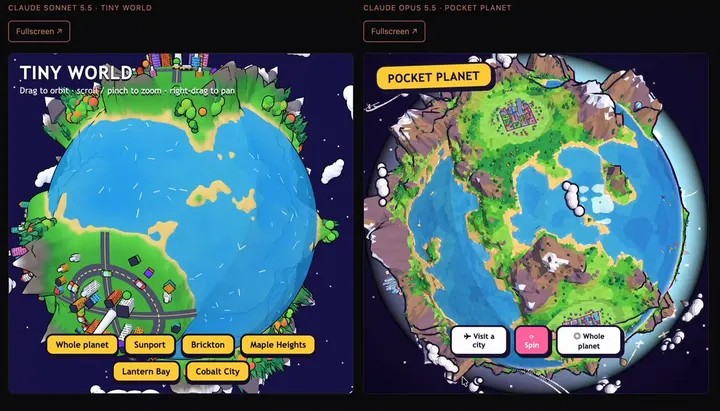
| Timothée Le Borgne (@Tim_LB) | 29 Sep | 3D tiny planet (TinyWorld) | $4.79 / 22.7 min | $0.96 / 10.8 min | Cheaper is enough |
| Bridgebench (@bridgebench) | 29 Sep | Lava lamp | $1.27 / 9.6 min | $0.47 / 5.7 min | Sonnet |
| BARIK (@Rahmanbarik) | 29 Sep | (unstated) both Medium | $7.00 / 50 min | $3.00 / 42 min | Opus |
| Sakata (@sakatayasha) | 2 Oct | (unstated) | $5.20 / 28 min | $2.90 / 20 min | Opus |
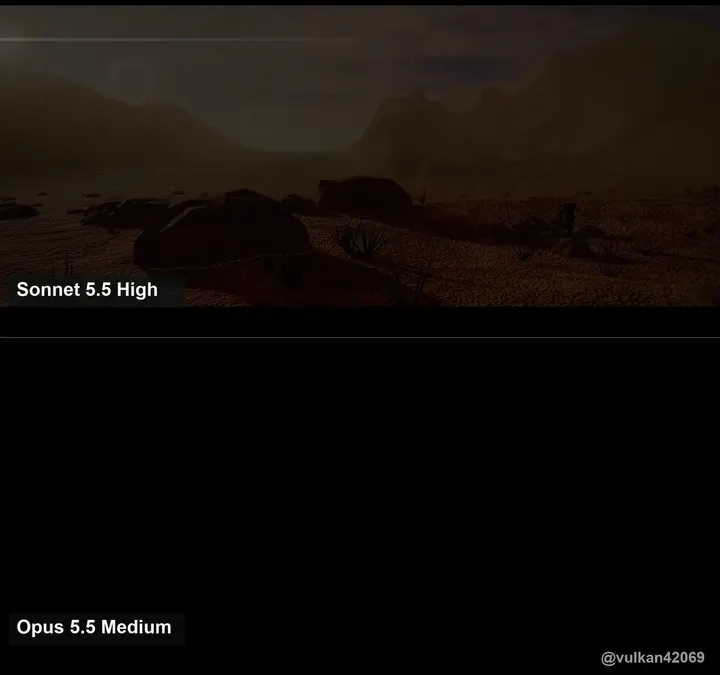
| VulKan (@VulKan42069) | 6 Oct | Javelin animation (Sonnet High / Opus Medium) | $6.50 / 40.8 min | $11.38 / 53.9 min | Sonnet |
| VulKan (@VulKan42069) | 10 Oct | Mini film animation (both Low) | $10.49 / 42.3 min | $7.85 / 50.1 min | Opus |
| Paruchh (@theparuchh) | 14 Oct | Jelly ship in a bottle | $29 / 2h 2m | $14 / 3h 22m | No verdict |
| Rhino (@0xRhinoX) | 14 Oct | Rippable jelly | $13 / 1h 17m | $4.00 / 44 min | Sonnet |
| Rhino (@0xRhinoX) | 16 Oct | Jelly Rubik's cube | $11.10 / 1h 23m | $7.36 / 1h 3m | No verdict |
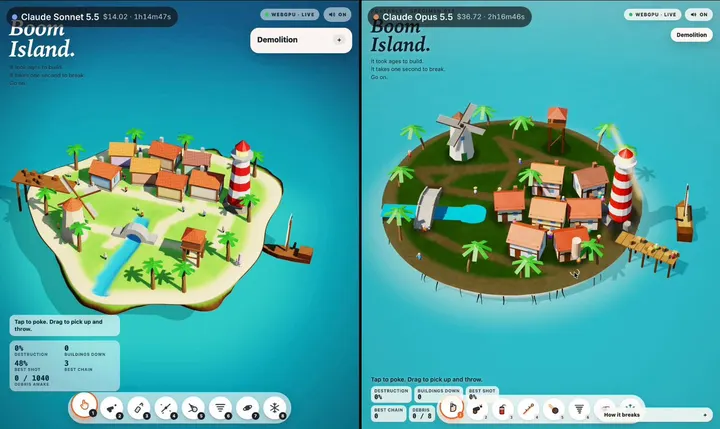
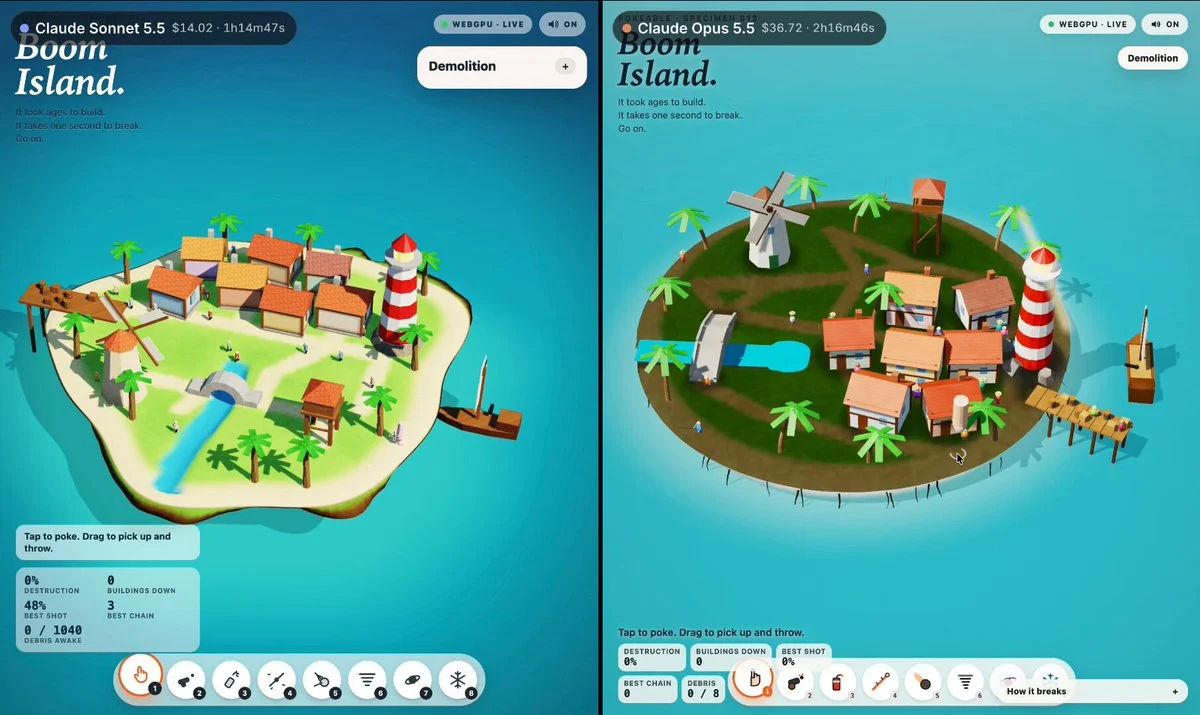
| Rhino (@0xRhinoX) | 18 Oct | Island you can blow up | $37 / 2h 17m | $14 / 1h 15m | Sonnet |
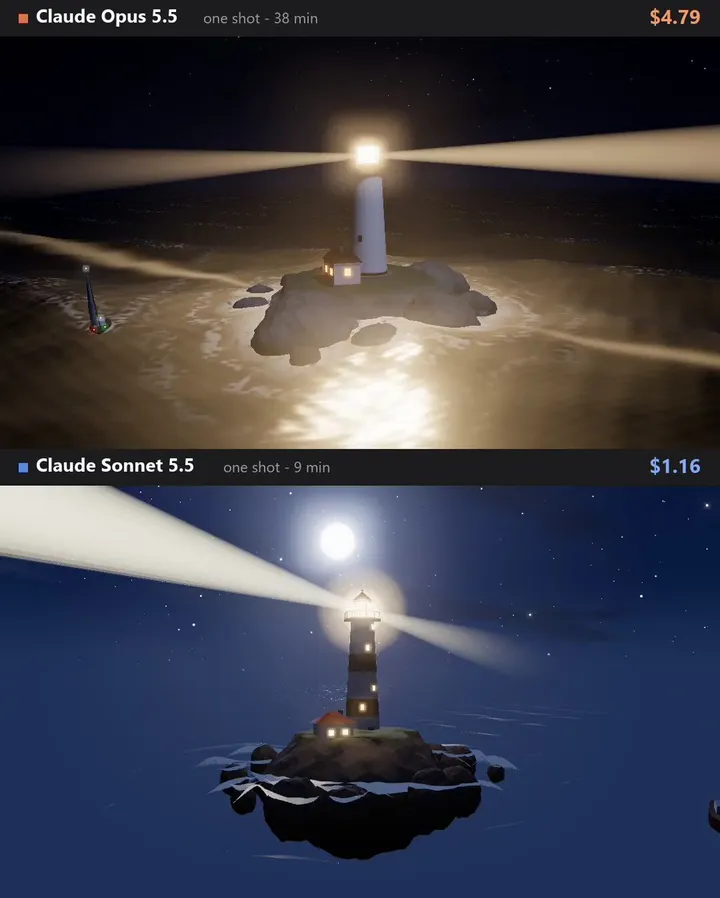
| Buzz (@buzzhive_ai) | 18 Oct | 15-second lighthouse scene | $4.79 / 38 min | $1.16 / 9 min | Opus |
| Pegon (@pegonch) | 17 Oct | Plane past a waterfall | $31.85 / 2h 45m | $23.38 / 1h 14m | No verdict |
Sample/method: Sample: runs that give both cost and time for both models, from 40 same-prompt test posts with figures; costs are mostly API-priced estimates reported by the testers and were not re-run by us.
Rhino (@0xRhinoX) posted this side-by-side on 18 October 2026: Sonnet 5.5's destructible island on the left at $14.02 and 1h 14m 47s, Opus 5.5's on the right at $36.72 and 2h 16m 46s. It shows the cost and time gap from one prompt. It does not show that the extra spend bought a better result. (Item: Sonnet 5.5 vs Opus 5.5: same prompt, blow-up island)
Testers who chose Opus usually cared most about density and physical consistency. Timothée Le Borgne (@Tim_LB) found the Opus planet denser, but said Sonnet was "almost at the level of Opus" for about a fifth of the cost. Buzz (@buzzhive_ai) said Opus built a real ocean with the lighthouse beam sweeping the water, while Sonnet made a floating island. Hakimi Eiqbal (@hakimieiqbal) rated Opus's steampunk whale the stronger 3D result, at about $156 against $109 for Sonnet. 0xAlbus reported that Opus kept a jelly lemon at 165 g through every cut, while Sonnet's shrank from 172 g to 159 g.
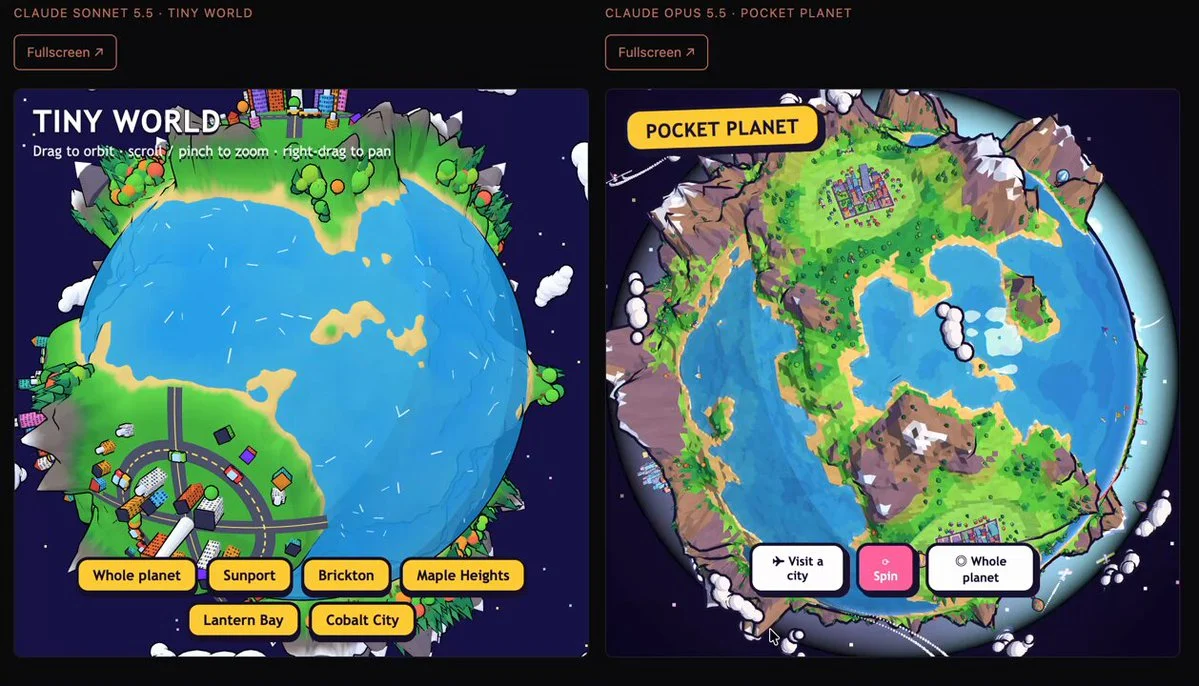
Timothée Le Borgne (@Tim_LB) posted these two planets from one prompt on 29 September 2026: Sonnet 5.5's "Tiny World" on the left and Opus 5.5's "Pocket Planet" on the right. The Opus terrain and town are visibly denser. A single screenshot cannot say whether that difference is worth five times the cost. (Item: Opus 5.5 vs Sonnet 5.5 on the TinyWorld video benchmark)
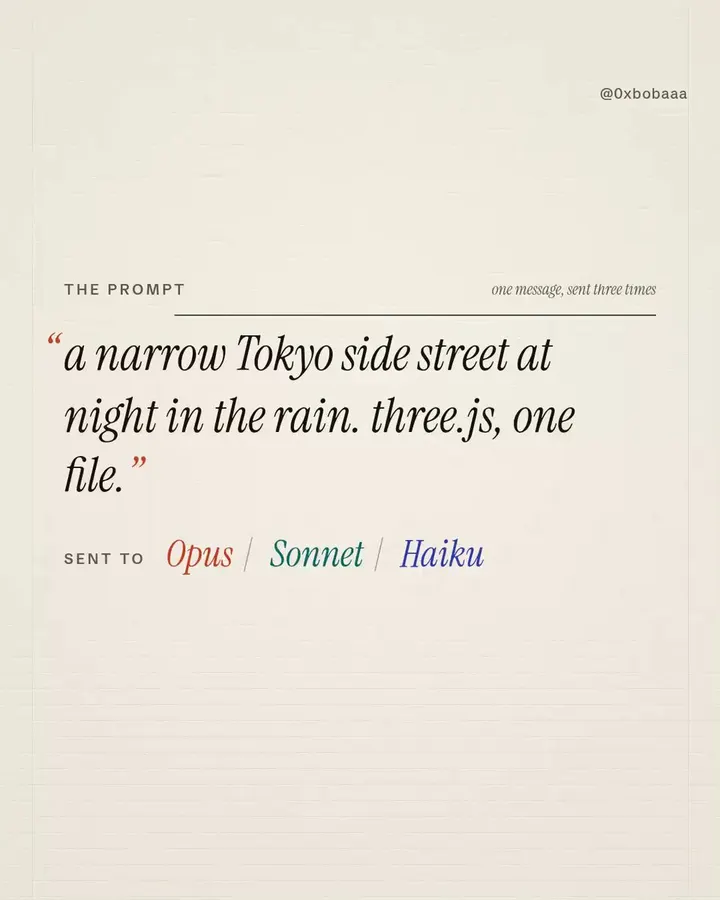
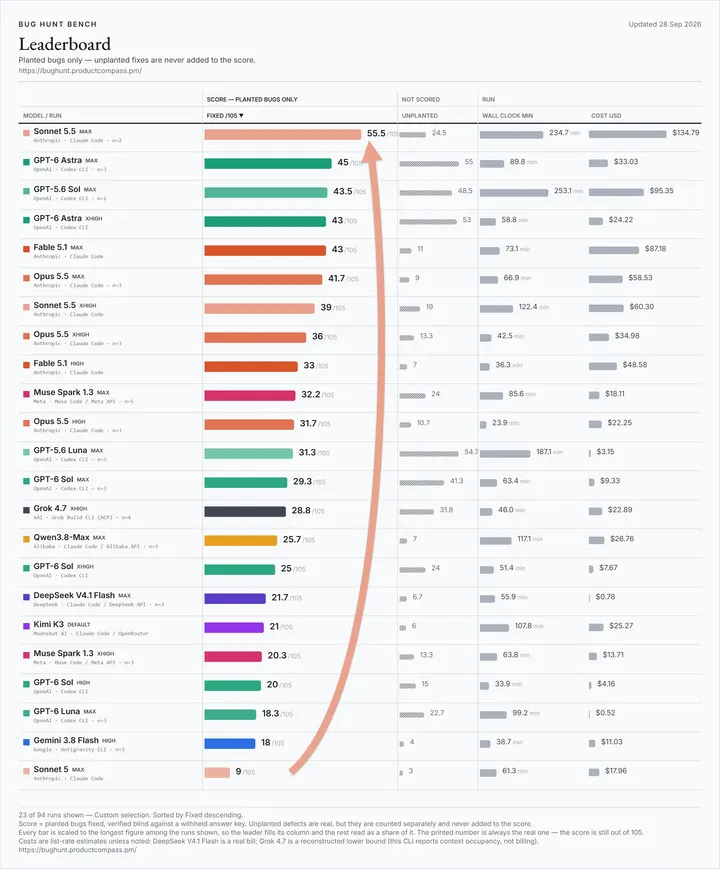
Testers who chose Sonnet usually found it good enough for less, or simply better. In Rhino's island test Sonnet's island broke into 1,040 pieces and Opus's into 203, though Opus cost 2.6 times as much. Bridgebench (@bridgebench) preferred Sonnet's lava lamp at $0.47 to Opus's at $1.27. 0xbobaa (@0xbobaaa) preferred Sonnet's rainy Tokyo street at $0.57 to Opus's at $2.75. On 105 bugs in two real repositories, Paweł Huryn (@PawelHuryn) scored Sonnet 5.5 at 55.5 and Opus 5.5 at 41.7 with both on max, but Sonnet used about 2.8 times as many turns.
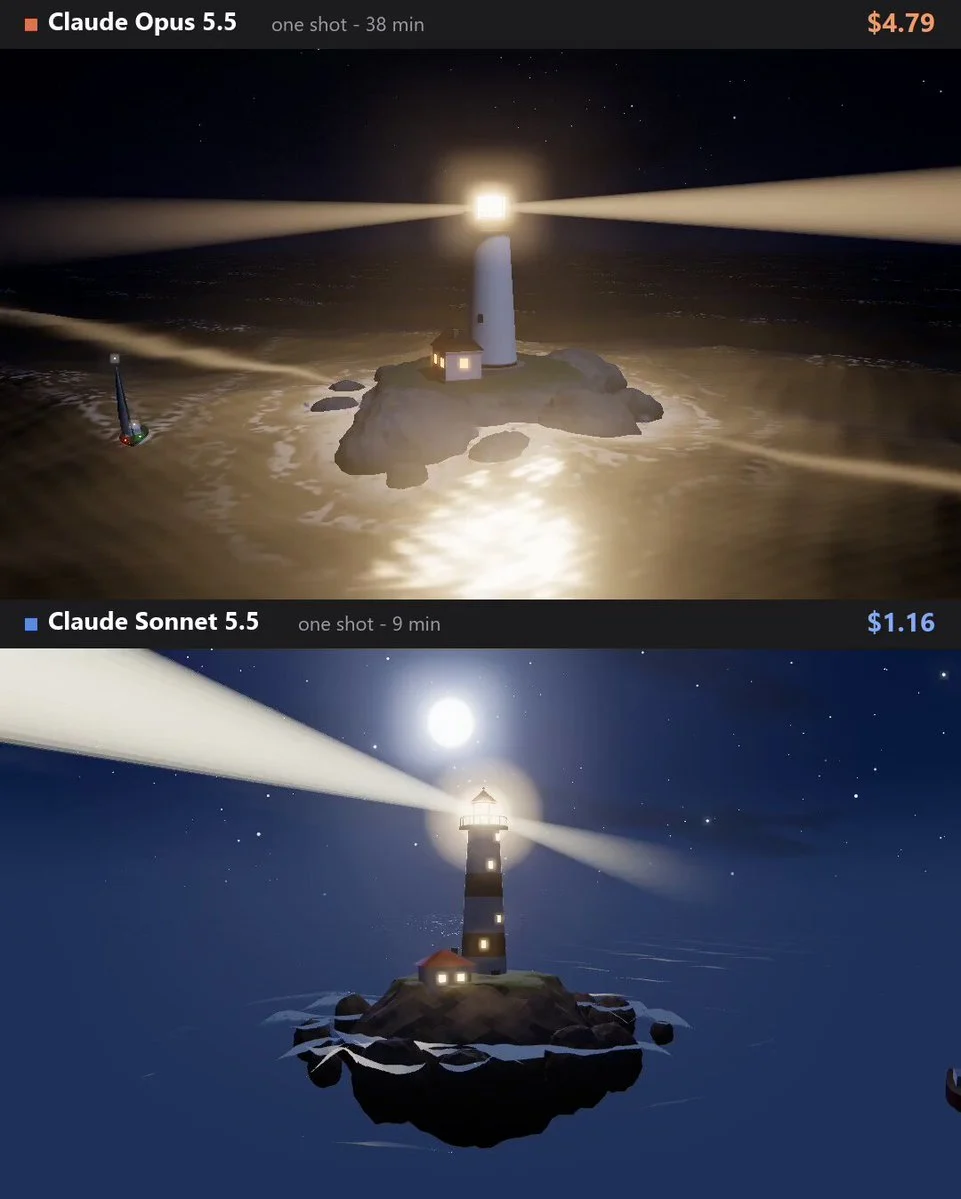
Buzz (@buzzhive_ai) posted this lighthouse comparison on 18 October 2026: Opus 5.5 on top at 38 minutes and $4.79, Sonnet 5.5 below at 9 minutes and $1.16. Opus lights the sea, while Sonnet's island floats in the air. It shows how the two handled one prompt, not that Opus is worth four times the price on every task. (Item: Opus 5.5 vs Sonnet 5.5: same prompt, 15-second 3D lighthouse animation)
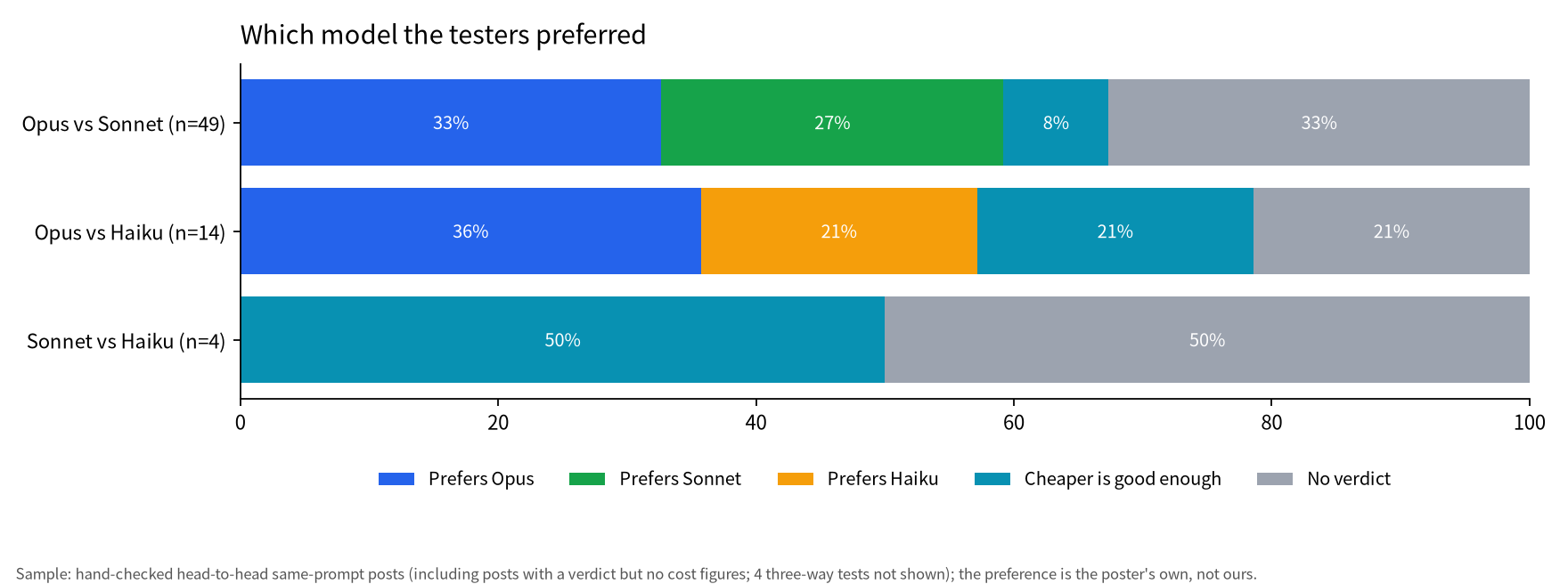
Sample/method: Sample: hand-checked head-to-head posts, classified by the poster's own verdict; 4 three-way tests not shown.
Why Sonnet is not always cheaper: effort and token use
Sonnet costs half as much per token, but per task it can cost as much as Opus or more. Two likely reasons are its high default effort and its tendency to use more tokens.
VulKan (@VulKan42069) ran a javelin animation with Sonnet on High and Opus on Medium. Sonnet cost $11.38 and took 53m 55s, and Opus cost $6.50 and took 40m 49s. With both on Low, Opus cost $10.49 and Sonnet $7.85, but Sonnet was slower (50 minutes against 42). vib3coded reported close costs too: $7.45 for Opus against $6.20 for Sonnet on a jelly pufferfish, and $13.30 against $11.25 on a crab, and called the savings "tiny".
Relayed benchmark figures point the same way. Stats Wire relayed Artificial Analysis's cost per Intelligence Index task as $5.98 for Opus and $7.67 for Sonnet. Merge relayed average task times for the week of 12 October as 13.2 minutes for Opus and 15.3 for Sonnet. Haider. (@haider1) posted that Sonnet 5.5 max produced 193k output tokens per task against 119k for Opus 5.5 max, without naming a source.
Table: The tiers in third-party benchmarks and longer tests (relayed, not verified)
| Source (poster) | What it measures | Opus 5.5 | Sonnet 5.5 | Haiku 5.5 |
|---|---|---|---|---|
| Artificial Analysis Intelligence Index (via Stats Wire) | Cost per index task | $5.98 | $7.67 | — |
| Artificial Analysis (via Merge, week of 12 Oct) | Avg time per task / index score | 13.2 min / 57.6 | 15.3 min / 56.0 | — |
| Nous Research eval | Score / cost per task | 63.31 / $4.99 | 53.14 / $2.82 | — |
| Arena Image-to-WebDev (10 Oct) | Score (Opus Max, Sonnet xHigh) | 1749, #1 | 1740, #2 | — |
| KingBench 4 (AICodeKing, 6 large projects) | Score / cost per task | 57.8% / $7.5 | — | 54.2% / $1.23 |
| Pawel Huryn: 105 bugs in 2 real repos | Score / avg turns (all max) | 41.7 / 476 turns | 55.5 / 1,330 turns | — |
| SKatalystAI: repo with 9 hidden defects | Defects found | 9/9 | — | 8/9 (xhigh) |
Sample/method: All figures come from posts in the collections; each benchmark measures something different, so the rows are not comparable with each other. We did not re-check the original leaderboards.
The practical point is to set effort explicitly when comparing. Anthropic's docs list Sonnet's API default as high and Opus's as medium, so a comparison at default settings does not compare like with like.
Haiku 5.5: dozens of times cheaper, but good enough?
Haiku 5.5 usually built the whole scene for a small fraction of the Opus cost, with less detail. It was not always faster, and as the worker in a swarm it could cost more than expected.
Table: Haiku 5.5 in same-prompt tests against Opus and Sonnet (self-reported)
| Tester | Date (UTC+8) | Task | Opus | Sonnet | Haiku | Tester's pick |
|---|---|---|---|---|---|---|
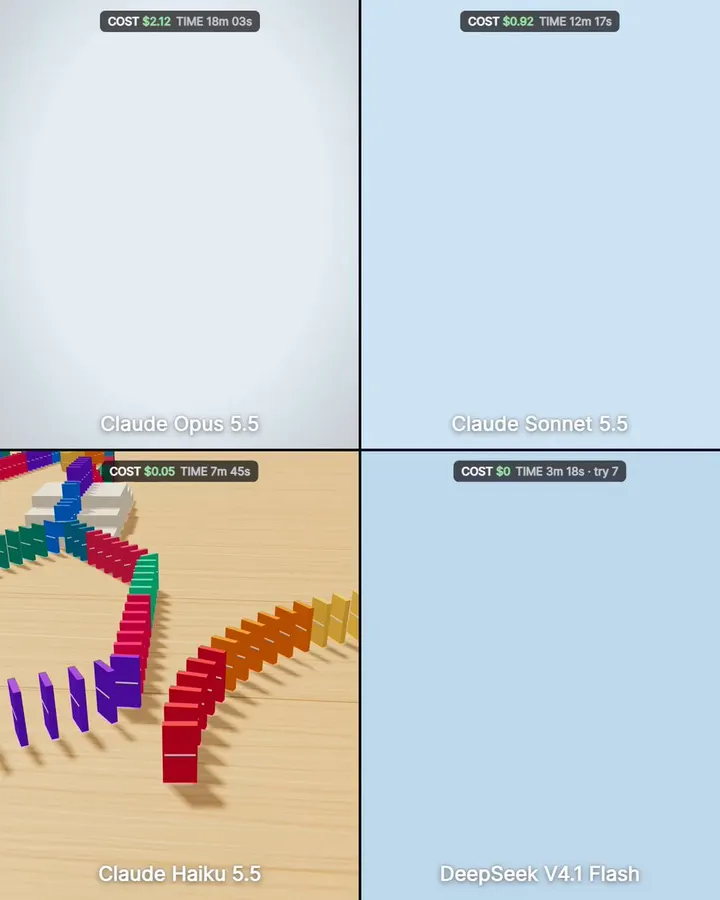
| Arix (@arixxbt) | 18 Oct | Dominoes | $2.12 / 18 min | $0.92 / 12 min | $0.05 / 8 min | Cheaper is enough |
| 0xbobaa (@0xbobaaa) | 9 Oct | Rainy Tokyo side street | $2.75 / — | $0.57 / — | $0.07 / — | Sonnet |
| 0xbobaa (@0xbobaaa) | 8 Oct | Golden Gate at sunset | $3.04 / 16 min | — | $2.19 / 5.5 min | Opus |
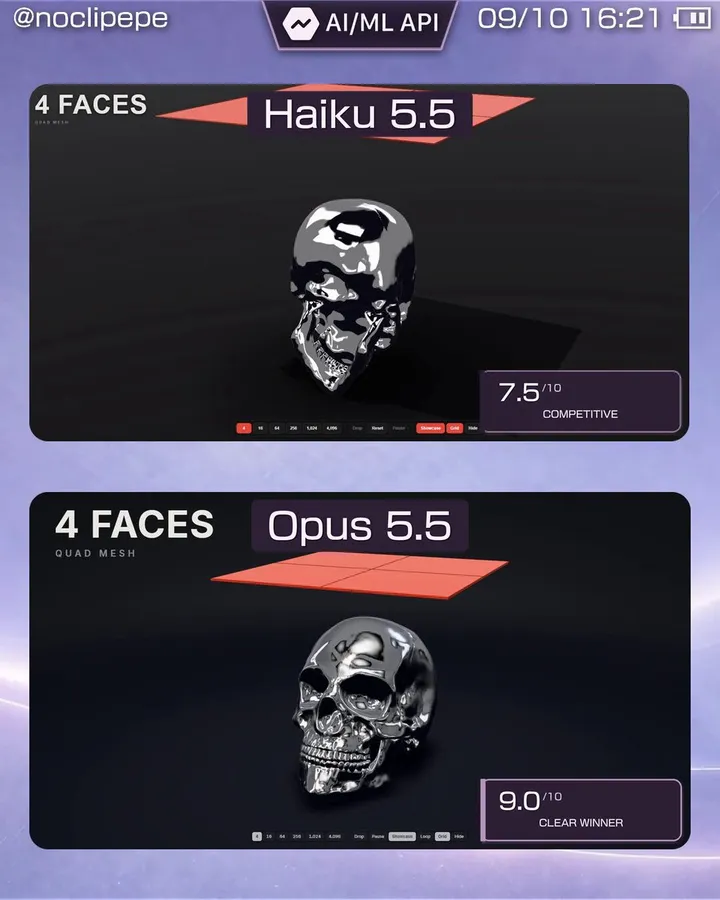
| noclipepe (@noclipepe) | 10 Oct | Cloth physics (4 to 4,096 faces) | $10.62 / 51.7 min | — | $3.08 / 1h 3m | Opus |
| 0xbobaa (@0xbobaaa) | 11 Oct | Shrine temple scene | $5.17 / 36 min | — | $0.13 / 16 min | No verdict |
| romance (@romance0x) | 11 Oct | Koi canal boat ride | $26.84 / — | — | $5.31 / — | Cheaper is enough |
| Kinder (@kinderlayer) | 12 Oct | Floating voxel island | $25 / — | — | $2.00 / — | Cheaper is enough |
| aloha (@alohaproxy) | 13 Oct | Sci-fi mech launch (extra high) | — / 12 min | — | — / 19 min | Opus |
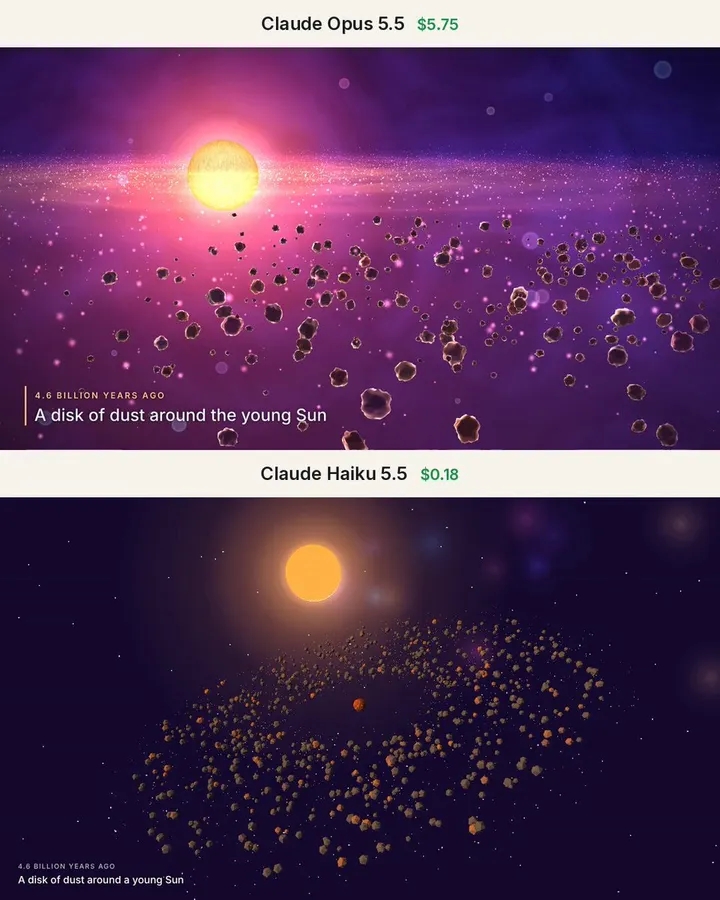
| AiMind (@AIMind_Ai) | 14 Oct | Birth of Earth | $5.75 / 49 min | — | $0.18 / 10 min | Cheaper is enough |
| Buzz (@buzzhive_ai) | 17 Oct | 300 dominoes | $0.88 / 7 min | — | $0.03 / 5 min | Opus |
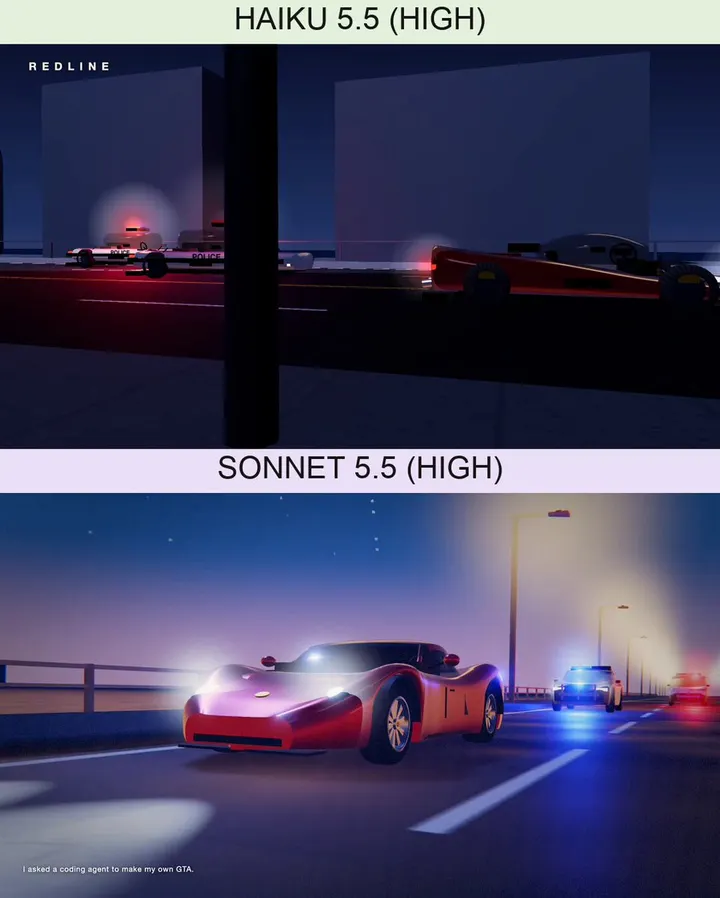
| shownotover (@shownotover) | 10 Oct | GTA-style chase (both High) | — | $3.69 / 28.5 min | $0.52 / 14.8 min | Cheaper is enough |
| Rubens Soto (@rubenssoto_ai) | 8 Oct | Electric motor explainer | — | — / 33 min | — / 11.2 min | No verdict |
Sample/method: Cells are cost / time; a dash means the tester did not say. 0xbobaaa's Tokyo street gave thinking time only (Opus 13 min, Sonnet 4, Haiku 6), so no total time is listed. Self-reported, not re-run by us.
The cost gap was often more than tenfold. AiMind (@AIMind_Ai) reported $5.75 on Opus and $0.18 on Haiku for a birth-of-Earth scene. Buzz paid $0.88 on Opus and $0.03 on Haiku for 300 dominoes. Arix (@arixxbt) ran all three on a domino scene: $2.12 for Opus, $0.92 for Sonnet and $0.05 for Haiku. There are exceptions: on 0xbobaa's Golden Gate sunset, Haiku cost $2.19, 72% of Opus's $3.04.
Speed did not track price. In noclipepe's cloth physics test Haiku took 1h 3m against 51.7 minutes for Opus. With both on extra high, aloha (@alohaproxy) timed Haiku at 19 minutes and Opus at about 12. SimonasLTU1 said Haiku took about two hours on a large prompt that Sonnet and Opus had each finished in about an hour (by their recollection), and that it got stuck halfway. It used 0% of the weekly limit on their $20 plan.
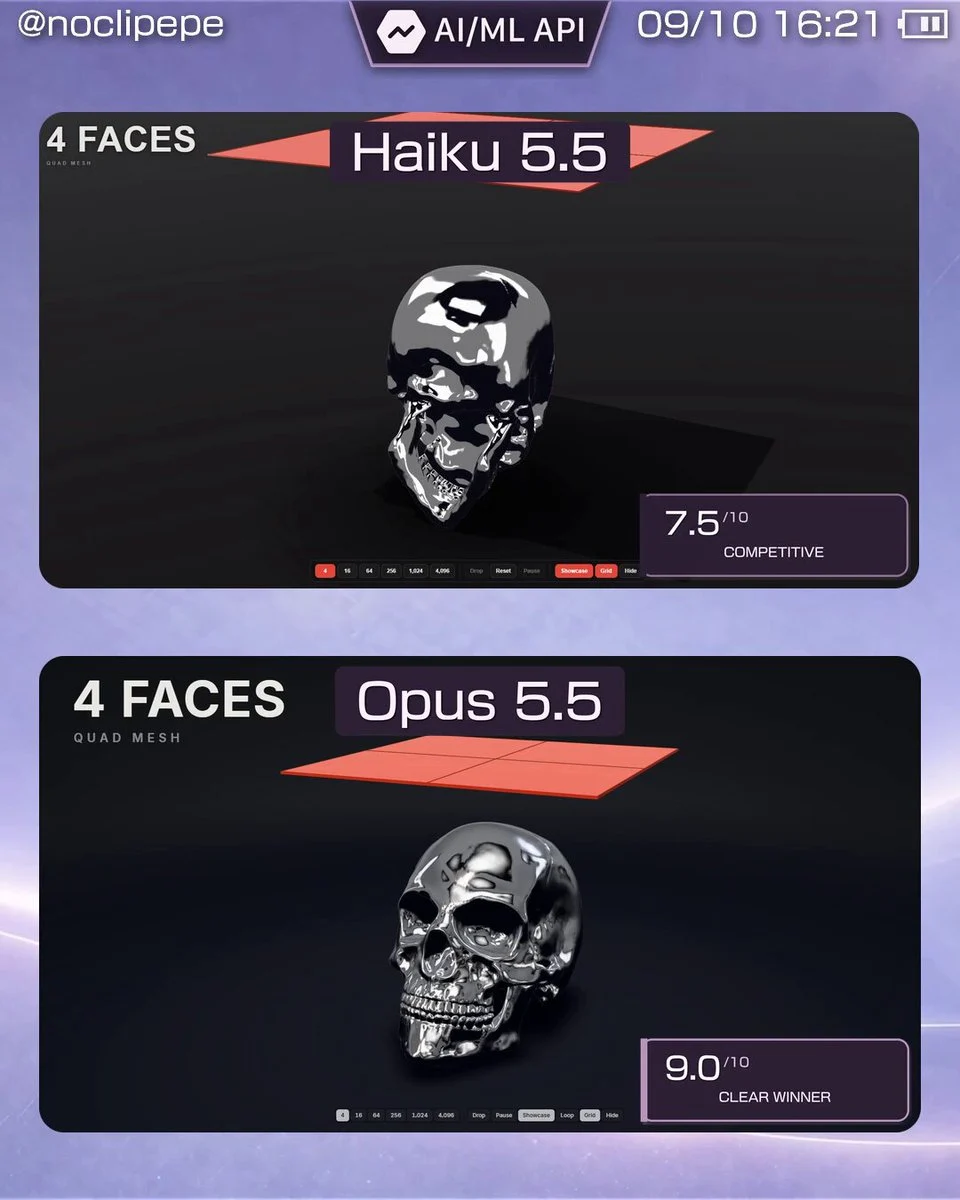
noclipepe (@noclipepe) posted this cloth physics comparison on 10 October 2026: Haiku 5.5 on top, which the author scored 7.5, and Opus 5.5 below at 9.0, marked the clear winner. These are the author's own scores and do not show that Haiku is worse at every physics task. (Item: Haiku 5.5 vs Opus 5.5: cloth physics animation compared)
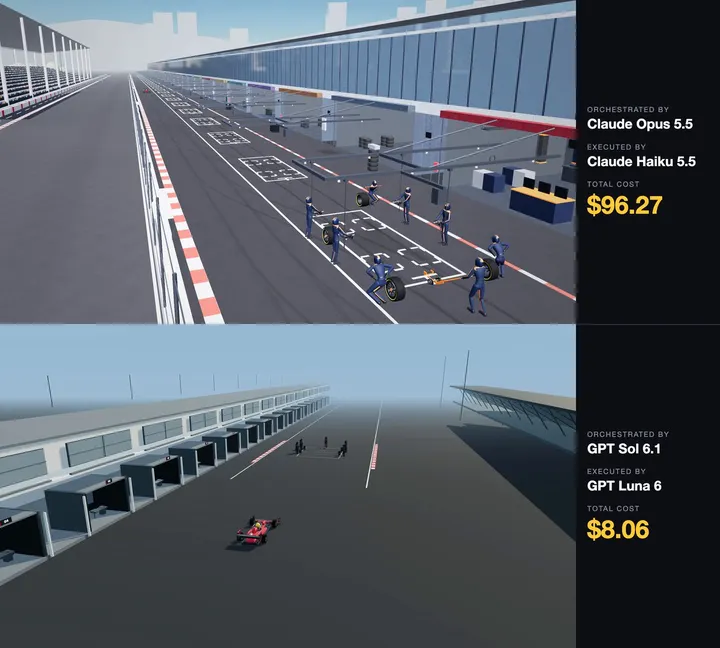
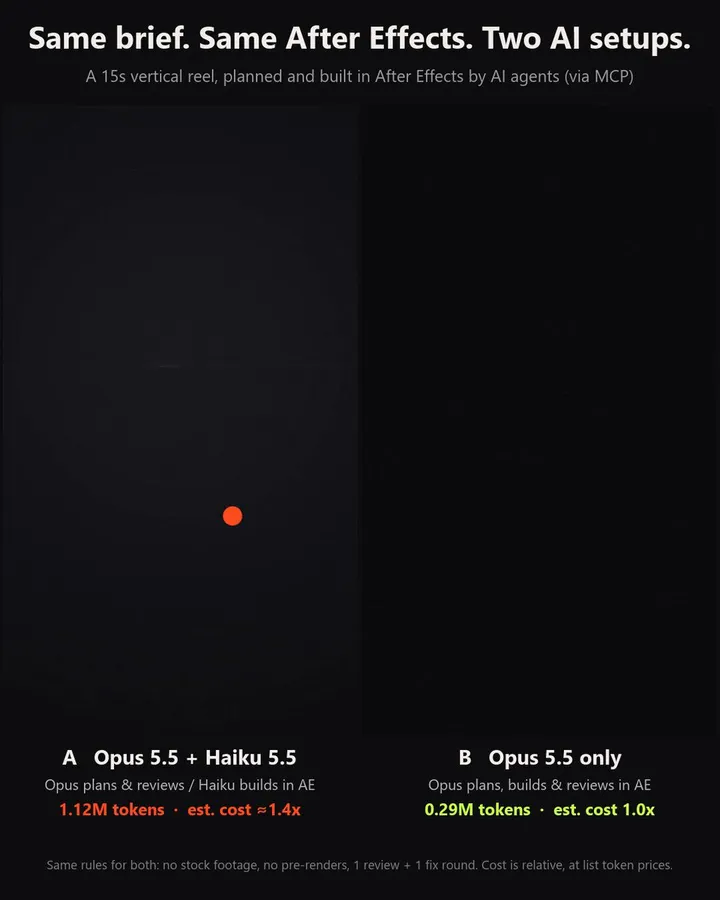
Using Haiku as cheap labour in a swarm did not always save money. Rubens Soto (@rubenssoto_ai) had Opus orchestrate and Haiku execute a 30-second F1 pit-stop animation. The total was $96.27, and the Haiku share ($61.77, 819.9M tokens) was larger than the Opus share ($34.50). In sammyo_official's After Effects reel, an Opus-designs, Haiku-builds setup used 1.12M tokens against 0.29M for Opus alone, at an estimated 1.4 times the cost.
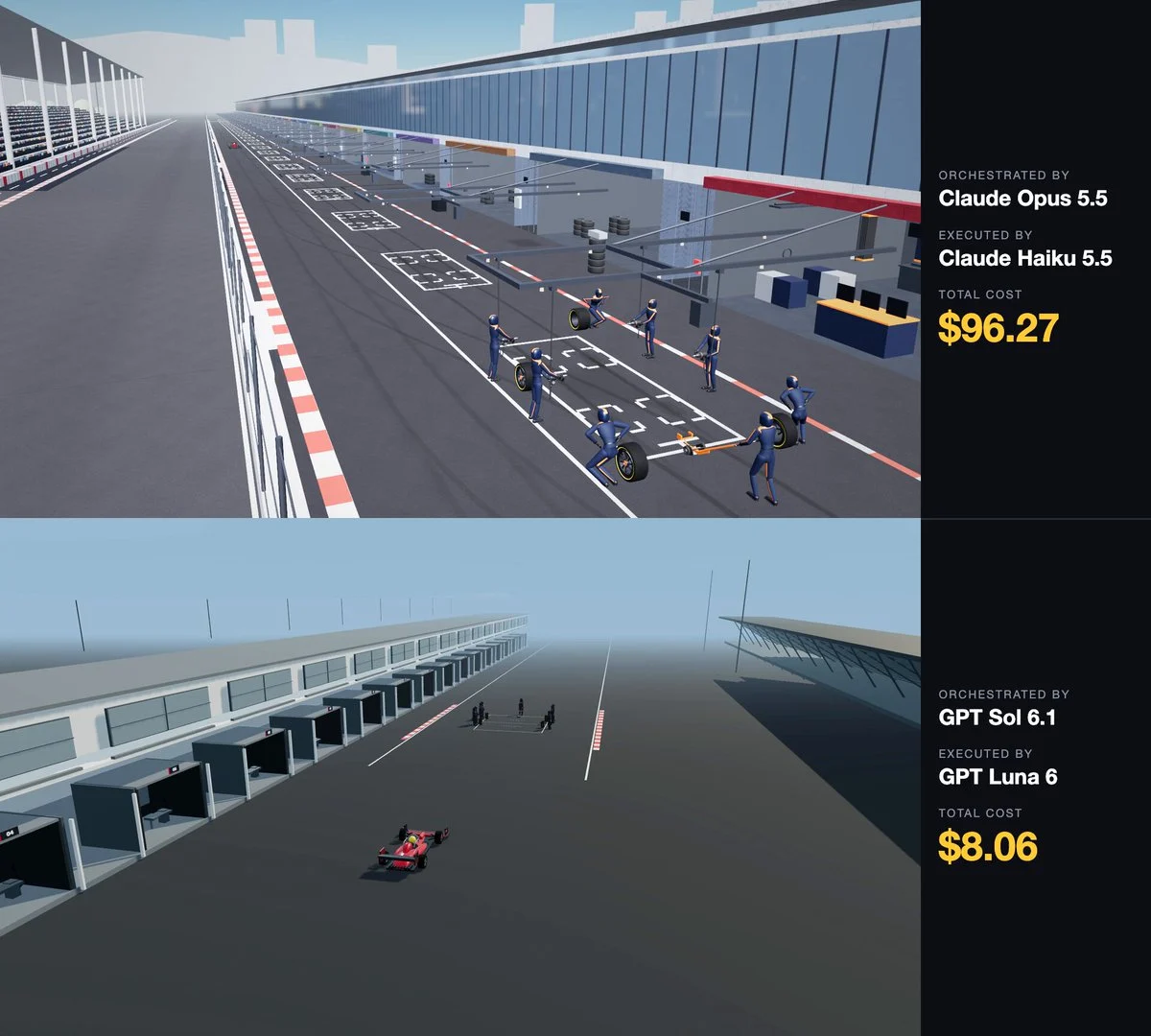
Rubens Soto (@rubenssoto_ai) posted this F1 pit-stop comparison on 9 October 2026: Opus 5.5 orchestrating Haiku 5.5 on top for $96.27 in total, and GPT-6.1 Sol with GPT-6 Luna below for $8.06. It shows the difference in total bills, not which model did the better job. (Item: Opus 5.5 vs GPT setups on a one-shot Three.js F1 short)
Haiku also held up in places. Arix preferred Haiku's stormy lighthouse because it was brighter and closer, though it left out the boat. On a messy repository with nine hidden defects, SKatalystAI reported that Haiku at xhigh found eight and Opus found all nine. AICodeKing's KingBench 4 put Opus at 57.8% and Haiku at 54.2%, at about $7.5 and $1.23 per task.
How to pick by task
Choose by task and budget, and compare at the same effort level.
For one-shot visual builds, prototypes and landing pages, start with Sonnet 5.5. Several testers found it close enough to Opus at about half the cost. Move to Opus 5.5 when detail, physical consistency or long autonomous work matters for the final result. It won most of the detail and physics calls in these tests, and Anthropic positions it for long-running autonomous coding. Use Haiku 5.5 for quick drafts, many variants, sub-agent calls and classification or extraction. Arix suggests running a cheap model several times and keeping the best version before paying for an expensive run. That is user advice, not a measured result. If you mix models, count the whole bill: in these reports a swarm could still cost more than one model working alone.
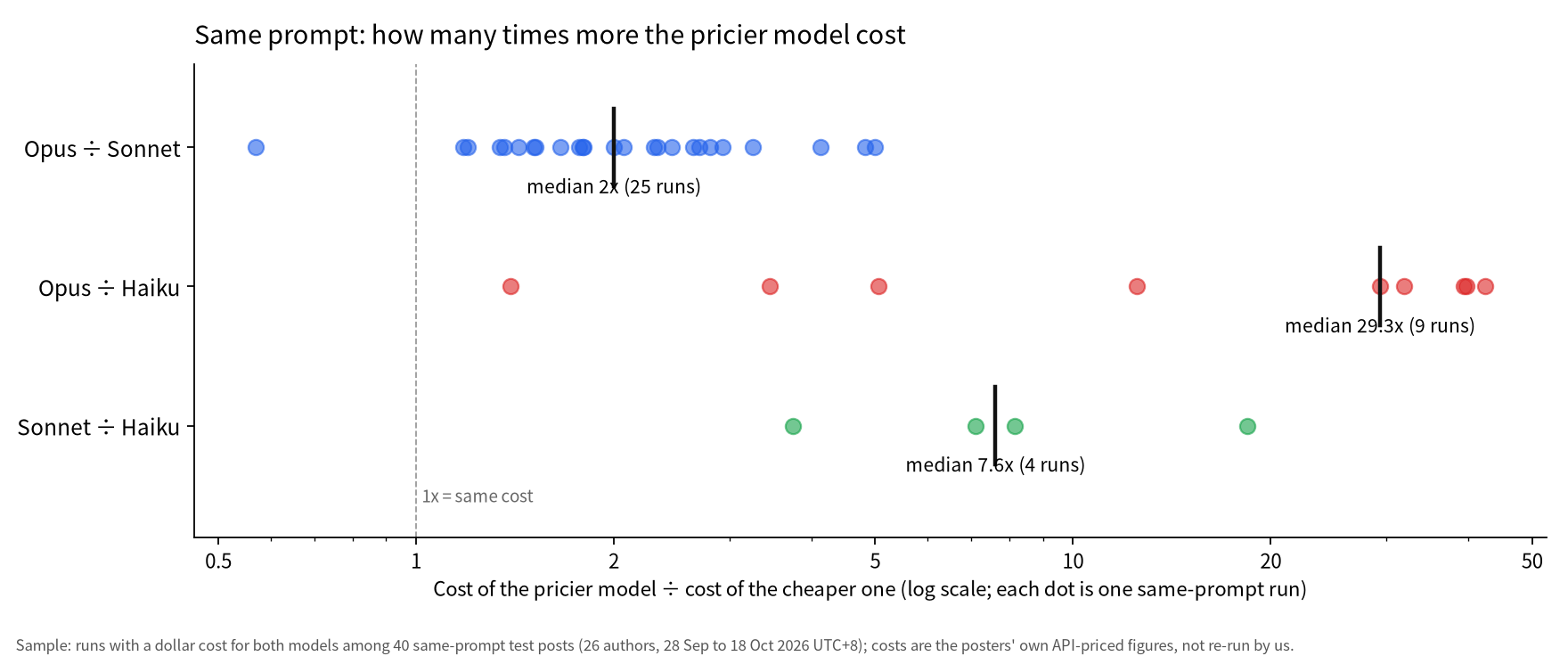
Sample/method: Sample: same-prompt runs with dollar costs for both models (25 Opus/Sonnet, 9 Opus/Haiku, 4 Sonnet/Haiku); self-reported, not re-run by us.
These tests have limits. Most are single runs on prompts the authors chose, mostly 3D and animation, and the costs are mostly API-price estimates. Of the 692 posts, an AI first pass flagged 188 as same-prompt tests and manual reading kept 71. The rest were relays, Claude-vs-GPT posts or promotion.
Questions and answers
Can Sonnet 5.5 replace Opus 5.5?
For many one-shot builds, yes. In 49 Opus vs Sonnet tests, 13 preferred Sonnet and 4 said the cheaper model was enough, while Opus won 16 on detail and physics. Anthropic positions Opus for complex, long-running agentic work.
Is Haiku 5.5 worth using?
For drafts, sub-agents and simple scenes, yes. In user runs it cost a median of about one twenty-ninth of Opus, but with less detail and sometimes more time. Its official per-token price rises fivefold for prompts over 100,000 tokens.
Why does Sonnet 5.5 sometimes cost more than Opus 5.5?
Its API default effort is high while Opus's is medium (official), and several reports show Sonnet using more tokens or turns per task. Artificial Analysis cost per task, as relayed, was $7.67 for Sonnet against $5.98 for Opus.
What do Opus 5.5, Sonnet 5.5 and Haiku 5.5 cost on the API?
Per million input/output tokens: $4/$20 for Opus 5.5, $2/$10 for Sonnet 5.5, and $0.10/$0.50 for Haiku 5.5 (rising to $0.50/$2.50 for prompts over 100,000 tokens). The Batch API is 50% off.