GPT-6.1 Terra review: how much faster and cheaper it was in same-task tests, and where it lost on quality
GPT-6.1 Terra is the fastest and cheapest way to get a decent result from OpenAI right now, but not the best-looking one. In 30 same-task bills posted by users it was cheaper 28 times with a median gap of 5.0x and finished faster in 29 of 31 timed pairs, yet of 30 people who judged quality, 23 preferred the rival, and none of the 12 who compared it directly with Claude Sonnet 5.5 picked Terra.
Use GPT-6.1 Terra for drafts, high-volume simple jobs, sub-agents, and any workflow where waiting costs more than visual polish. Keep Claude Sonnet 5.5 or Claude Opus 5.5 when the finished look of the result matters, and reserve GPT-6.1 Sol or GPT-6 Astra for difficult coding, just as OpenAI advises.
On raw unit pricing, Terra lists at $1.00 per million input tokens and $5.00 per million output tokens. That is half the price of GPT-6.1 Sol and Claude Sonnet 5.5, one quarter the price of Opus 5.5, and one tenth the price of GPT-6 Astra. Ultra-budget alternatives such as Claude Haiku 5.5 and DeepSeek V4.1 Flash remain cheaper per token on paper.
When measured by completed task bills rather than list rates, rivals cost a median 5.0x more across 30 user receipts. Claude Sonnet 5.5 cost a median 45.0x more, Opus 5.5 was 8.7x higher, and Haiku 5.5 was 3.3x higher. The only two exceptions in that set were GPT-6.1 Sol on one extended job and DeepSeek V4.1 Flash on one 3D scene, which came out to roughly identical bills.
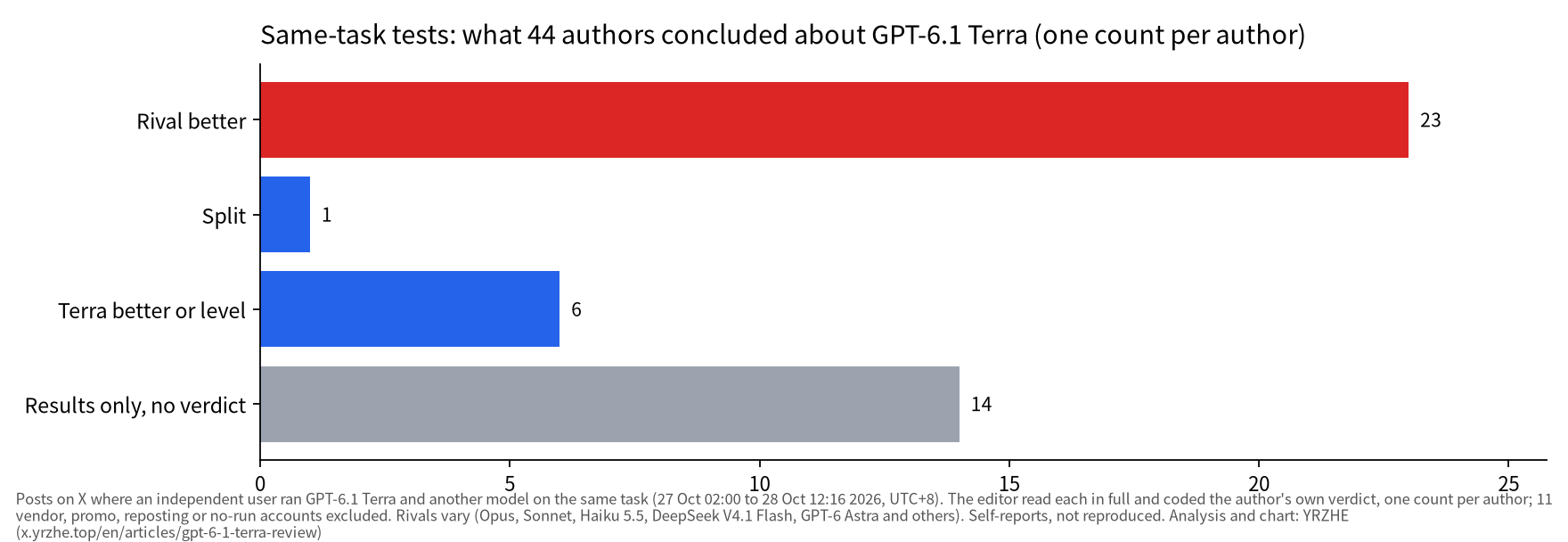
Quality judgments went the other way. Among 30 authors who declared a winner, 23 preferred the competing model, while only 6 favored Terra or called the result level. Not one of the 12 side-by-side Sonnet 5.5 reviews went to Terra, and only 2 of 9 Opus 5.5 verdicts gave Terra an outright win.
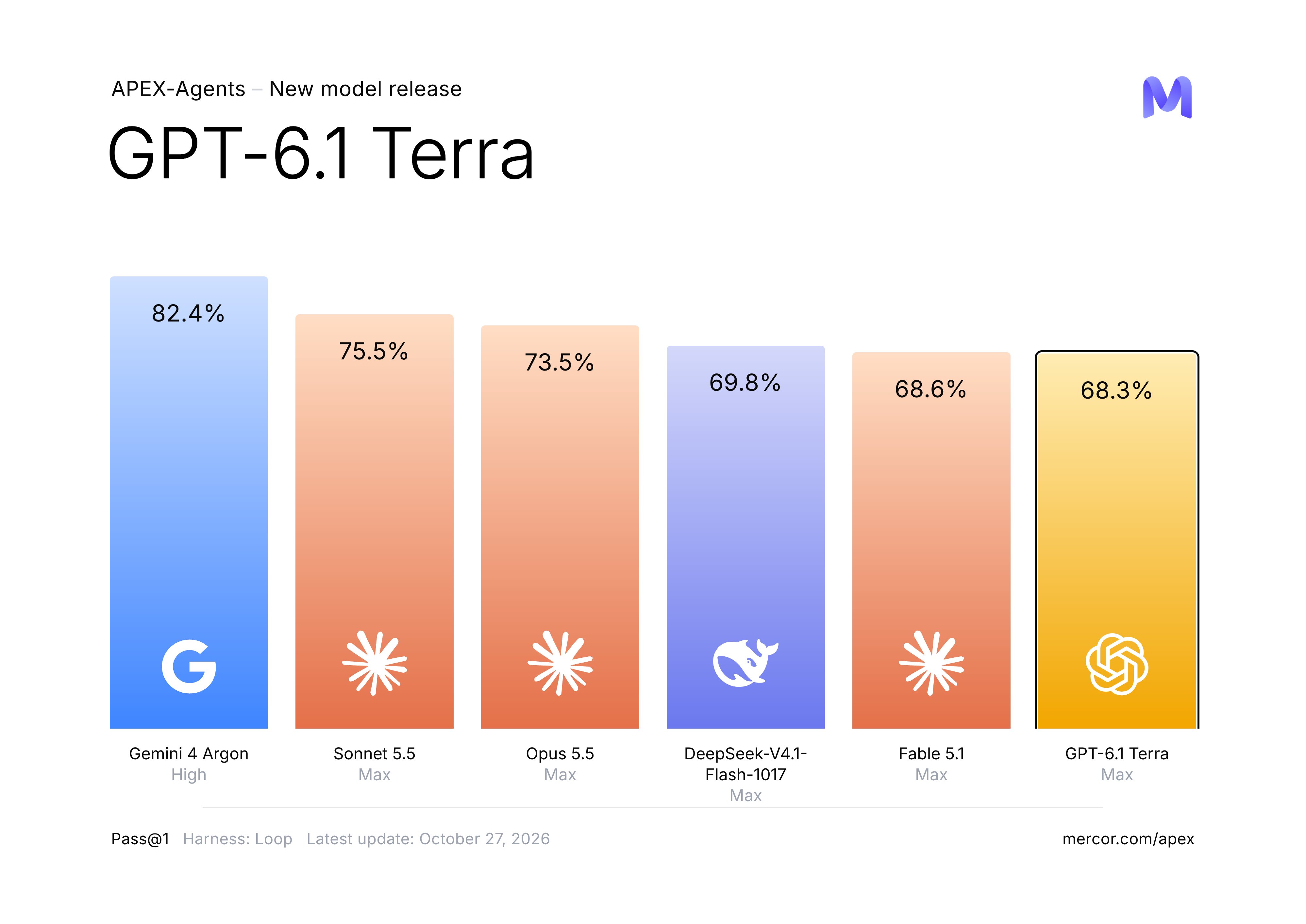
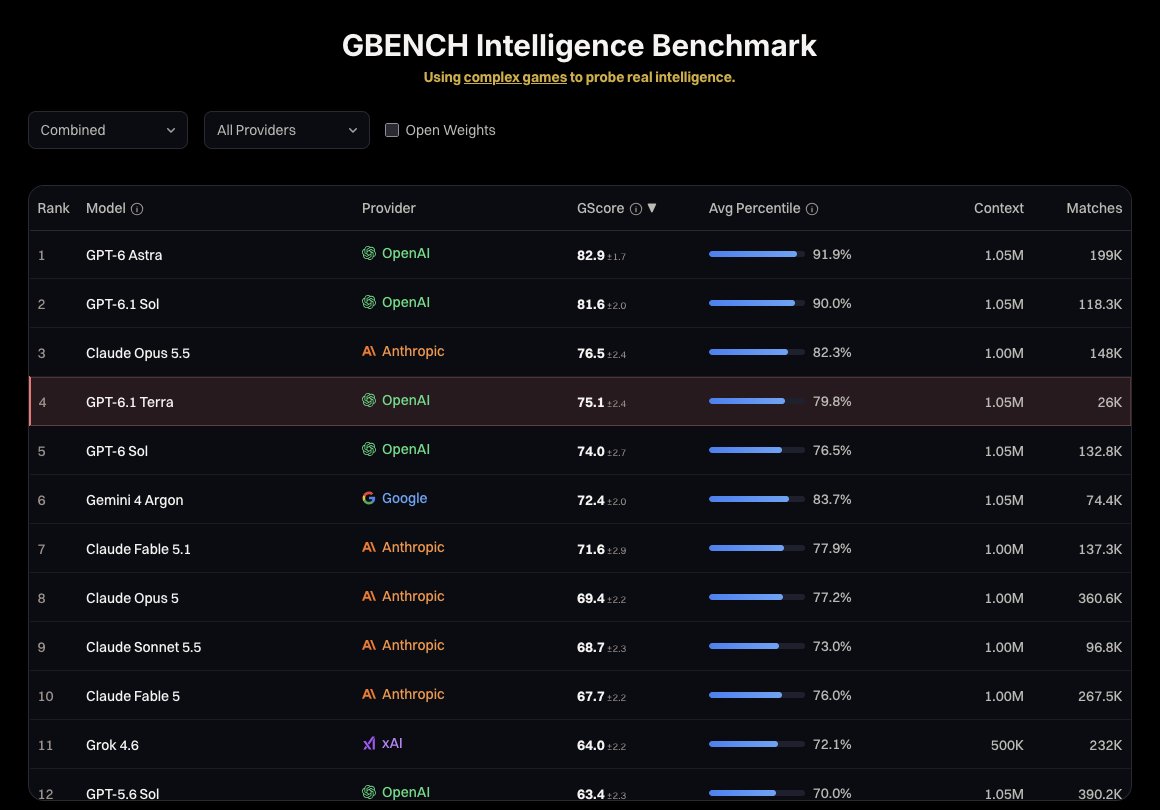
Formal benchmarks reflect that division. OpenAI reports that Terra matches its flagship GPT-6 Astra on Agents' Last Exam. Independent benchmark platforms place it in the middle of the pack, scoring 51 on Artificial Analysis Intelligence Index v5, sixth place on Mercor APEX-Agents, and fourth on GBENCH.
More same-task tests are in the GPT-6 Astra collection, the DeepSeek V4.1 Flash collection and the Opus 5.5 collection; see also GPT-6 Sol vs Astra, Opus, Sonnet and Haiku 5.5 compared and our DeepSeek V4.1 Flash review.
What GPT-6.1 Terra is: price, effort levels and where to use it
Terra is OpenAI's new middle tier, released on 26 October 2026, priced at half the rate of GPT-6.1 Sol and pitched at computer use, image understanding, and writing rather than hard software engineering.
According to OpenAI's official launch announcement, Terra scores 15 points above GPT-5.6 Terra on Agents' Last Exam, matching GPT-6 Astra at one tenth of Astra's per-token rate. OpenAI states that Terra runs more than 3x faster than Astra and Sol, and at maximum reasoning effort delivers roughly 9x lower cost per task than Claude Opus 5.5. The lab also explicitly states: 'For the most complex coding tasks, GPT-6.1 Sol and GPT-6 Astra remain the better choice.'
Table: API list prices compared (checked 28 October 2026)
| Model | Input (per 1M tokens) | Cached input | Output (per 1M tokens) | Notes |
|---|---|---|---|---|
| GPT-6.1 Terra | $1.00 | $0.05 | $5.00 | input above 272K tokens: 2x input, 1.5x output; Batch / Flex half price |
| GPT-6.1 Sol | $2.00 | $0.10 | $10.00 | OpenAI's pick, with Astra, for complex coding |
| GPT-6 Astra | $10.00 | $1.00 | $50.00 | OpenAI's top tier |
| Claude Opus 5.5 | $4.00 | $0.20 | $20.00 | |
| Claude Sonnet 5.5 | $2.00 | $0.10 | $10.00 | |
| Claude Haiku 5.5 | $0.10 | $0.01 | $0.50 | $0.50 / $0.05 / $2.50 for prompts over 100K tokens |
| DeepSeek V4.1 Flash | ¥2 peak / ¥1 off-peak | ¥0.04 / ¥0.02 | ¥8 / ¥4 | peak is 9–12 and 14–18 Beijing time on weekdays; USD list price we checked on 18 Oct: $0.30 / $1.20 at peak |
Sample/method: Sources: OpenAI API pricing and GPT-6.1 Terra model page, Claude API pricing, DeepSeek pricing page (Chinese), all opened 28 Oct 2026; DeepSeek USD prices from our 18 Oct check. Unit prices only, not cost per task. Compiled by YRZHE.
On the developer API, Terra offers reasoning effort settings from none to max, defaulting to medium. The model features a 1.05 million token context window with up to 128,000 max output tokens. Context usage beyond 272,000 input tokens incurs a surcharge, billed at 2x input and 1.5x output rates. Batch and Flex processing modes run at a 50 percent discount, while tool calling requires integration through OpenAI's Responses API.
ChatGPT subscribers access the model through ChatGPT Work and Codex across Plus, Pro, Business, Enterprise, and Edu plans, where it appears in the Advanced model selector. It is not available in Chat. Support for the model was also rolled into Codex CLI version 0.165.0 on 27 October.
Table: Allowances inside ChatGPT (Plus, official docs)
| Model | ChatGPT Plus local messages per 5 hours | Credits per 1M tokens (input / cached / output) |
|---|---|---|
| GPT-6 Astra | 5–45 | 250 / 25 / 1,250 |
| GPT-6.1 Sol | 15–160 | 50 / 2.5 / 250 |
| GPT-6.1 Terra | 35–285 | 25 / 1.25 / 125 |
| GPT-6 Luna | 350–3,000 | — |
Sample/method: Source: ChatGPT docs pricing and usage page, opened 28 Oct 2026. Message counts are ranges that depend on task size; OpenAI says overall plan limits are unchanged. Compiled by YRZHE.
For paying ChatGPT subscribers, these allowances give Terra roughly twice the 5-hour message allocation of Sol at half the credit consumption rate. OpenAI notes that overall account plan limits remain unchanged.
Same-task bills: faster and cheaper almost every time
Speed and operational price are the specific claims in OpenAI's announcement that user receipts consistently substantiate. Across 30 head-to-head bill comparisons posted by 14 authors on X, Terra was cheaper in 28 cases; across 31 timed pairs from 16 authors, it completed the task first in 29 runs.
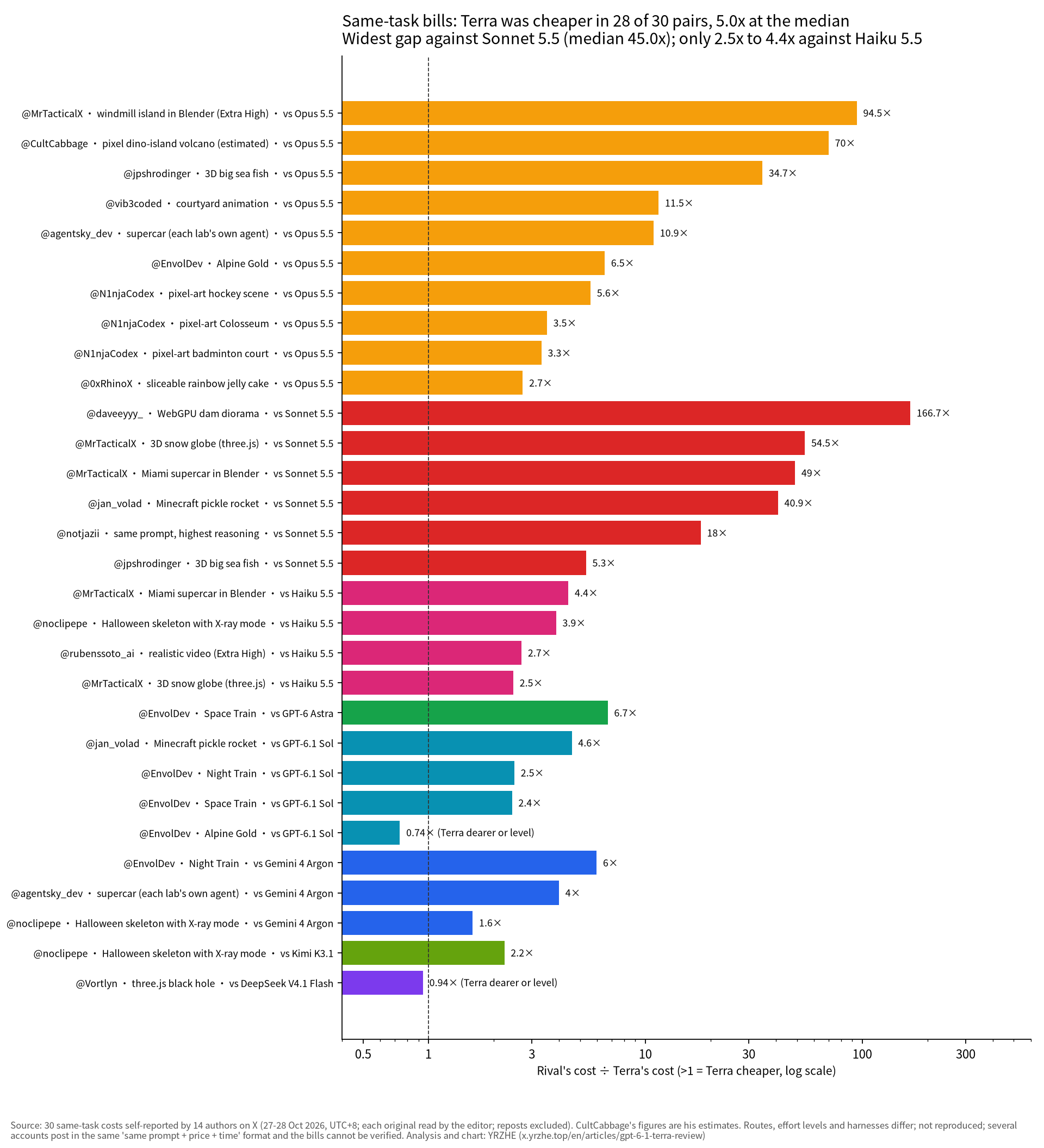
Sample/method: 30 same-task costs self-reported by 14 authors on X, each checked against the post; self-reported, not reproduced. Analysis and chart: YRZHE (x.yrzhe.top/en/articles/gpt-6-1-terra-review)
Table: Same-task bills, grouped by rival
| Rival | Pairs with cost | Terra cheaper | Rival cost ÷ Terra (median) | Pairs with time | Terra faster | Rival time ÷ Terra (median) |
|---|---|---|---|---|---|---|
| Claude Opus 5.5 | 10 | 10 | 8.7x | 6 | 6 | 3.1x |
| Claude Sonnet 5.5 | 6 | 6 | 45.0x | 7 | 7 | 12.5x |
| Claude Haiku 5.5 | 4 | 4 | 3.3x | 5 | 5 | 2.9x |
| GPT-6.1 Sol | 4 | 3 | 2.5x | 4 | 3 | 2.2x |
| GPT-6 Astra | 1 | 1 | 6.7x | 1 | 1 | 1.6x |
| Gemini 4 Argon | 3 | 3 | 4.0x | 3 | 2 | 2.3x |
| DeepSeek V4.1 Flash | 1 | 0 | 0.9x | 4 | 4 | 10.1x |
| Kimi K3.1 | 1 | 1 | 2.2x | 1 | 1 | 5.3x |
Sample/method: 38 same-task results posted on X by 20 authors (27–28 Oct 2026, UTC+8), each read by the editor with attachments; a multiple above 1 means Terra was cheaper or faster. Tools and effort levels differ; bills not reproduced. Analysis by YRZHE.
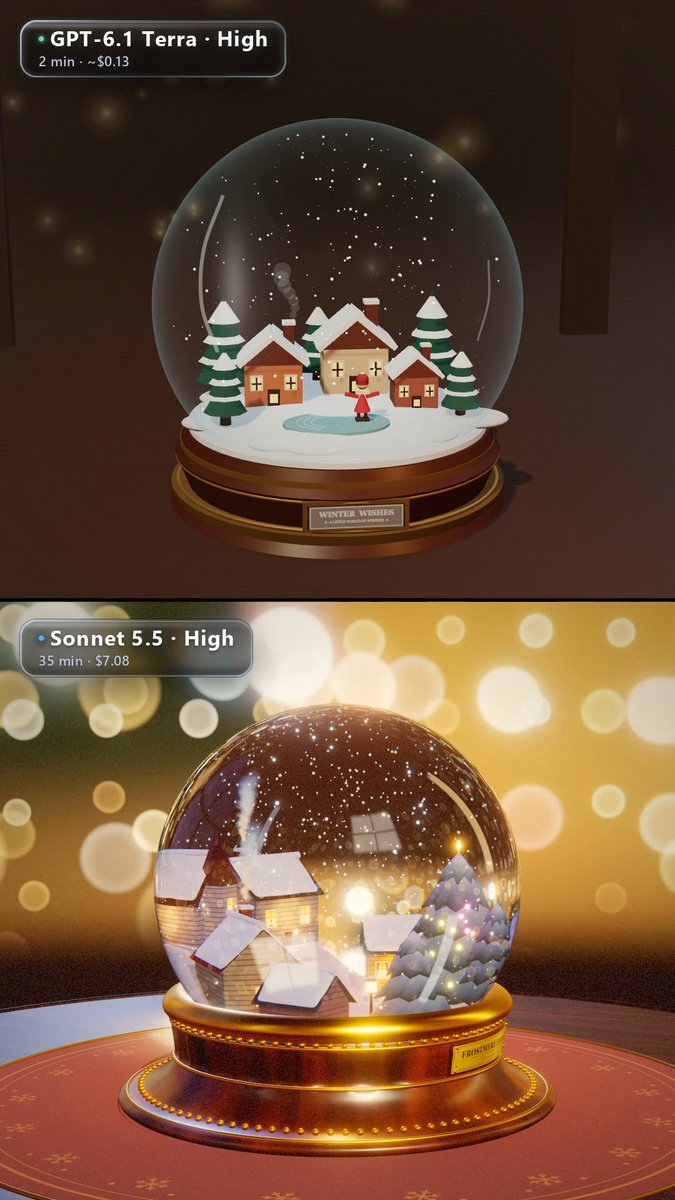
The largest differences appeared in comparisons against Claude Sonnet 5.5. Mr Tactical (@MrTacticalX) generated a 3D snow globe in three.js, logging 2 minutes and roughly $0.13 on Terra versus 35 minutes and $7.08 on Sonnet 5.5. Davey (@daveeyyy_) reported an even wider gap on a WebGPU dam diorama, where Terra cost $0.09 compared to $15 on Sonnet 5.5.
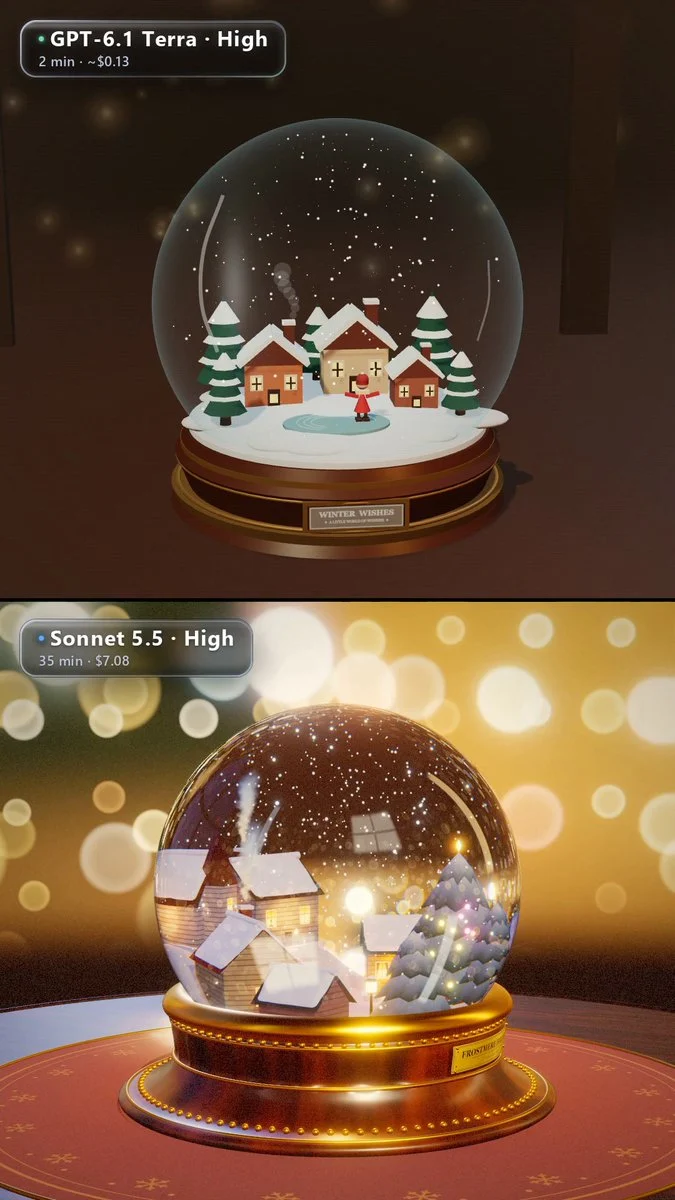
Mr Tactical (@MrTacticalX) posted a video frame comparing a single prompt for a 3D snow globe on 27 October 2026, showing GPT-6.1 Terra finishing in 2 minutes for about $0.13 while Claude Sonnet 5.5 required 35 minutes and $7.08. The numbers are the poster's own and were not reproduced. (Item: GPT-6.1 Terra vs Sonnet 5.5: same prompt, 3D snow globe in three.js)
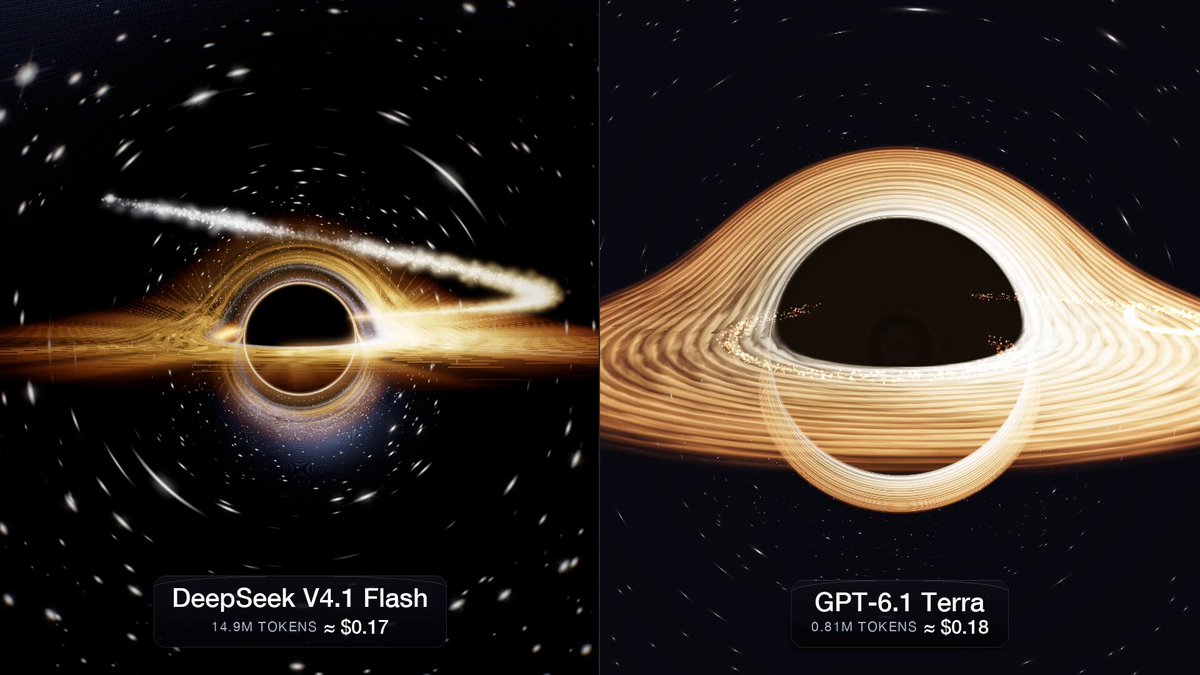
Detailed token receipts indicate that Terra achieves lower costs largely by generating concise outputs. In an evals.ag benchmark shared by chacha (@maker_evan), Terra finished in 79 seconds while outputting 3,500 tokens; by contrast, DeepSeek V4.1 Flash ran for 32 minutes and produced 220,000 output tokens for $0.29, while Claude Opus 5.5 took 16 minutes and 79,000 tokens. Similarly, Vortlyn (@Vortlyn) logged 0.81 million tokens on Terra versus 14.9 million tokens on DeepSeek.
The brevity is not fixed, though. It varies by configuration: Artificial Analysis observed that Terra was 'somewhat verbose' at maximum reasoning effort, consuming 99 million output tokens across its standard index compared to a median of 63 million.
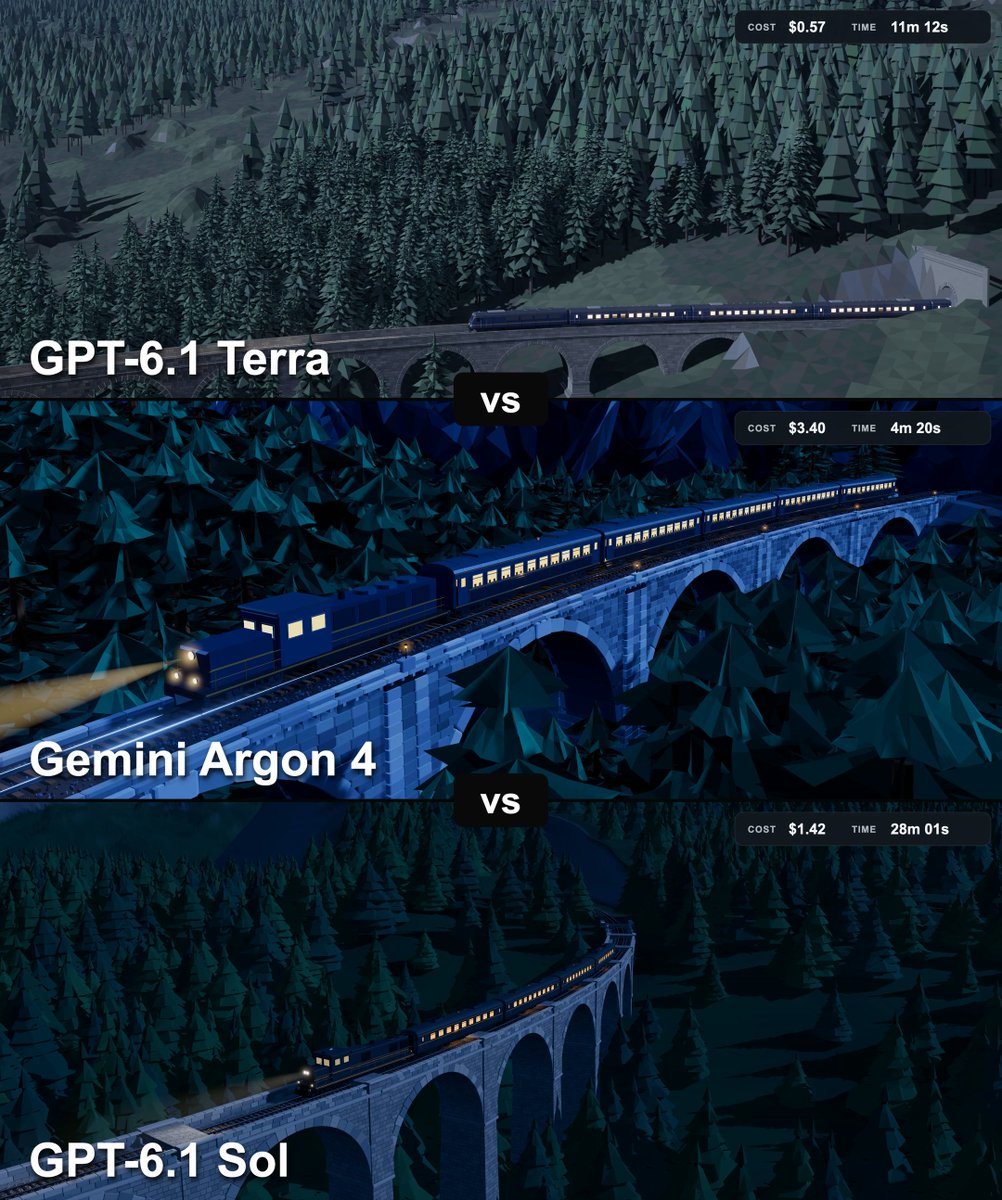
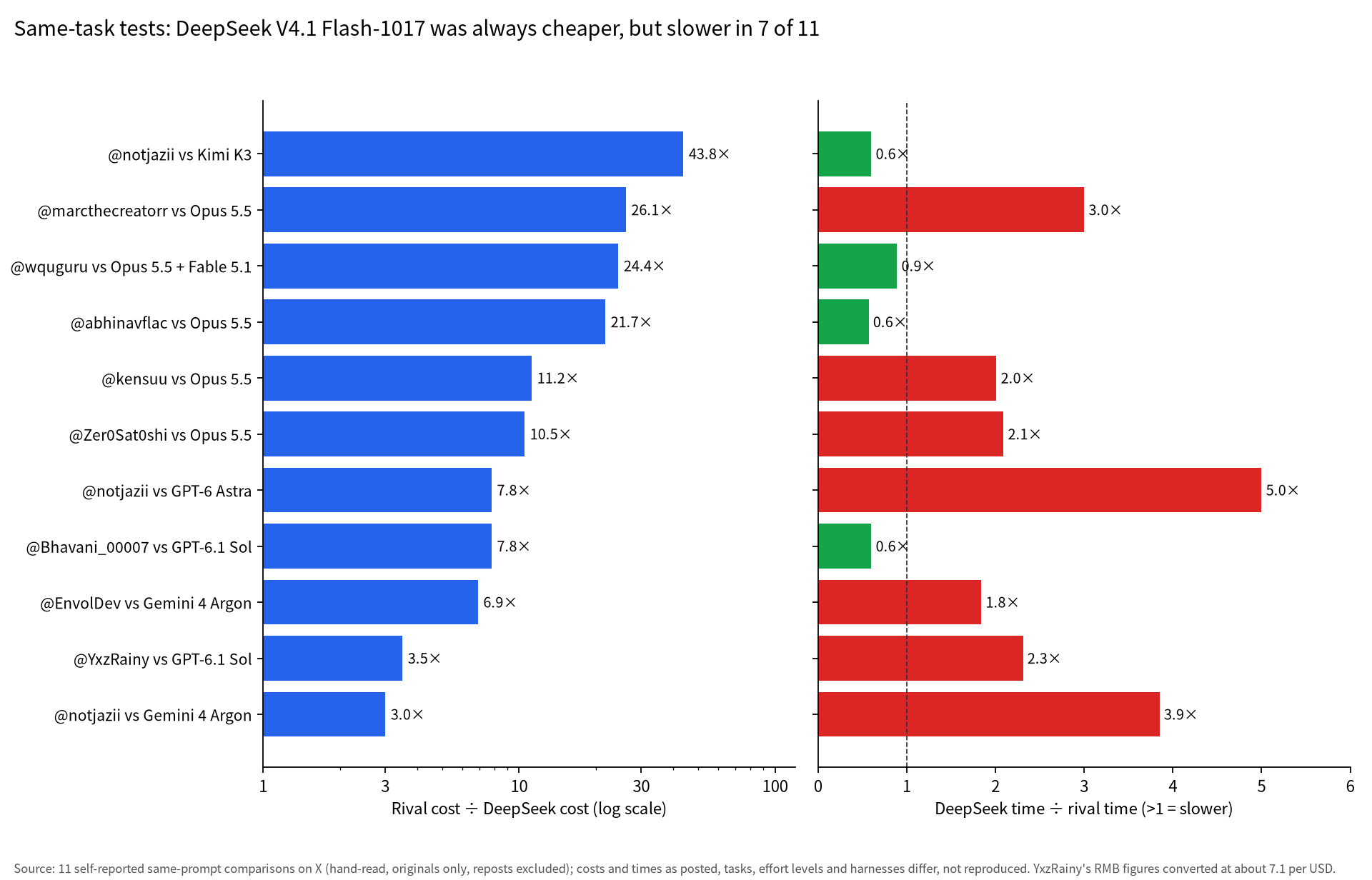
A few runs diverged from the broader trend. In an Alpine Gold benchmark published by Tony (@EnvolDev), Terra cost $4.90 while GPT-6.1 Sol cost $3.62, with both runs taking 43 minutes. On a Night Train prompt, Tony (@EnvolDev) recorded 11.2 minutes on Terra compared to 4.3 minutes on Gemini 4 Argon, though Terra remained about 6x cheaper. In a three.js black hole test from Vortlyn (@Vortlyn), Terra and DeepSeek V4.1 Flash came out to nearly identical bills of $0.18 and $0.17, respectively, but Terra finished in 2.5 minutes while DeepSeek took 34 minutes.
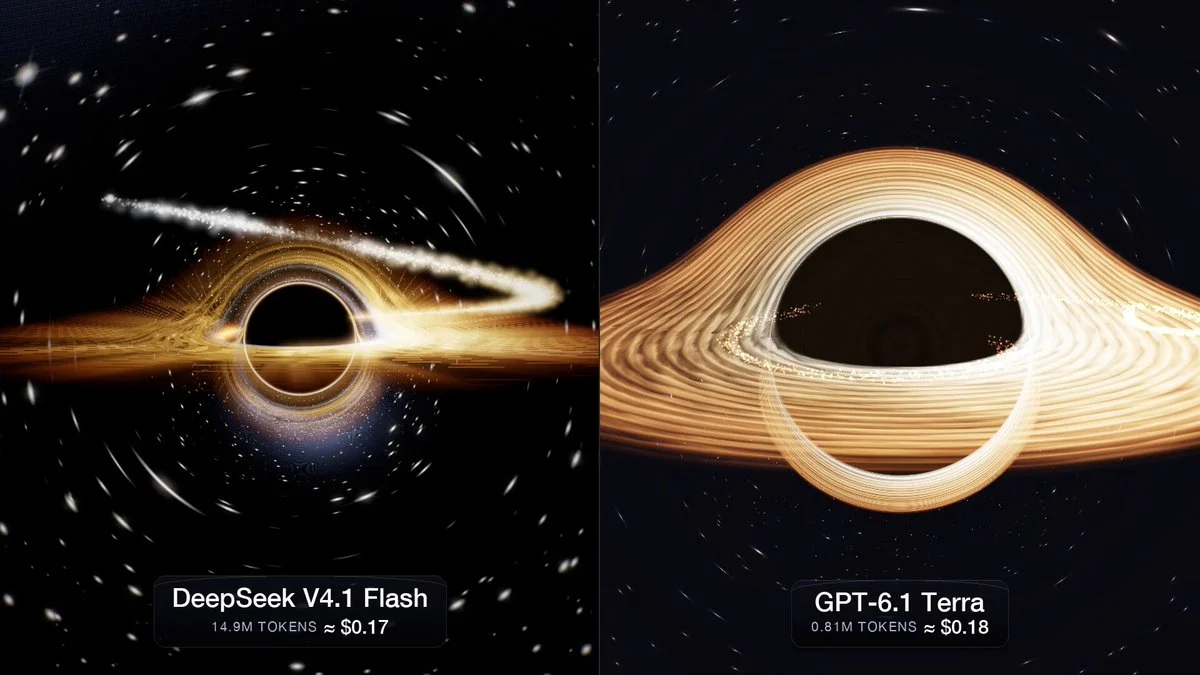
Vortlyn (@Vortlyn) shared a video frame on 27 October 2026 showing a three.js black hole generated by DeepSeek V4.1 Flash for $0.17 over 34 minutes alongside GPT-6.1 Terra at $0.18 over 2.5 minutes. The comparison shows Terra matching DeepSeek on overall spend while completing the build significantly faster. (Item: Same three.js black hole prompt: V4.1 Flash takes 34 min and $0.17, GPT-6.1 Terra 2.5 min for $0.18)
A caveat: many of these receipts came from accounts posting in the same 'same prompt + price + time' format within minutes of one another. We counted each account once, but every bill is self-reported and none could be verified. In addition, user setups varied in their reasoning effort tiers and client tools.
Quality: most people who judged it picked the rival
The cheaper, faster result was usually the plainer one.
Of 44 independent authors who tested Terra against an alternative model on identical prompts, 30 published an explicit verdict: 23 selected the competing model, 6 chose Terra or rated the pair as equal, 1 split the decision, and 14 presented raw outputs without declaring a preference.
Sample/method: Posts on X where an independent user ran GPT-6.1 Terra and another model on the same task (27 Oct 02:00 to 28 Oct 12:16 2026, UTC+8). The editor read each in full and coded the author's own verdict, one count per author; 11 vendor, promo, reposting or no-run accounts excluded. Rivals vary (Opus, Sonnet, Haiku 5.5, DeepSeek V4.1 Flash, GPT-6 Astra and others). Self-reports, not reproduced. Analysis and chart: YRZHE (x.yrzhe.top/en/articles/gpt-6-1-terra-review)
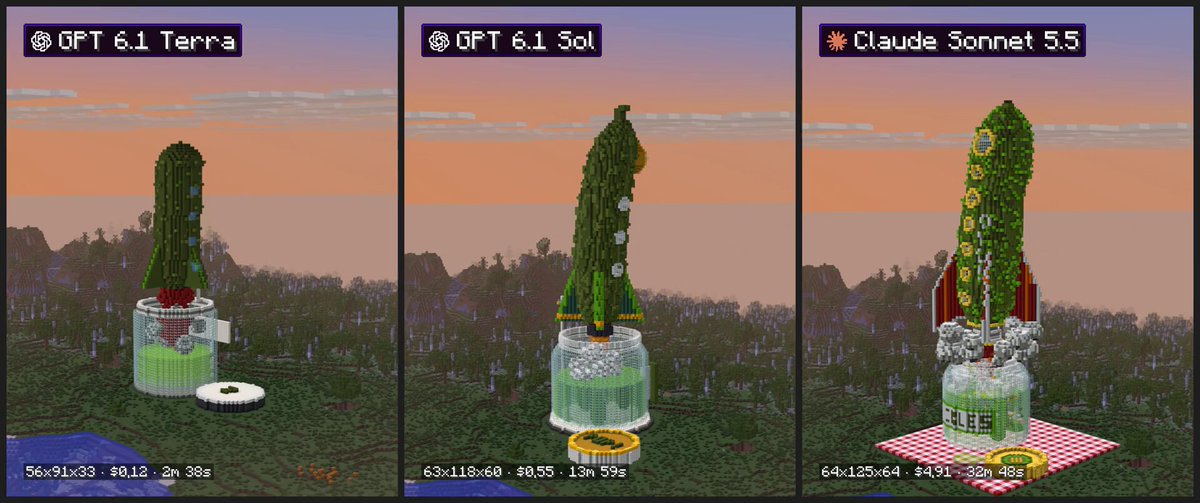
When matched against Claude Sonnet 5.5, 12 reviewers offered quality verdicts: 11 chose Sonnet, 1 split the result, and none picked Terra. Jan 🌕 (@jan_volad) wrote that 'Sonnet beats both by a mile, outside and inside' on a Minecraft build, where Terra's rooms were 'pretty bare'. Reviewer notjazii (@notjazii) stated that 'sonnet just mogged it from all sides' and concluded Terra is 'clearly made for simple and quick tasks', while IndependentEco (@IndependentEco) commented that 'Sonnet has better design taste'.
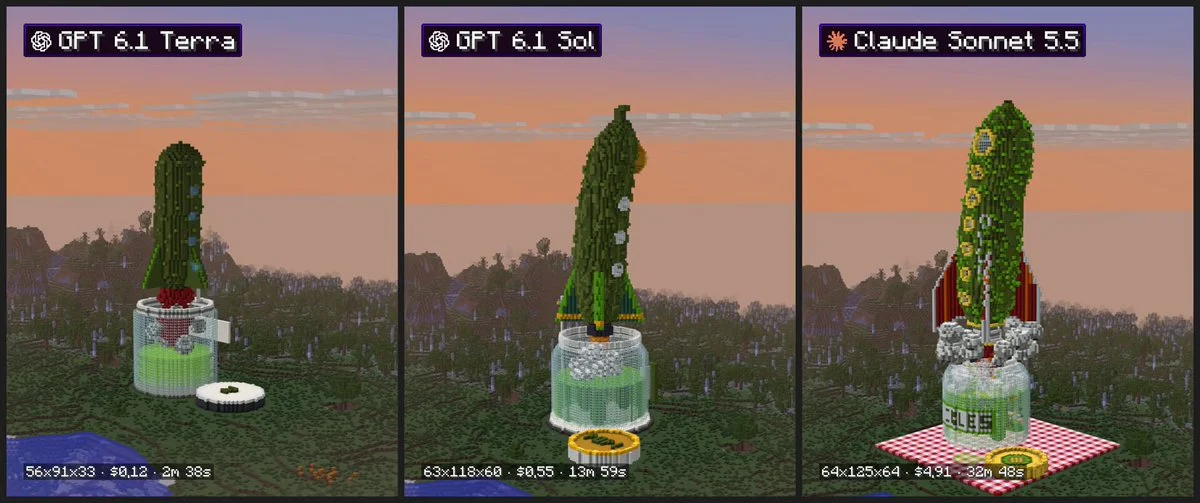
Jan 🌕 (@jan_volad) posted a Minecraft pickle rocket test on 27 October 2026 comparing GPT-6.1 Terra ($0.12 in 2 minutes 38 seconds), GPT-6.1 Sol ($0.55 in 13 minutes 59 seconds), and Claude Sonnet 5.5 ($4.91 in 32 minutes 48 seconds). The poster preferred Sonnet, whose rooms were 'packed with furniture and detail'. (Item: Minecraft pickle rocket: Claude Sonnet 5.5 vs GPT-6.1 Terra and Sol)
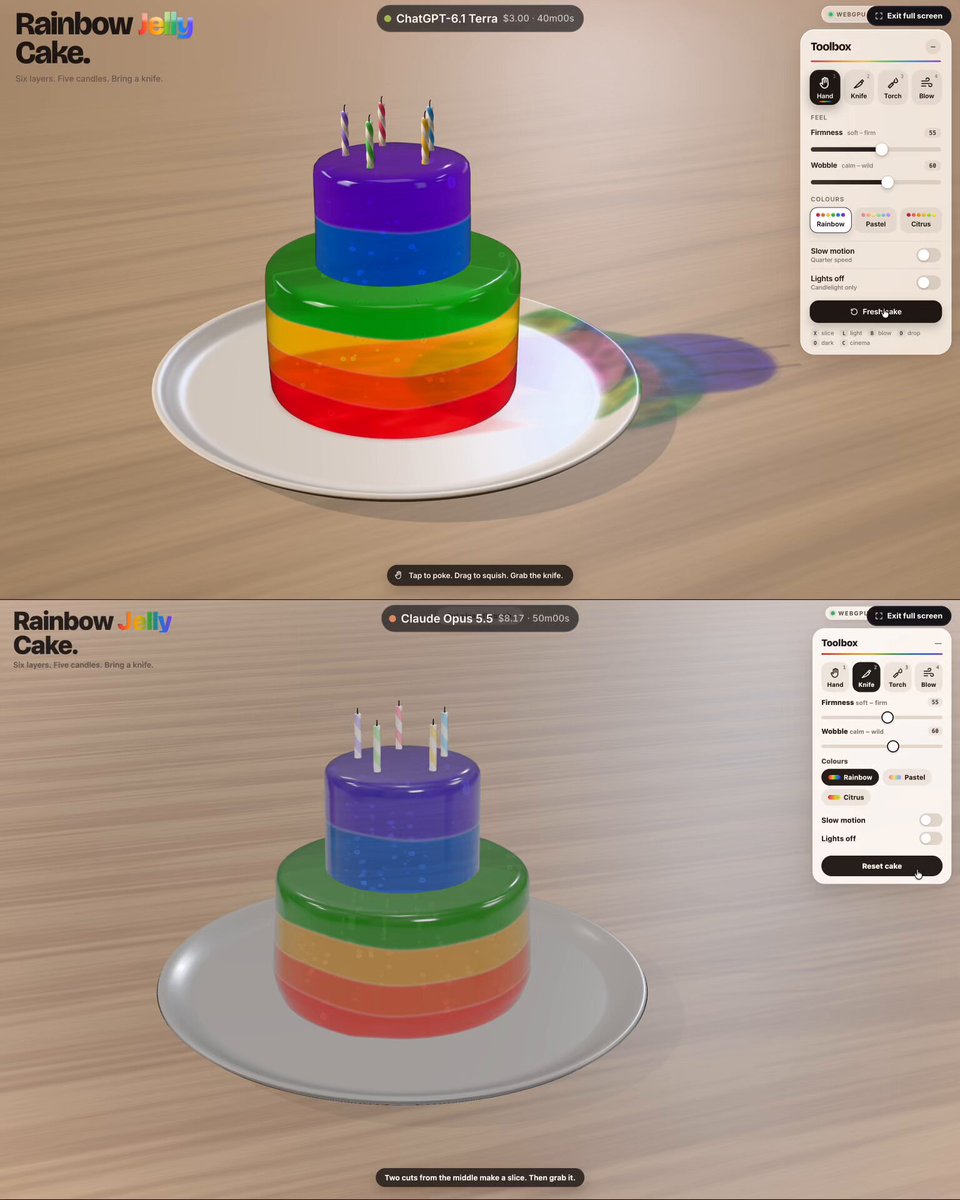
Against Claude Opus 5.5, 9 authors recorded verdicts, with 2 picking Terra outright. Rhino (@0xRhinoX) praised Terra's interactive rainbow jelly cake build, claiming it 'just out-jellied Opus. For $3', and VraserX (@VraserX) reported being 'blown away by how well GPT-6.1 Terra keeps up with Claude Opus 5.5'. Leo Linsky's (@leo_linsky) GBENCH ranking put Terra just below Opus, though on the cost-performance frontier, so we do not count it as a win. Edward Jr (@CultCabbage) summed up the other side: 'Opus wins the eruption. Terra wins on price.'
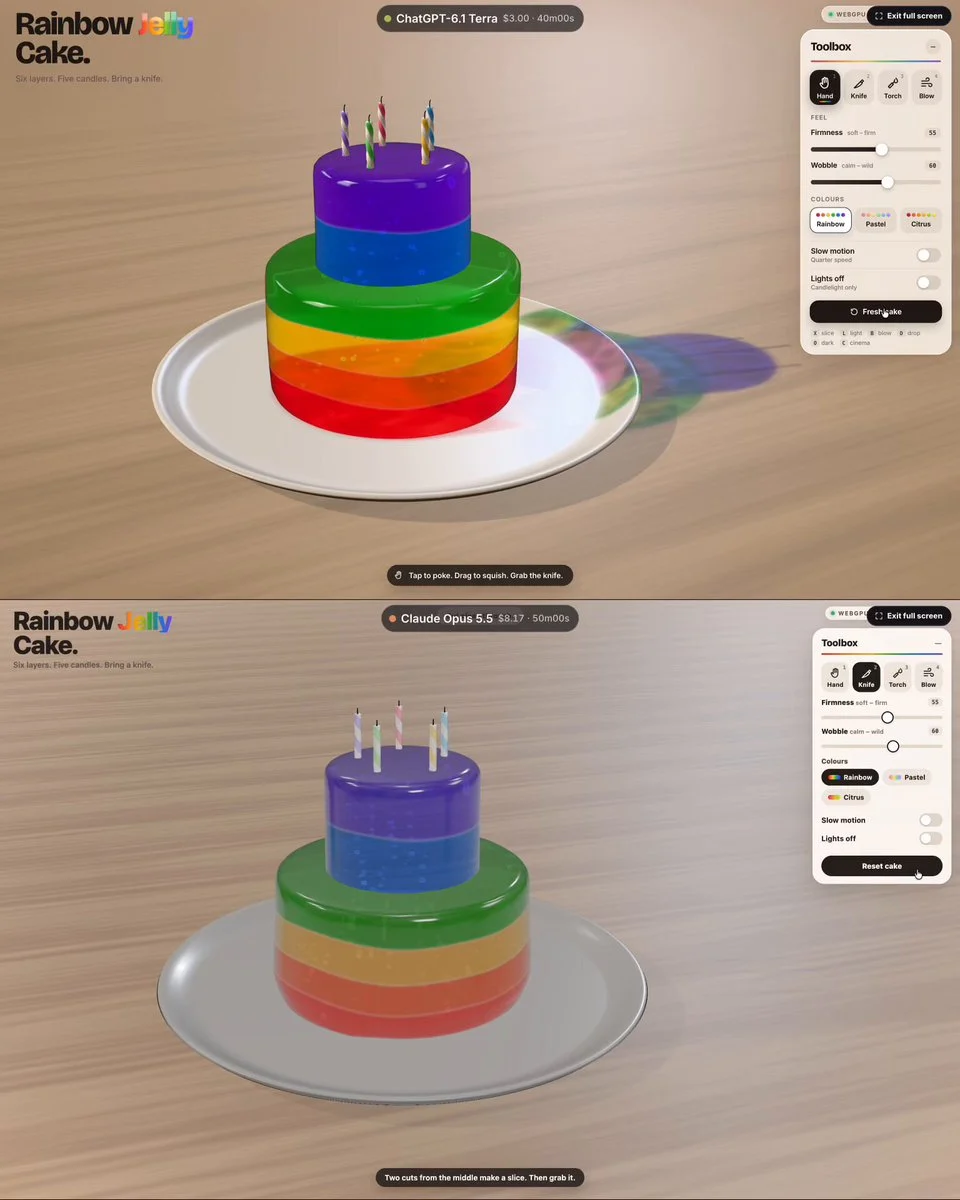
Rhino (@0xRhinoX) shared a video capture on 27 October 2026 of a sliceable rainbow jelly cake prompt, giving the win to GPT-6.1 Terra ($3.00) over Claude Opus 5.5 ($8.17). He wrote that every slice of Terra's cake 'bounces like real jelly', while Opus 'made a pretty cake. It just doesn't jiggle.' (Item: GPT-6.1 Terra vs Opus 5.5: same sliceable rainbow jelly cake prompt)
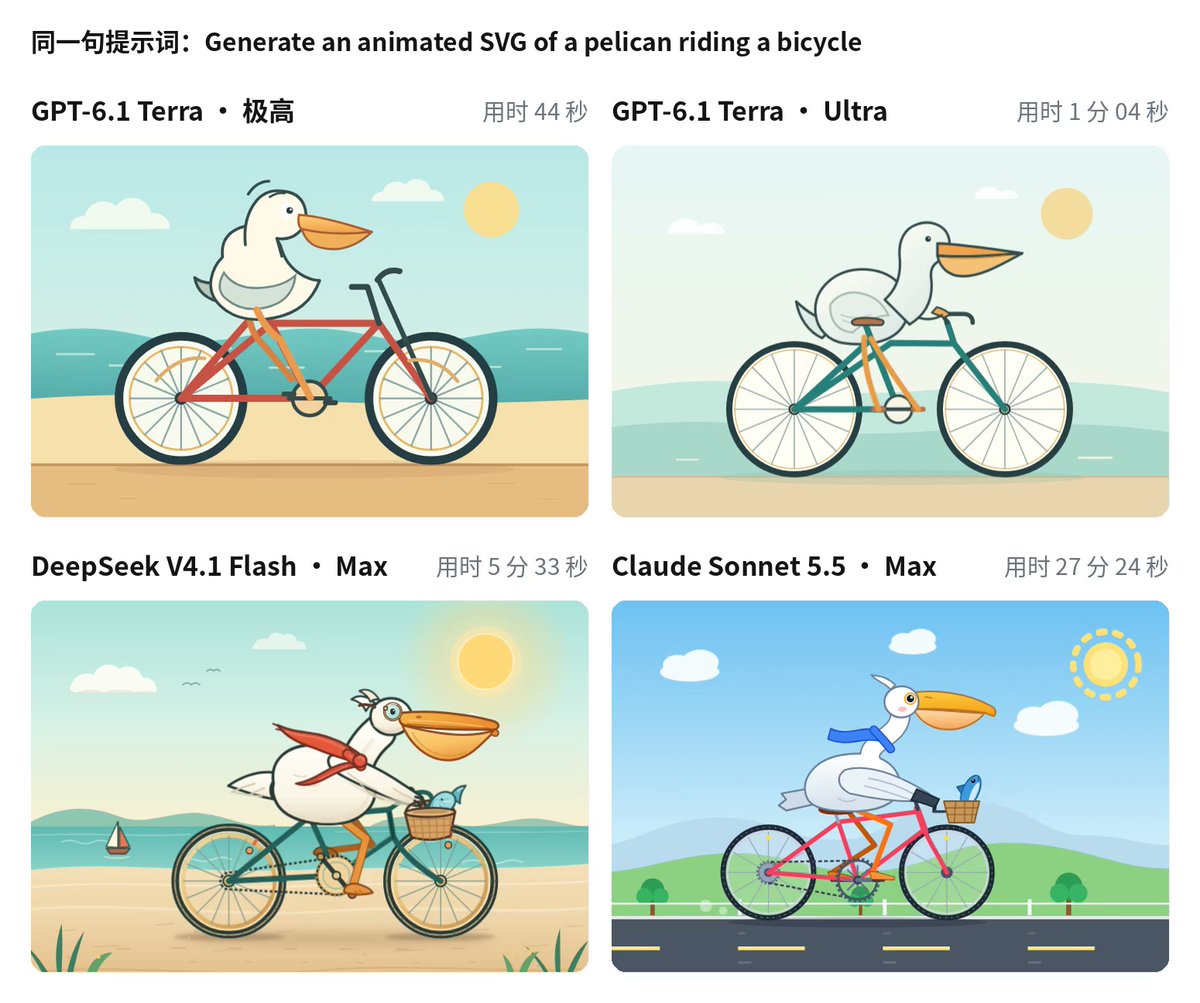
In comparisons with DeepSeek V4.1 Flash, the primary low-cost rival, DeepSeek took 4 out of 6 verdicts, primarily in animated SVG demonstrations. 雨哥向前冲 (@xiangxiang103) found Terra's drawing too simple and DeepSeek's 'fast and detailed'; Andy L (@AndyL5cc) thought Terra's details looked more natural but its motion logic and smoothness clearly worse. Leo · Building w/ AI (@leo114119) observed that Terra was more consistent overall but termed it 'a Haiku 5.5-level model', while Ann Nguyen (@ann_nnng) offered praise on a pixel animation, calling Terra 'crazy fast, cheap, and the work is actually good'.
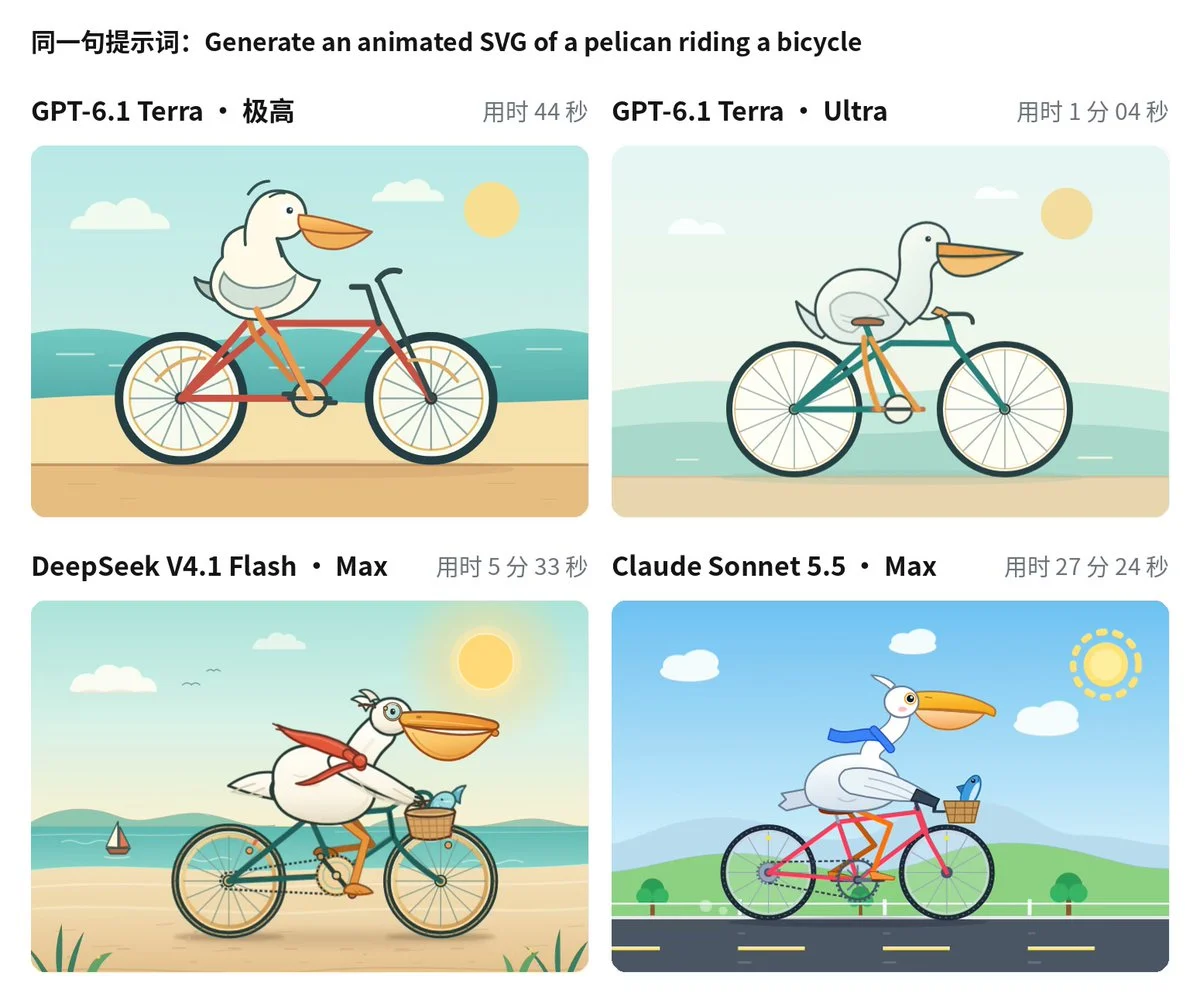
雨哥向前冲 (@xiangxiang103) published four video panels on 27 October 2026 showing an animated SVG pelican on a bicycle generated by GPT-6.1 Terra, Terra Ultra, DeepSeek V4.1 Flash Max, and Claude Sonnet 5.5 Max. The poster found Terra's version too simple even at the Ultra setting and picked DeepSeek as both fast and detailed. (Item: Pelican-on-bicycle SVG test: DeepSeek V4.1 Flash Max balances speed and detail)
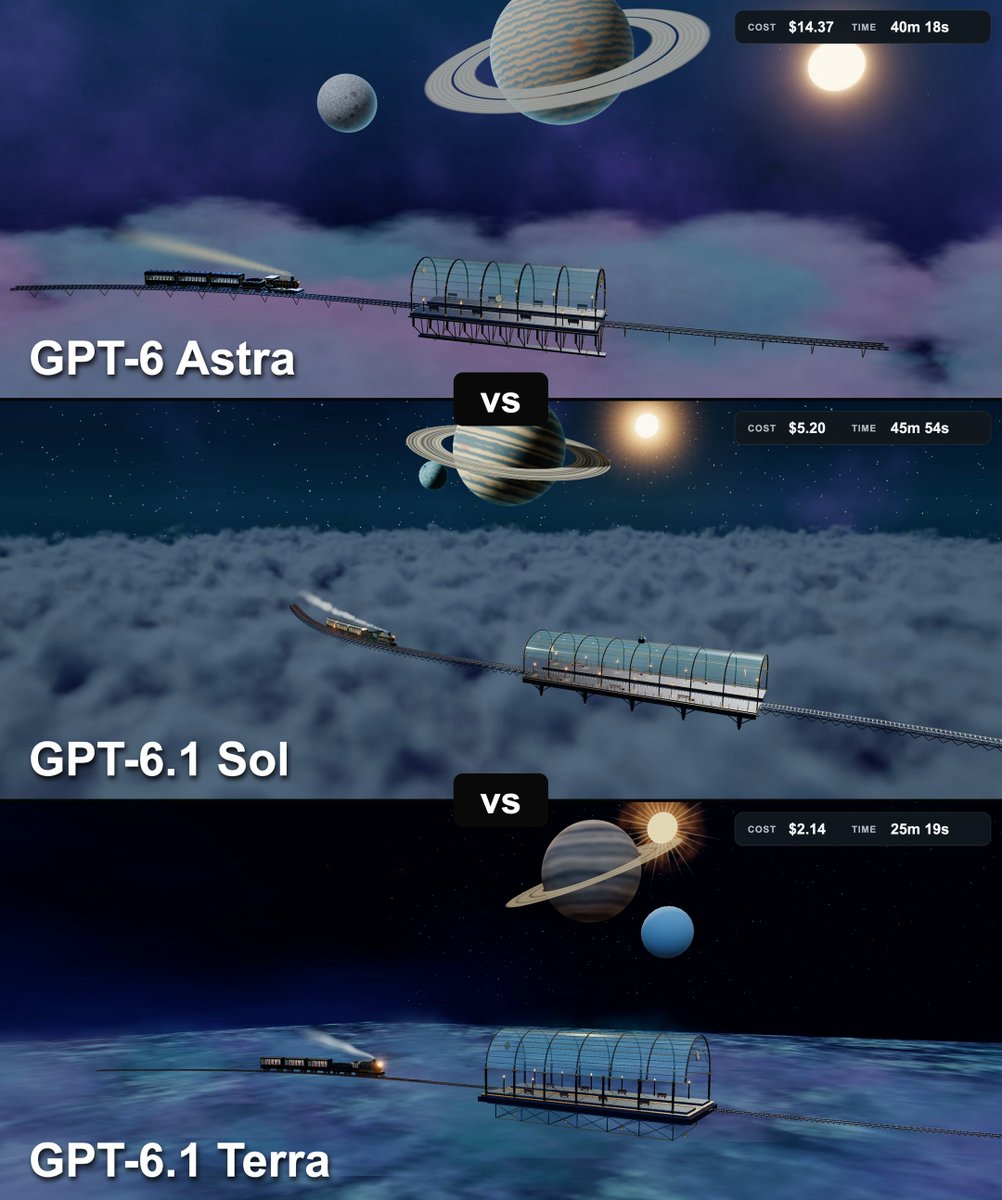
Within OpenAI's portfolio, Tony (@EnvolDev) ran a Space Train test pitting Terra against Astra and Sol, with Terra at a fraction of the bill, and picked Terra as the winner on a separate Night Train prompt. Tim Jayas (@TimJayas), after running one three.js scene on both, remarked on 'how good gpt-6-astra is against 6.1-terra'.
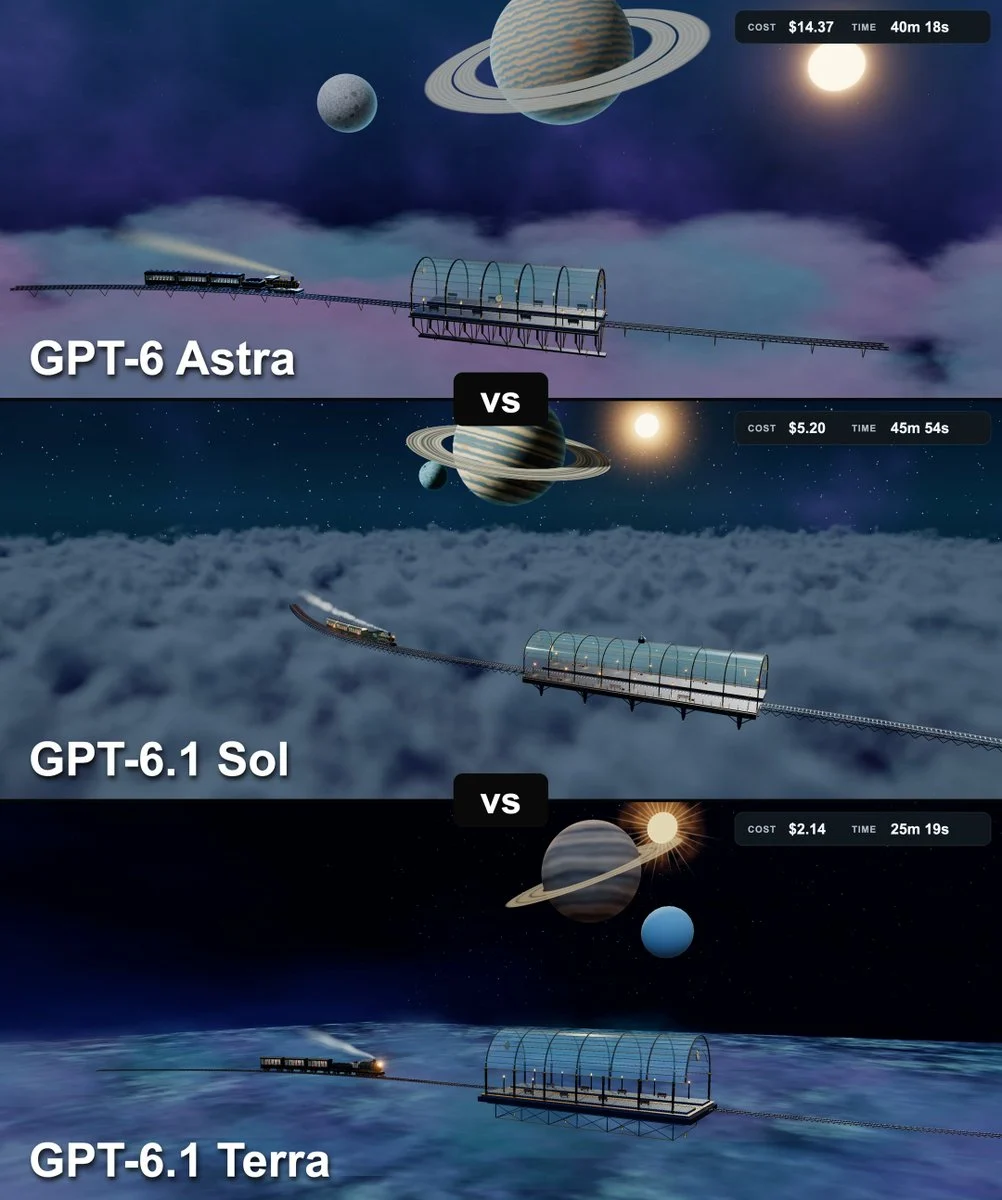
Tony (@EnvolDev) shared video frames on 27 October 2026 of a Space Train prompt comparing GPT-6 Astra ($14.37, 40 minutes), GPT-6.1 Sol ($5.20, 46 minutes), and GPT-6.1 Terra ($2.14, 25 minutes). Terra was both the fastest and the cheapest of the three on this task. (Item: Space Train benchmark: GPT-6 Astra slower and ~7x pricier than Terra)
One bias to keep in mind: nearly all of these were visual one-shots (three.js, Blender, SVG, pixel art), a genre where Claude is strong and not what OpenAI built Terra for.
Benchmarks: OpenAI says Astra-level, third parties put it mid-pack
OpenAI's official benchmark figures show substantial progress, particularly when contrasted against the older GPT-5.6 Terra, whereas third-party evaluators position the model below top-tier offerings like GPT-6 Astra, GPT-6.1 Sol, and Anthropic's flagship tier.
Table: Official and third-party test results
| Test (who ran it) | GPT-6.1 Terra | For comparison |
|---|---|---|
| Agents' Last Exam (OpenAI, self-reported) | 15 points above GPT-5.6 Terra | on par with GPT-6 Astra |
| Terminal-Bench 4.0, max effort (OpenAI, self-reported) | 50.3% | GPT-5.6 Terra 21.5% |
| Hallucination rate (OpenAI, self-reported) | 16.7% at low, 4.3% at max | GPT-5.6 Terra 53.6% |
| Artificial Analysis Intelligence Index v5 (max) | 51, #11 of 51 | $0.96 per index task; 90.9 tokens/s; about 78 s to first token |
| Mercor APEX-Agents, Pass@1 (max) | 68.3%, #6 | Gemini 4 Argon 82.4%, Sonnet 5.5 75.5%, Opus 5.5 73.5%, DeepSeek V4.1 Flash 69.8% |
| GBENCH combined (screenshot posted by leo_linsky) | 75.1, #4 | GPT-6 Astra 82.9, GPT-6.1 Sol 81.6, Opus 5.5 76.5, Gemini 4 Argon 72.4, Sonnet 5.5 68.7 |
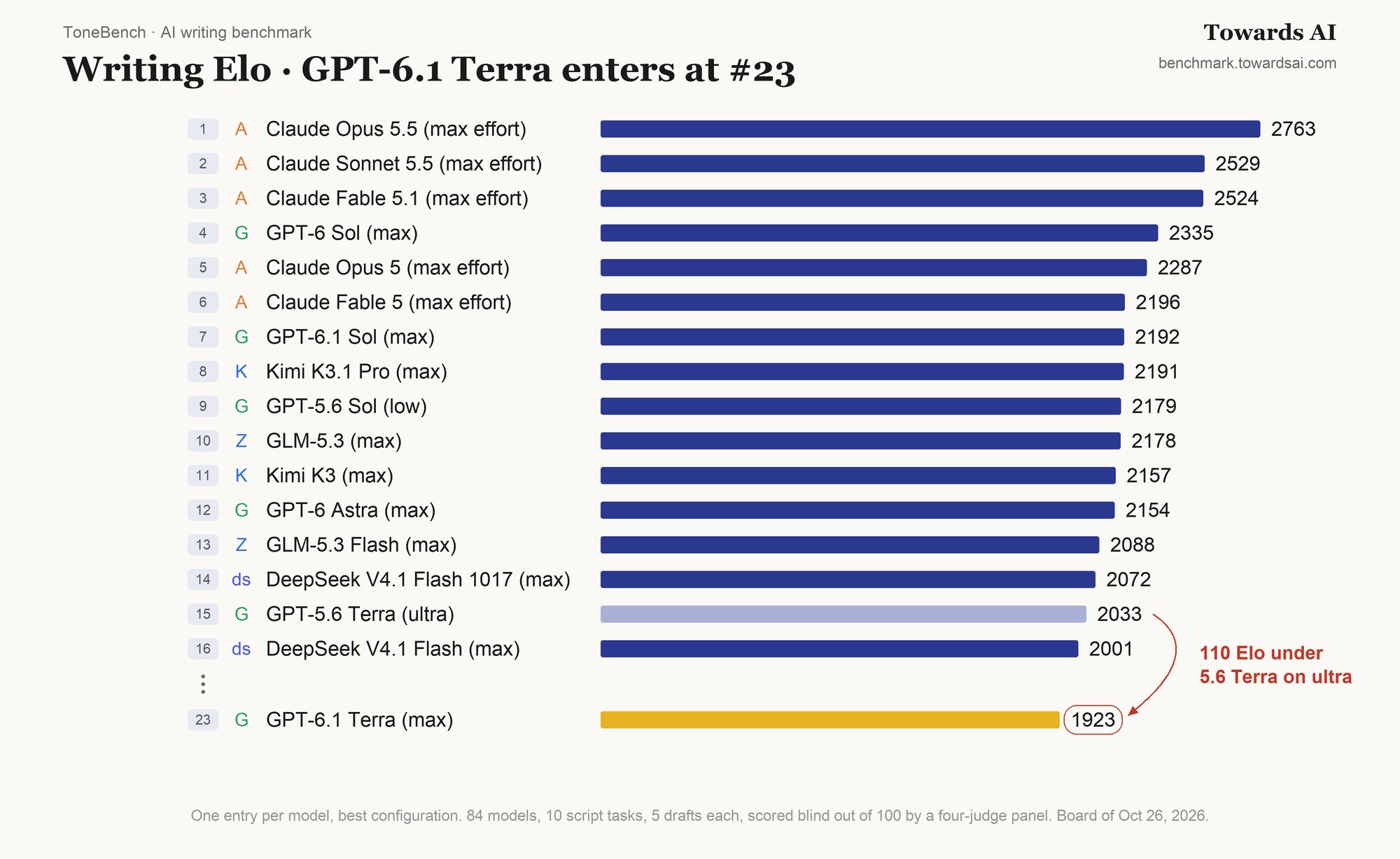
| ToneBench writing Elo (Whats_AI) | #23 of 84 | GPT-5.6 Terra #15 |
| Vision: reading text, detection, counting (skalskip92) | beat GPT-6 Astra | about 47% faster, about 92% cheaper |
Sample/method: First three rows from OpenAI's launch post (self-reported); Artificial Analysis from its model page, opened 28 Oct 2026 (the index is now v5; launch-day posts quoted 48 on v4); the rest from screenshots or posts on X, 27–28 Oct. Different setups; do not combine. Compiled by YRZHE.
On the Mercor APEX-Agents benchmark evaluating practical workplace agent tasks, Terra achieved a 68.3 percent Pass@1 rate to rank sixth overall, gaining 10.1 points over GPT-5.6 Terra. It finished second overall in management consulting at 80.9 percent, but slipped by 5.4 points in corporate legal workflows.
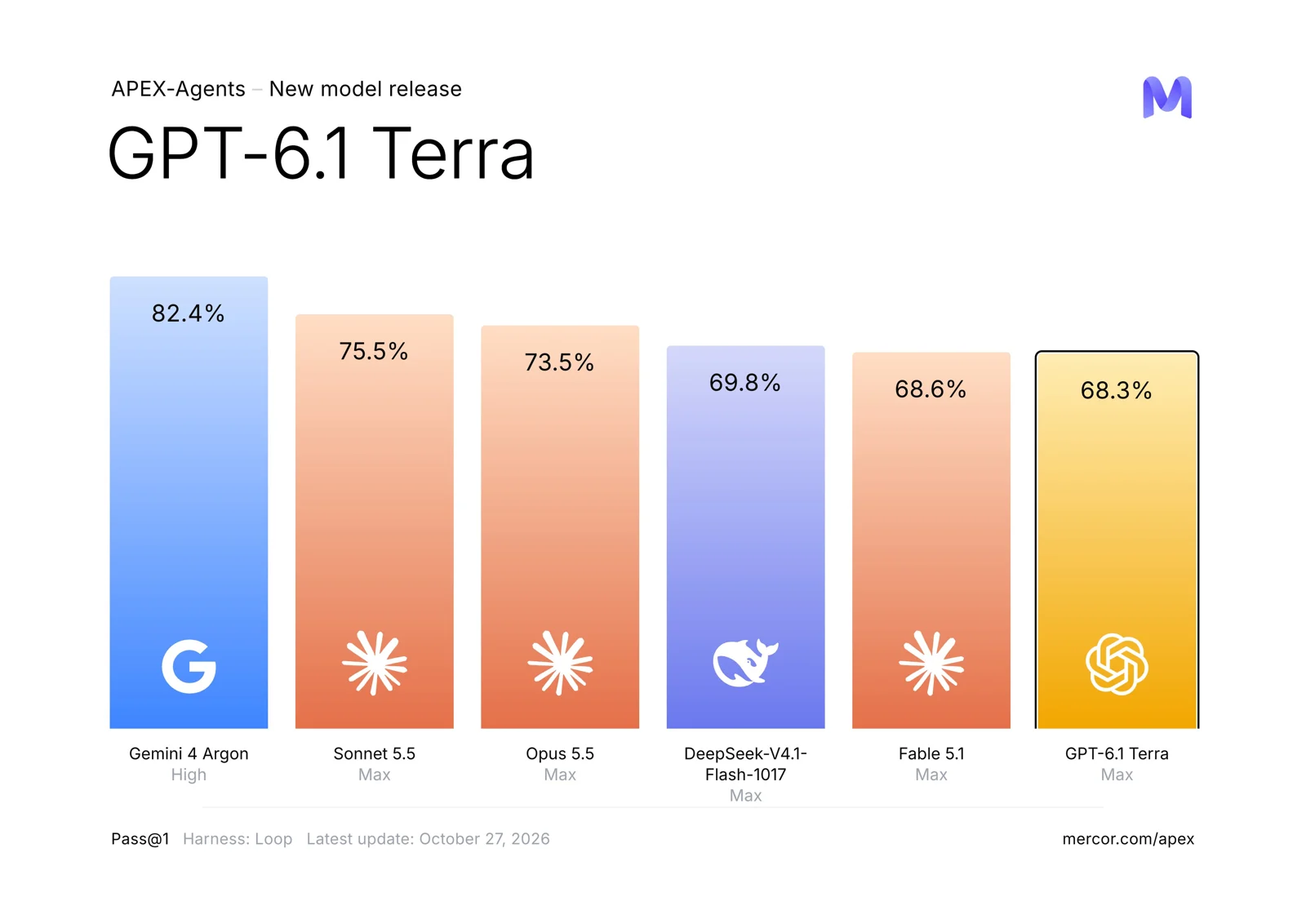
Mercor (@mercor) published an APEX-Agents leaderboard update on 27 October 2026 displaying GPT-6.1 Terra in sixth place at 68.3% Pass@1, trailing Gemini 4 Argon, Sonnet 5.5, Opus 5.5, DeepSeek V4.1 Flash and Fable 5.1. It measures one leaderboard's Pass@1, not overall quality on real work. (Item: GPT-6.1 Terra trails Gemini 4 Argon on APEX-Agents consulting tasks)
On GBENCH, which scores models by having them play complex games, Terra ranked fourth with a combined score of 75.1, placing just behind Opus 5.5 at 76.5 while outscoring Gemini 4 Argon at 72.4 and Sonnet 5.5 at 68.7.
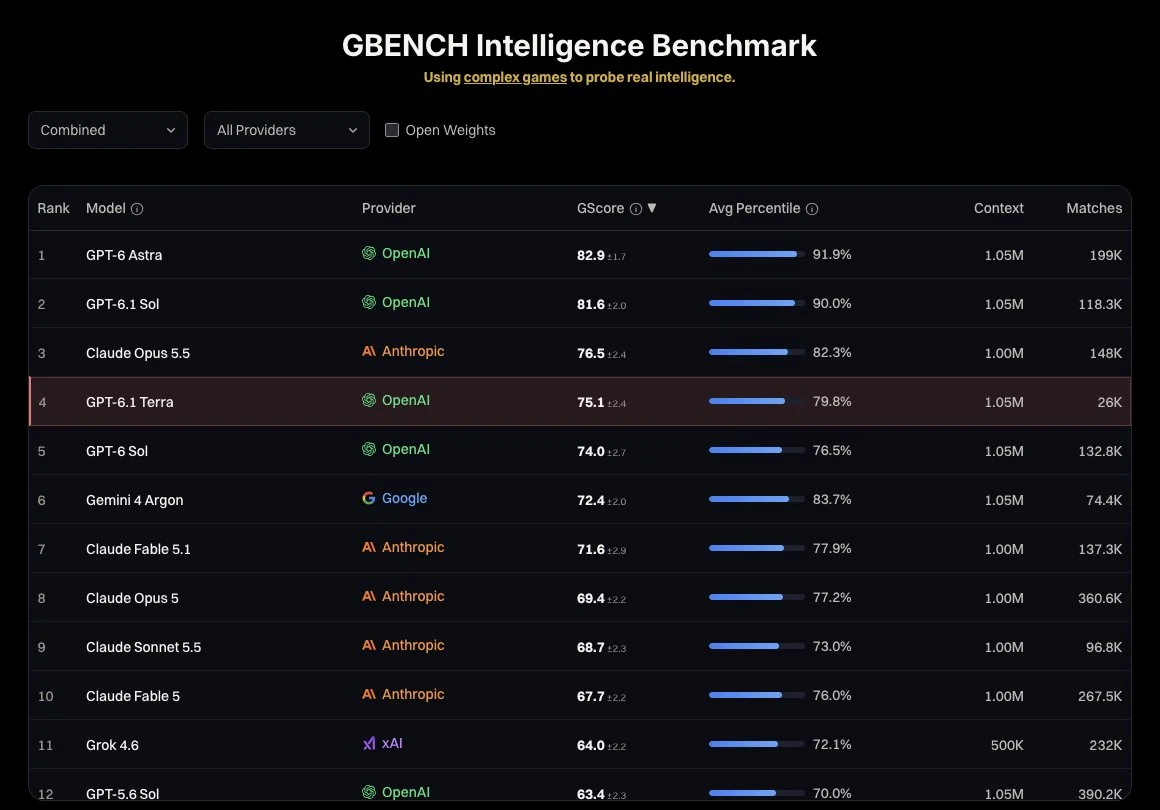
Leo Linsky (@leo_linsky) posted a screenshot of the GBENCH combined leaderboard on 28 October 2026 showing GPT-6.1 Terra in fourth position at 75.1, behind GPT-6 Astra, GPT-6.1 Sol, and Claude Opus 5.5. He described Terra as sitting on the cost-performance (Pareto) frontier. (Item: GBENCH: GPT-6.1 Terra coding lands between Gemini 4 Argon and Opus 5.5)
On writing, Louis-François Bouchard (@Whats_AI) shared ToneBench evaluations placing Terra at rank 23 of 84 models, falling behind the older GPT-5.6 Terra at rank 15 despite writing being highlighted by OpenAI as a core competency. In contrast, visual evaluations by skalskip92 (@skalskip92) showed Terra outperforming GPT-6 Astra on text recognition, object detection, and counting while running approximately 47 percent faster and 92 percent cheaper.
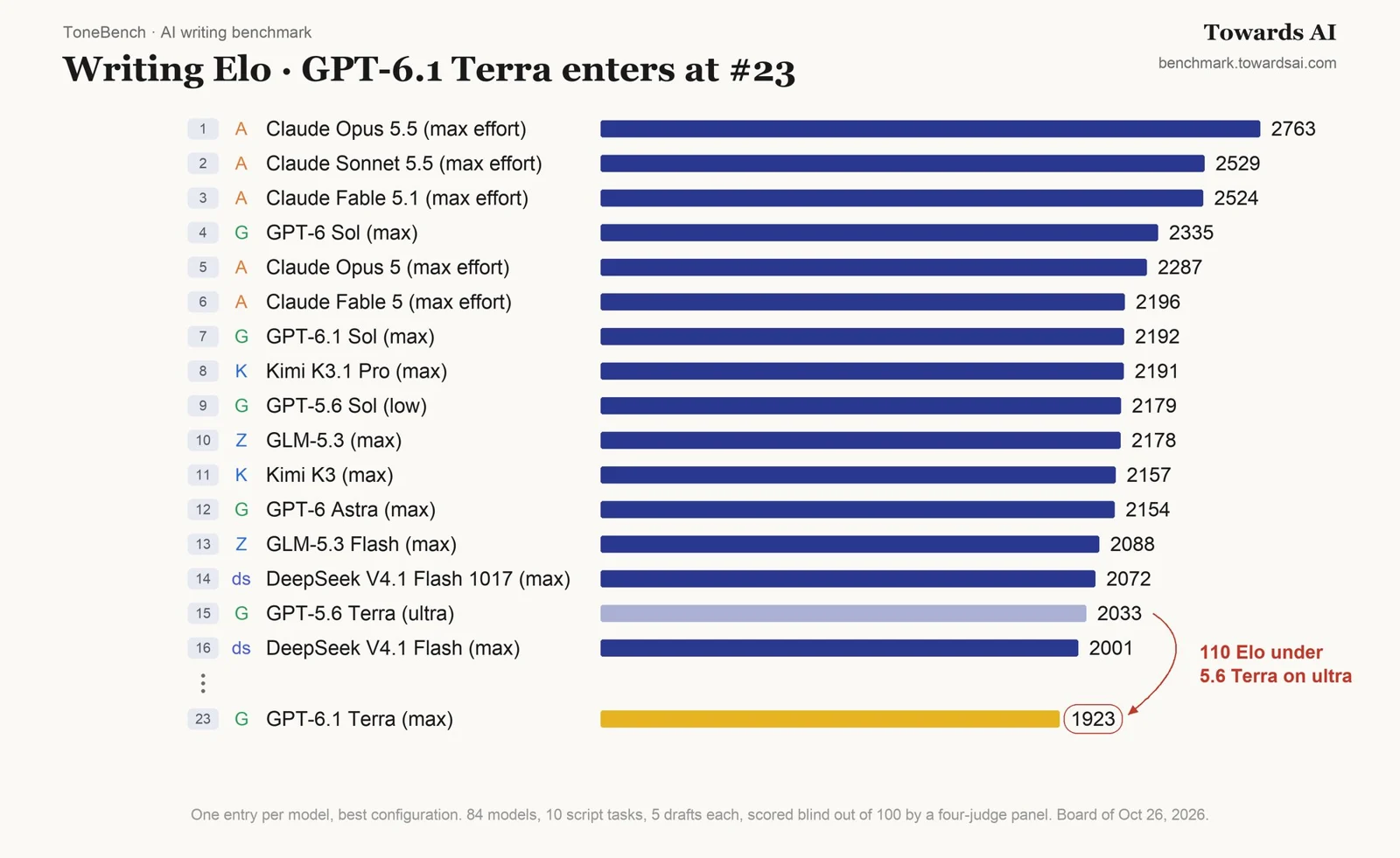
Louis-François Bouchard (@Whats_AI) shared a ToneBench Elo ranking chart on 27 October 2026 showing GPT-6.1 Terra entering at 23rd place out of 84 evaluated models. On this writing test it ranked below its predecessor. (Item: ToneBench: DeepSeek V4.1 Flash 1017 writes better than GPT-6.1 Terra at $0.014 per script)
Artificial Analysis updated its benchmark suite to Index v5 shortly following Terra's release. While early launch posts cited a score of 48 under Index v4, the current v5 listing places Terra at 51, ranking 11th out of 51 evaluated models. It records an execution cost of $0.96 per index task, 90.9 output tokens per second, and a latency of approximately 78 seconds to the first output token at maximum reasoning effort.
Where it fits: sub-agents, high-volume simple work and vision
Users who reported successful implementations with GPT-6.1 Terra utilized it primarily as an operational worker rather than as an orchestrating lead model.
X user shion_takk (@shion_takk) noted that medium to high reasoning effort was enough for his research tasks and runs Terra as a worker under Sol or Astra. Similarly, GKev1n (@GKev1n) stated that Terra's capabilities are insufficient to challenge Opus 5.5 and that he uses it strictly as a sub-agent, echoing notjazii (@notjazii), who called it 'clearly made for simple and quick tasks'.
Vision workloads represent the single technical category where third-party testing showed Terra surpassing Astra, based on evaluations from skalskip92 (@skalskip92). Computer use, the headline use in OpenAI's launch post, had almost no first-hand tests in our sample. Treat that claim as unverified by users so far.
For programming pipelines, users should heed OpenAI's guidance and use Sol or Astra for the hardest coding tasks. A Terminal-Bench 4.0 score of 50.3 percent represents marked progress over GPT-5.6 Terra, but does not match top-tier coding frontiers.
Within the ChatGPT Plus interface, the expanded limit of 35 to 285 messages per 5-hour window—compared to 15 to 160 for Sol—positions Terra as a sensible default for general Work and Codex drafting tasks, with users switching to larger models only when output quality falls short.
Which one to use
Choose GPT-6.1 Terra for initial drafts, iteration passes, batch jobs, sub-agents and image reading, where jobs complete in minutes for pennies to low single-digit dollars.
When final visual aesthetics are critical, including 3D graphics, production frontend interfaces, and illustrations, choose Claude Sonnet 5.5 first, or Claude Opus 5.5 for demanding creative work, In these tests Opus 5.5 bills ran a median 8.7x Terra's and Sonnet 5.5 bills 45x.
For advanced software engineering and difficult debugging, select GPT-6.1 Sol or GPT-6 Astra in accordance with OpenAI's recommendations, as detailed in our Sol versus Astra comparison.
For the lowest cost per token, and if you can wait, DeepSeek V4.1 Flash, which also won several SVG animation tests; review our DeepSeek evaluation for detailed metrics.
These observations represent initial impressions gathered during launch week, and findings will be updated as deeper computer-use benchmarks and long-term project case studies emerge.
Questions and answers
How much does GPT-6.1 Terra cost?
GPT-6.1 Terra costs $1.00 per million input tokens, $0.05 per million cached input tokens, and $5.00 per million output tokens on the API, which is exactly half the price of GPT-6.1 Sol. Prompts exceeding 272,000 input tokens are billed at 2x the standard input rate and 1.5x the output rate, while Batch and Flex modes provide a 50 percent discount. In ChatGPT credit accounting, it uses 25 input, 1.25 cached, and 125 output credits per million tokens.
Is GPT-6.1 Terra better than Claude Sonnet 5.5?
Not on quality in the comparisons we found: of 12 reviewers who tested both, 11 favored Sonnet, 1 split the verdict, and none preferred Terra. However, Terra was substantially faster and across 6 paired bills Sonnet cost a median 45x as much.
GPT-6.1 Terra or DeepSeek V4.1 Flash?
DeepSeek V4.1 Flash offers lower list rates per token and captured 4 out of 6 head-to-head quality verdicts, particularly in SVG vector animations, while Terra finished faster in all 4 timed pairs with a median 10x speed advantage and matched DeepSeek's bill in the single paired cost test.
Can I use GPT-6.1 Terra in ChatGPT?
Yes, GPT-6.1 Terra is accessible inside ChatGPT Work and Codex for subscribers on Plus, Pro, Business, Enterprise, and Edu plans via the Advanced model dropdown, though it is not available in standard consumer Chat. On Plus tiers, it allows about 35 to 285 local messages per 5-hour window.
Is GPT-6.1 Terra good for coding?
For simple and high-volume coding, yes, but OpenAI advises keeping Sol or Astra for complex software engineering. On the Terminal-Bench 4.0 benchmark at maximum effort, it scored 50.3 percent, up from 21.5 percent on GPT-5.6 Terra.