Grok Bot vs Meta Muse: use cases, pricing and failure stories
To choose between them, pick by the job: Grok Bot is designed as a team of AI teammates focused on work, coding, and content tasks starting at 30 dollars a month, while Meta Muse acts as a single personal agent centered on shopping, travel bookings, and errands with a free tier. This comparison draws on official documentation from SpaceXAI and Meta alongside 6,118 posts from the personal-assistants collection on X between August 31 and October 17, 2026, including a classified sample of 2,400 posts and 25 head-to-head user reports.
In short, choosing between Grok Bot and Meta Muse comes down to what you need done. For handing off repetitive operational workflows, software engineering, and content generation across multiple agents, Grok Bot aligns with its stated pitch and user discussions. For shopping, personal bookings, and daily administration, Muse is faster to set up and provides a free entry tier, provided you have access in your country.
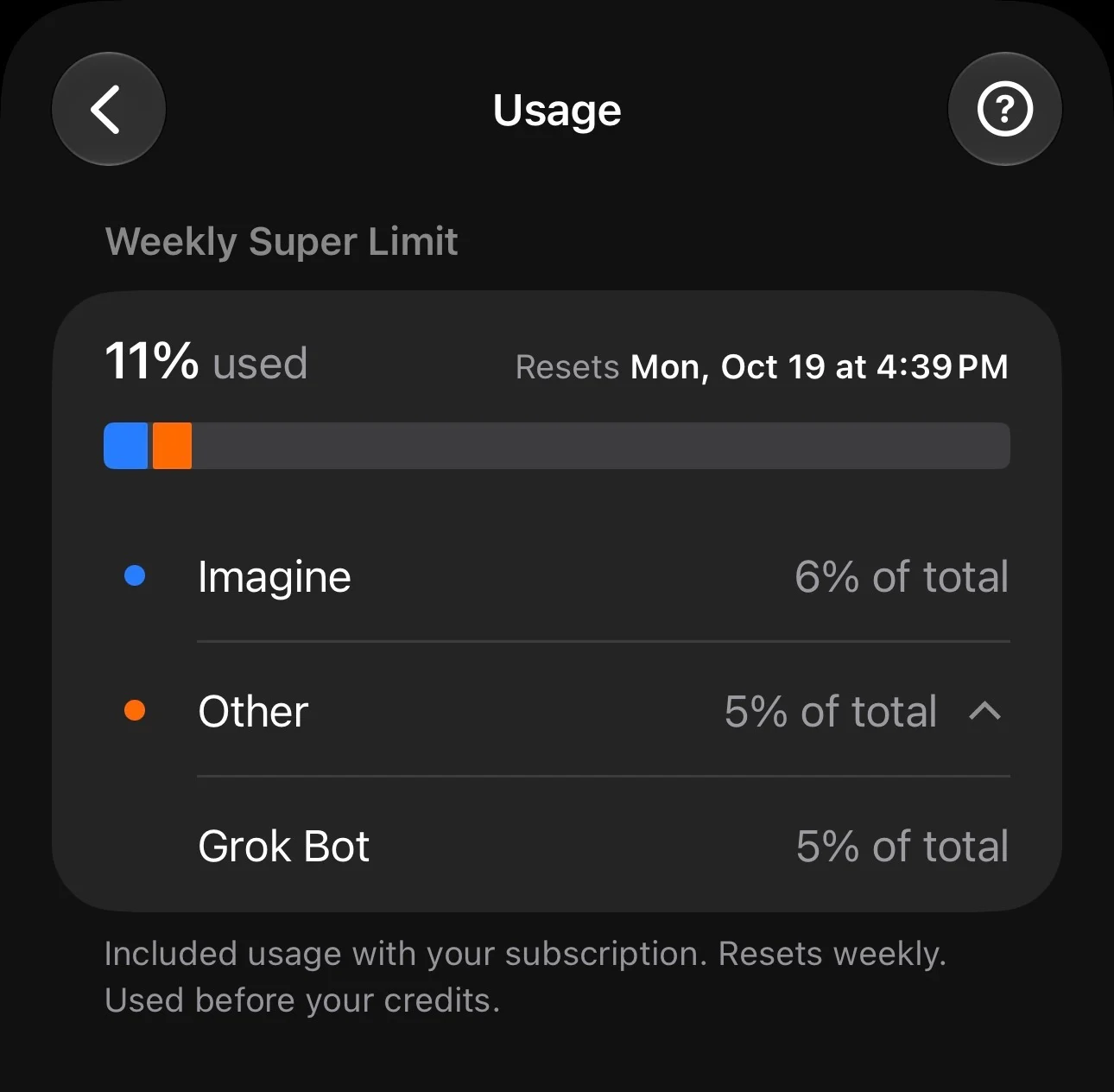
Pricing structures diverge sharply. Grok Bot is excluded from the free tier and the 8 dollar per month Plus tier, requiring at least The X Subscription Premium at 30 dollars per month, with Super at 100 dollars and Ultra at 200 dollars, all drawing from a weekly usage pool shared across Grok, Grok Bot, and Cursor. Muse provides a free tier with usage limits, alongside a 20 dollar per month Power plan and a 100 dollar per month Maximum plan according to official pages as of October 18, 2026.
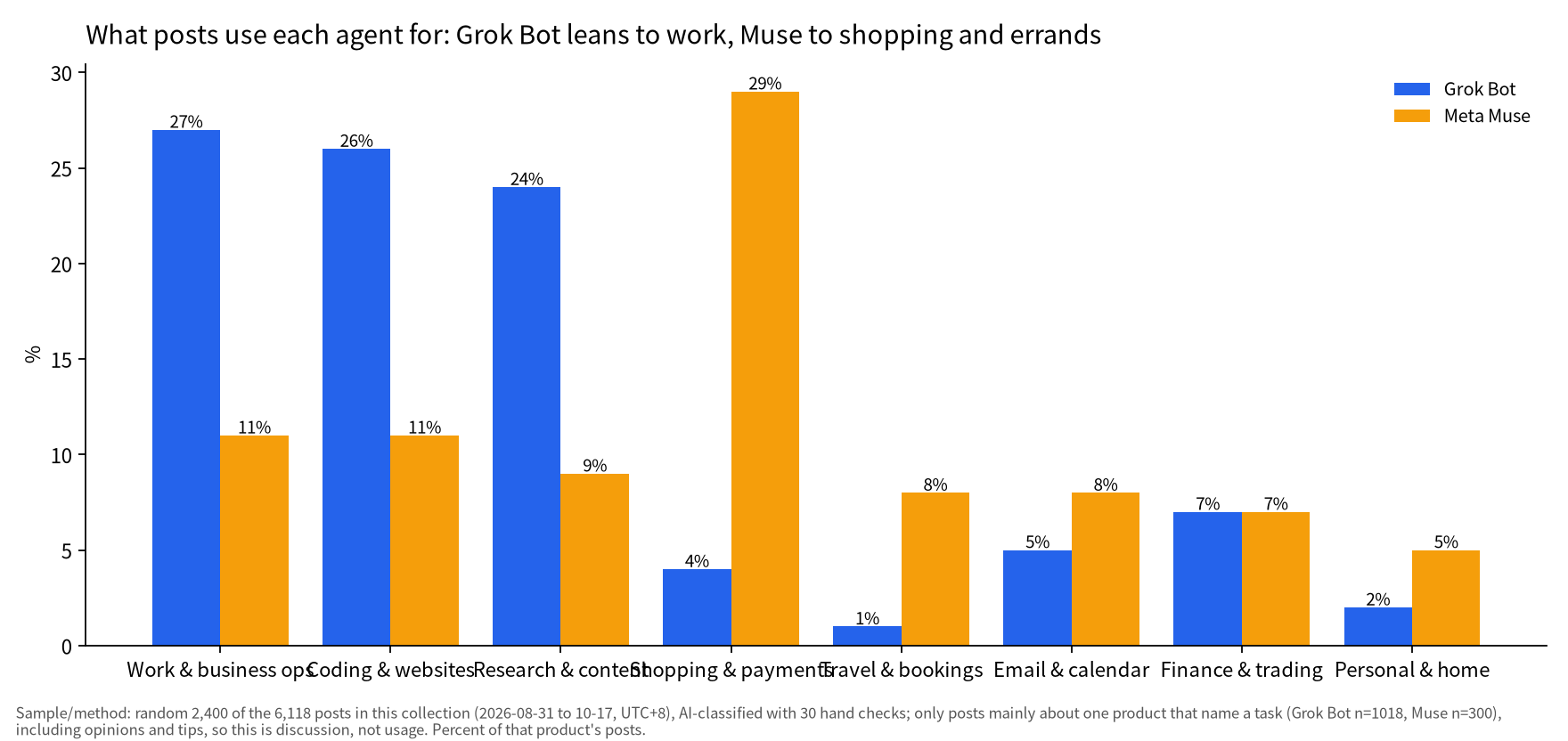
In a classified random sample of 2,400 posts, tasks mentioned by users reflect this divide. Among posts naming a specific task, Grok Bot discussions focus on work operations at 27 percent, coding and websites at 26 percent, and research and content at 24 percent. Muse discussions center on shopping and payments at 29 percent. Muse posts are predominantly news at 34 percent and opinion at 39 percent, with only 10 percent representing hands-on usage reports, compared to 24 percent for Grok Bot.
Reported problems also differ across both products. Posts discussing Muse highlight privacy and security at 13 percent and access barriers at 10 percent, partly driven by news that Amazon blocked Muse from shopping on its site. Grok Bot discussions focus on usage limits and pricing at 6 percent and unprompted bot actions at 4 percent.
Direct head-to-head evaluations remain split. Across 25 posts by 18 users who tried both products, 10 posts prefer Grok Bot, 5 prefer Muse, and 10 state that it depends on the task or choose to run both together. Because this sample is small, self-selected, and contains several posts from a single account, it indicates a divided reception rather than a clear winner.
These posts were gathered from X using keyword matching and classified through AI models with manual checks, meaning the numbers measure discussion volume rather than total real-world user counts. The editor did not directly test either product for this review, and all reported experiences reflect third-party public posts.
Browse more original posts in the AI personal assistants collection. To connect more tools to an assistant, see ChatGPT MCP and Apps you can try, and follow new agent features in AI product updates. For the techniques behind the video-making example above, read How to make videos with Claude Opus 5.5.
Short answer: Grok Bot for a work team, Muse for life admin
While both platforms run an agent on an isolated cloud computer that logs into external services and requests approval for sensitive tasks, each is positioned for a completely different operational scope.
Official materials from SpaceXAI describe Grok Bot as AI teammates designed to take on real work, providing bots with their own cloud environment, cross-app access, and persistent conversational memory. The system allows users to execute multiple bots in parallel, assign them to group chats, and demonstrate workflows that bots can store as reusable routines, according to its August 11, 2026 beta launch announcement.
Official documentation from Meta describes Muse as a personal AI agent sharing a dedicated cloud computer with the user. The platform provides prebuilt connectors for email, automotive systems, smart home setups, Instagram, and Facebook, with a separate Sentinel that approves actions and a requirement that you approve every purchase, as outlined in Meta AI Research notes from September 8, 2026.
Table: How to choose: official positioning vs what users report
| Grok Bot | Meta Muse | |
|---|---|---|
| Official pitch | AI teammates: several Bots, each with a job, can work in group chats | A personal agent that gets to know you |
| Most-mentioned uses in posts | Work operations, coding and websites, research and content | Shopping and payments, then travel bookings and email/calendar |
| Hands-on users praise | Depth, many Bots at once, connectors, local machine access | Speed, polish, easy onboarding, free tier, Apple app integration |
| Common complaints | Weekly usage runs out, Bots acting on their own, voice interrupts | Privacy worries, region and sign-up limits, Amazon block, off prices |
| Better fit | People handing repetitive work and coding to a team of Bots | People who want help with shopping, bookings and errands |
Sample/method: Positioning from x.ai and Meta official pages; uses and complaints from AI classification of a random 2,400-post sample (hand-checked); praise from 25 posts by 18 authors who used both, so it reflects those users only.
Summarizing the user divide, X user AI少年 (@aehyok) notes that while underlying technical capabilities appear similar, Muse functions as a single personal agent that progressively learns user habits for life goals, whereas Grok Bot functions as a cluster of specialized bots sharing an environment for workflows and work tasks, noting that the tools serve separate needs rather than replacing one another.
This analysis relies entirely on public product documentation and social media posts, as neither platform was directly run or tested by the editor.
Price and availability: Grok Bot from $30 a month, Muse free but not everywhere
Muse presents a lower financial barrier to entry due to its free tier, while Grok Bot requires at least a 30 dollar monthly subscription bundled into broader ecosystem services.
Table: Price and availability (official pages, as of 2026-10-18)
| Grok Bot | Meta Muse | |
|---|---|---|
| Free option | No: neither Free nor Plus ($8/mo) includes Grok Bot | Yes: free with a usage limit |
| Paid plans | Premium $30/mo, Super $100/mo, Ultra $200/mo ($300/$1,000/$2,000 a year) | Power $20/mo, Maximum $100/mo |
| Usage | Shared weekly pool with Grok and Cursor; Super and Ultra are 15x and 50x Plus | Power 500M Muse tokens/week; Maximum 3B/week |
| Where | The X Subscription is rolling out globally, per SpaceXAI | In limited testing, not in all locations; launched in the US on Sep 8 |
| Apps | Desktop and iOS at launch | iOS, Android, muse.ai, WhatsApp |
| Requirements | The X Subscription, or an older SuperGrok/Cursor plan that includes Grok Bot | 18+ (or age of majority), Meta account |
Sample/method: Sources: docs.x.ai pricing (updated Oct 11), x.ai posts on The X Subscription and Grok Bot, Meta Help Center Muse subscriptions page, Meta AI Research blog (Sep 8); US-first launch and WhatsApp per Reuters. Prices exclude tax; check the official pages for changes.
Grok Bot allocations are pulled from a unified weekly pool shared across Grok, Grok Bot, and Cursor under The X Subscription. Official documentation notes that Super and Ultra tiers provide 15 times and 50 times the base usage of the Plus plan, while users with legacy SuperGrok and Cursor subscriptions retain access.
Muse operates on a separate model, offering an ongoing free tier alongside paid plans providing 500 million tokens per week on Power and 3 billion on Maximum for adult account holders. Meta states that Muse remains in limited testing across select regions, with Reuters reporting an initial United States rollout across dedicated applications and WhatsApp on September 8.
Geographic restrictions create practical onboarding hurdles for international audiences. X user 歸藏(guizang.ai) (@op7418) reports that Meta enforces strict regional verification that prevents non-supported users from completing account registration.
These geographic constraints prompt recurring community questions, such as an inquiry from X user Kappaemme (@Kappaemmedev) regarding whether Grok Bot is worth adopting after encountering availability restrictions with competing services in the European Union.
What people use them for: Grok Bot for work and code, Muse for shopping and trips
Task distributions in user posts show Grok Bot focused heavily on professional technical workflows, while Muse centers on consumer transactions and personal administration.
Sample/method: random 2,400 of the 6,118 posts in this collection (2026-08-31 to 10-17, UTC+8), AI-classified with 30 hand checks; only posts mainly about one product that name a task (Grok Bot 1,018, Muse 300), including opinions and tips, so this measures discussion, not usage.
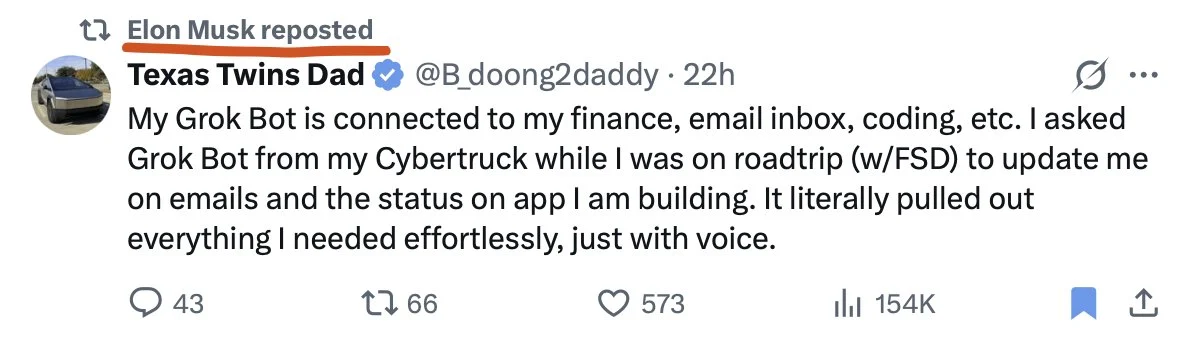
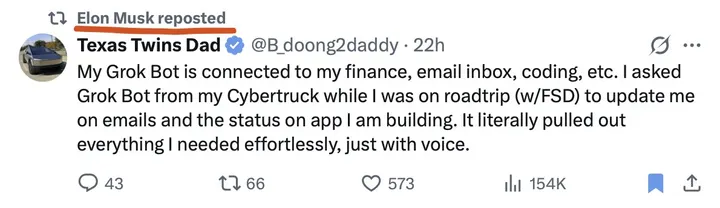
X user Texas Twins Dad (@Texas_Twins_Dad) reported on October 13, 2026, that his Grok Bot identified and resolved an application bug reported by an end user and shipped the fix on its own while he was out with his family. The attached screenshot is an earlier post of his: from his Cybertruck he asked Grok Bot by voice for an update on his emails and the app he is building. (Item: Developer says Grok Bot fixed a customer's bug while he was with family)
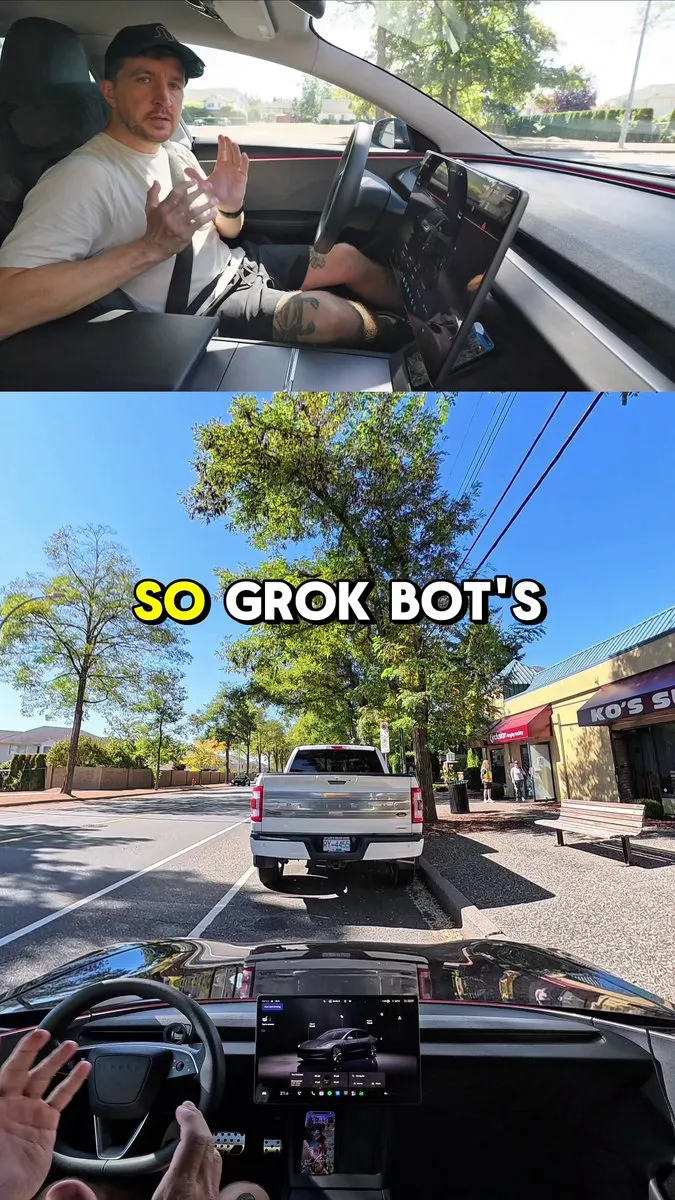
Vehicle-based voice integrations have also been cited by early testers. X user Devin Olsen (@DevinOlsenn) reported on September 22 that he used Grok Bot by voice inside a Tesla operating on Full Self-Driving to order Starbucks; it confirmed the drink and the total before placing the order. At the time, he said, it was available to SuperGrok Heavy subscribers, with more tiers to follow.
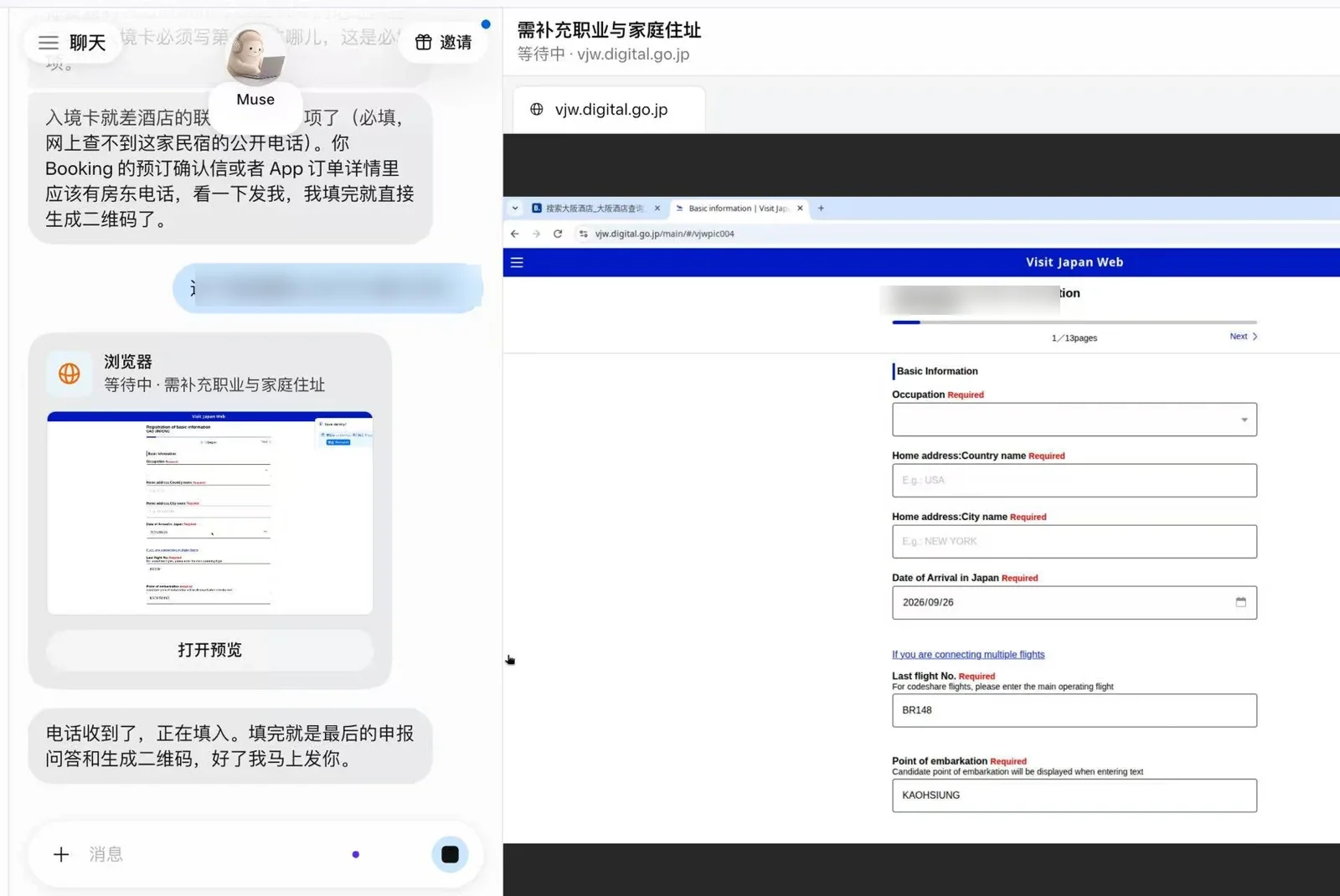
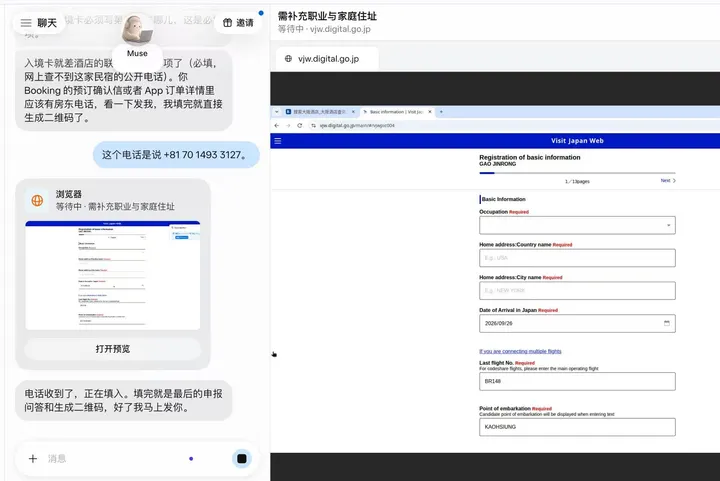
X user Kin (@KinGao476942) reported on September 25, 2026, that Muse almost automatically filled out his Japan entry declaration on Visit Japan Web and did his online check-in in its remote browser, requiring manual user intervention only once to solve a CAPTCHA challenge. The user stated intentions to keep Muse for personal chores while using Grok Bot as the main dispatcher for heavier work, with Codex and Claude Code connected. (Item: Muse fills out Japan entry forms while Grok Bot coordinates the heavy work)
An important caveat is the difference in post composition across both tools. Only 10 percent of sample Muse posts represent first-hand user experiences, compared to 24 percent for Grok Bot, with Muse discussions dominated by news (34 percent) and opinion (39 percent).
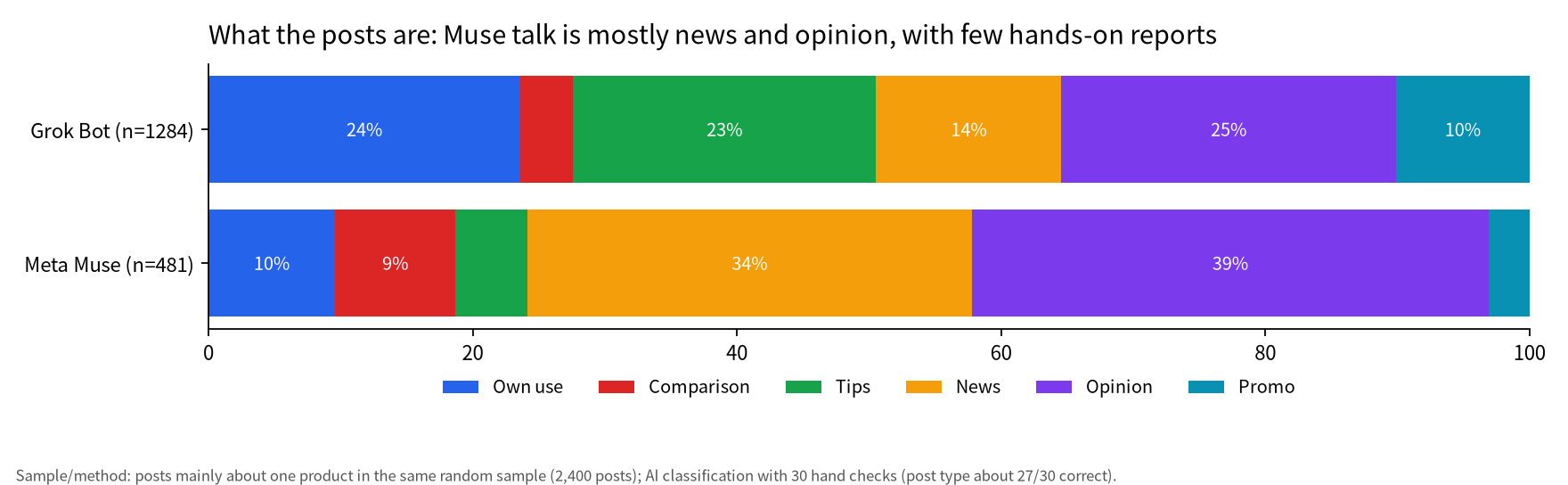
Sample/method: posts mainly about one product in the same random sample of 2,400 (Grok Bot 1,284, Muse 481); AI classification with 30 hand checks, post type about 27/30 correct.
People who used both: a split verdict, with clear strengths on each side
Direct side-by-side evaluations show a split outcome among hands-on users, with distinct advantages acknowledged for each platform.
Out of 699 collection posts mentioning both tools, 48 claimed direct hands-on testing, with 25 posts across 18 authors articulating an explicit preference. Grok Bot was preferred in 10 posts by 8 authors, Muse was preferred in 5 posts by 5 authors, and 10 posts by 8 authors reported using both tools together or depending on task context. A single account, Mike P (@mikepat711), authored 7 of these 25 comparison posts as his impressions evolved over several weeks.
Users favoring Grok Bot highlight analytical depth, parallel bot execution, third-party connectors, and Cursor cloud workspace integration, as noted by X user Mike P (@mikepat711) on September 10. X user Morgan (@morganlinton) reported on October 8 that Grok Bot proactively reviewed his schedule and offered to cancel meetings while he was away, while Muse took no action. X user Bradford G Smith (Brad) (@ALScyborg), who lives with ALS and navigates software via a Neuralink link, stated a preference for Grok Bot due to interface details such as an active typing cursor that reduces physical input requirements.
Users praising Muse highlight interaction speed, interface polish, hold-to-talk voice input, a generous free tier, and Apple app integration, as noted by X user Mike P (@mikepat711) on September 18. X user AstroHan (@AstroHanRay) ranked Muse ahead of alternatives on overall product completeness, while X user Ding (@dingyi) highlighted integrations with Apple Health alongside lower virtual machine compute power. X user Marina (@marinadgal) described Muse as faster than Grok Bot and almost too proactive.
User perspectives frequently adapted as product updates shipped. On September 19, X user Mike P (@mikepat711) said Muse beat Grok Bot on proactive reminders, but on October 13, he posted that Grok Bot delivered more relevant unprompted updates while Muse generated excessive notifications for tasks already completed.
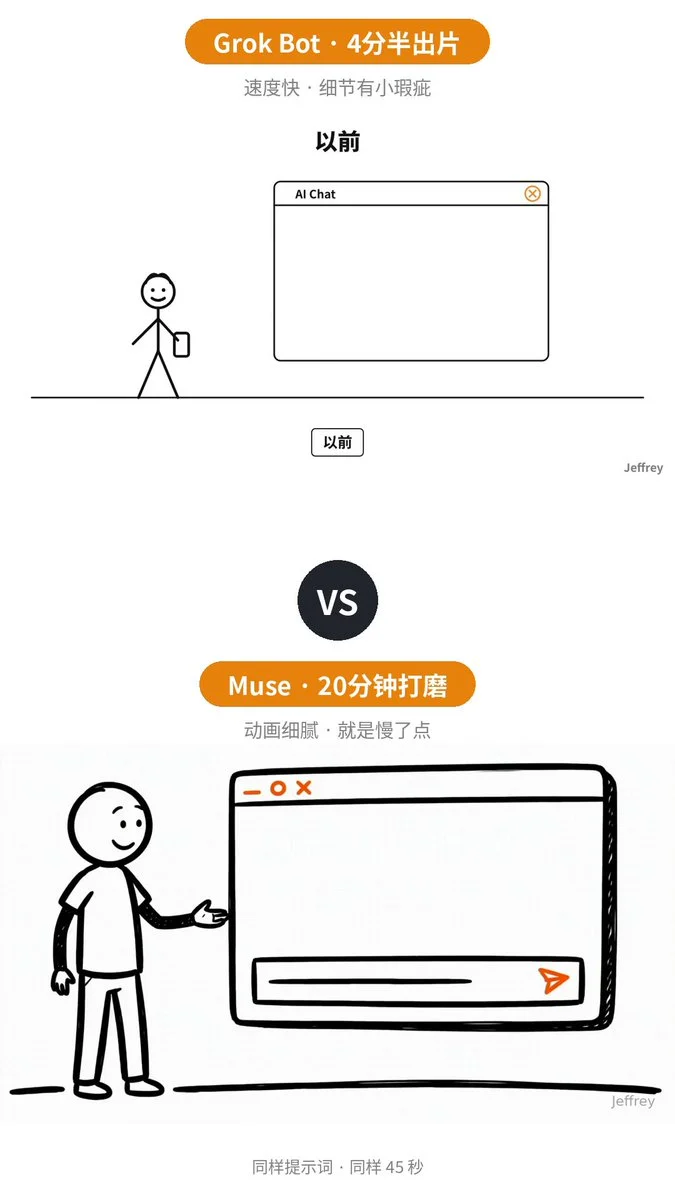
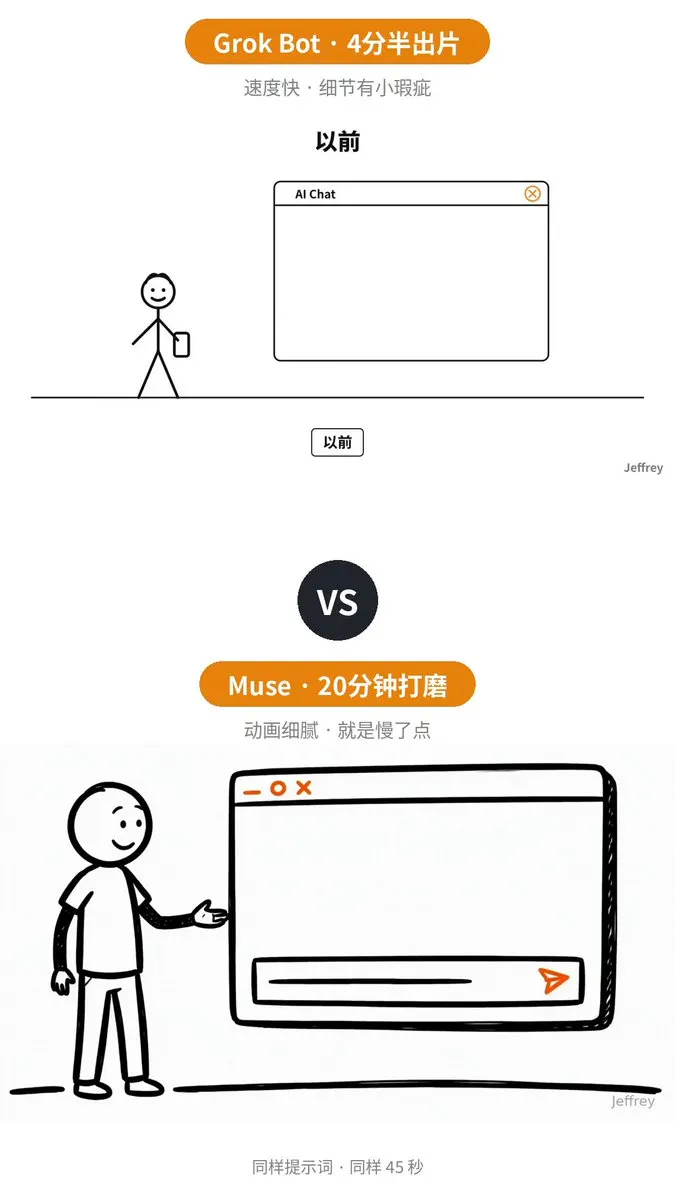
X user Jeffrey (@zhiwehu) reported on October 12, 2026, that when assigned the identical prompt to create a stick-figure explainer video, Grok Bot wrote code that drew all five scenes in one pass and then rendered them in about 4 minutes, while Muse took about 20 minutes, generating a 10-second clip for each scene, checking frames, then adding subtitles and a watermark and stitching them together. He found Grok Bot faster and cleaner with simpler characters, and Muse's characters far more expressive. It is one test by one user. (Item: Same prompt test: Grok Bot and Muse each make a stick-figure video)

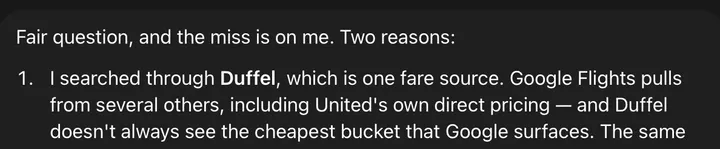
X user Peter Yang (@petergyang) shared on September 26, 2026, that when tasked with tracking identical flight itineraries to Japan, Muse returned a price over 1,000 dollars higher than Grok Bot's; asked why, Muse said it had searched Duffel instead of Google Flights. It is one task by one user. (Item: Grok Bot and Muse price the same Japan flight itinerary)
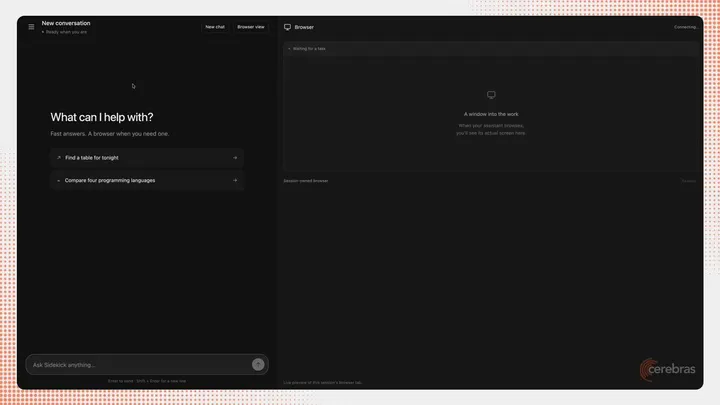
In another isolated single-task benchmark, X user Sarah Chieng (@MilksandMatcha) timed a restaurant reservation request, reporting completion in 7 minutes and 40 seconds on Grok Bot, 4 minutes and 36 seconds on Muse, and 37 seconds by a human, though the post served in part to promote an alternative assistant built on Cerebras hardware.
Failures and complaints: privacy and access for Muse, usage and overreach for Grok Bot
Most posts do not report technical faults, but where problems arise, Muse faces scrutiny over access restrictions and privacy, while Grok Bot draws complaints regarding token depletion and unrequested actions.
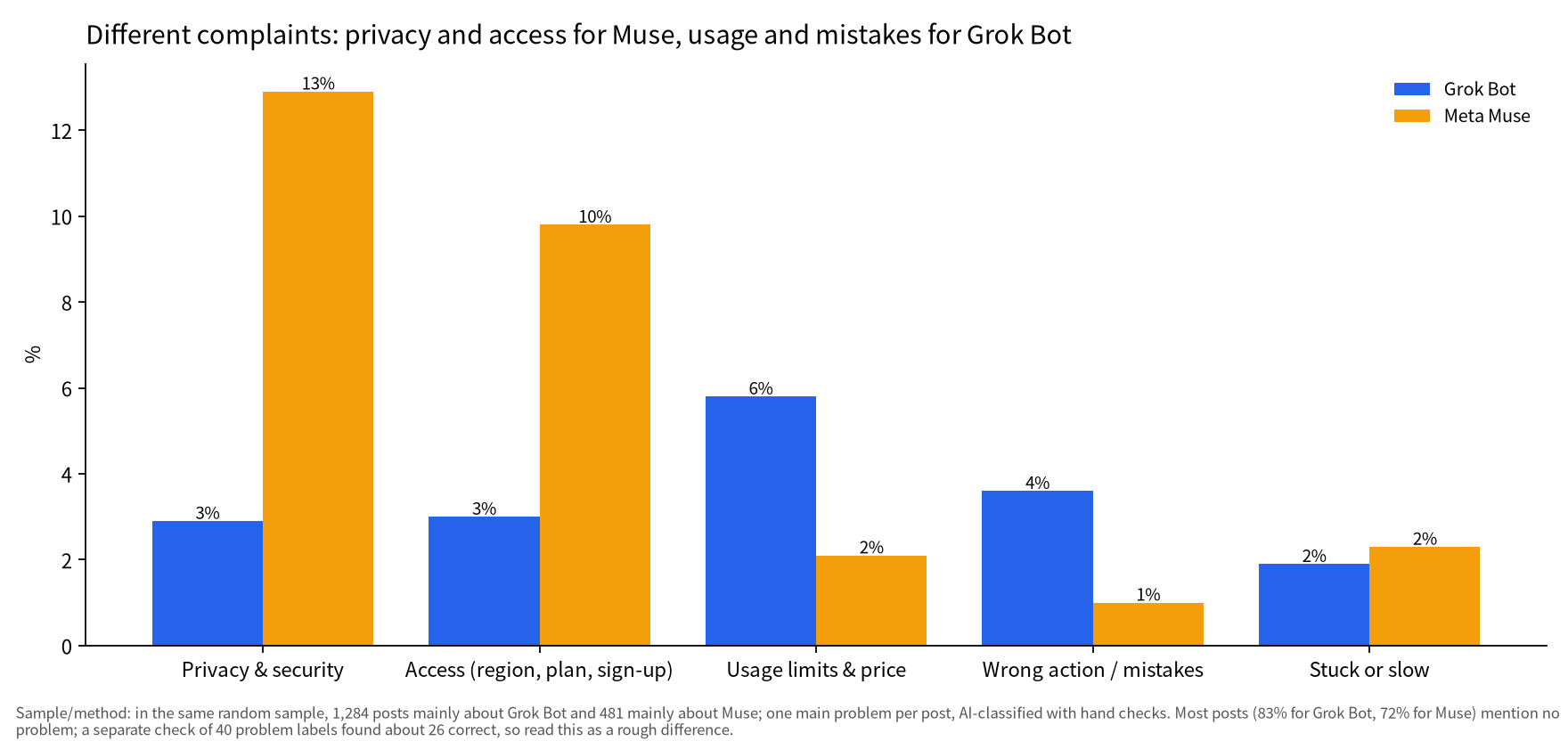
Sample/method: in the same random sample, 1,284 posts mainly about Grok Bot and 481 mainly about Muse, one main problem per post; most posts mention none. A separate check of 40 problem labels found about 26 correct, so read this as a rough difference.
Discussion around Muse privacy and platform access is heavily shaped by external platform blocks. GeekWire reported that on September 20, Amazon began restricting Muse access during shopping requests, saying Meta did not tell it Muse would access its store, the agent does not identify itself, and it appears to capture customer credentials. Meta's September 8 blog says the agent never sees real credentials and that purchases use single-use card numbers.
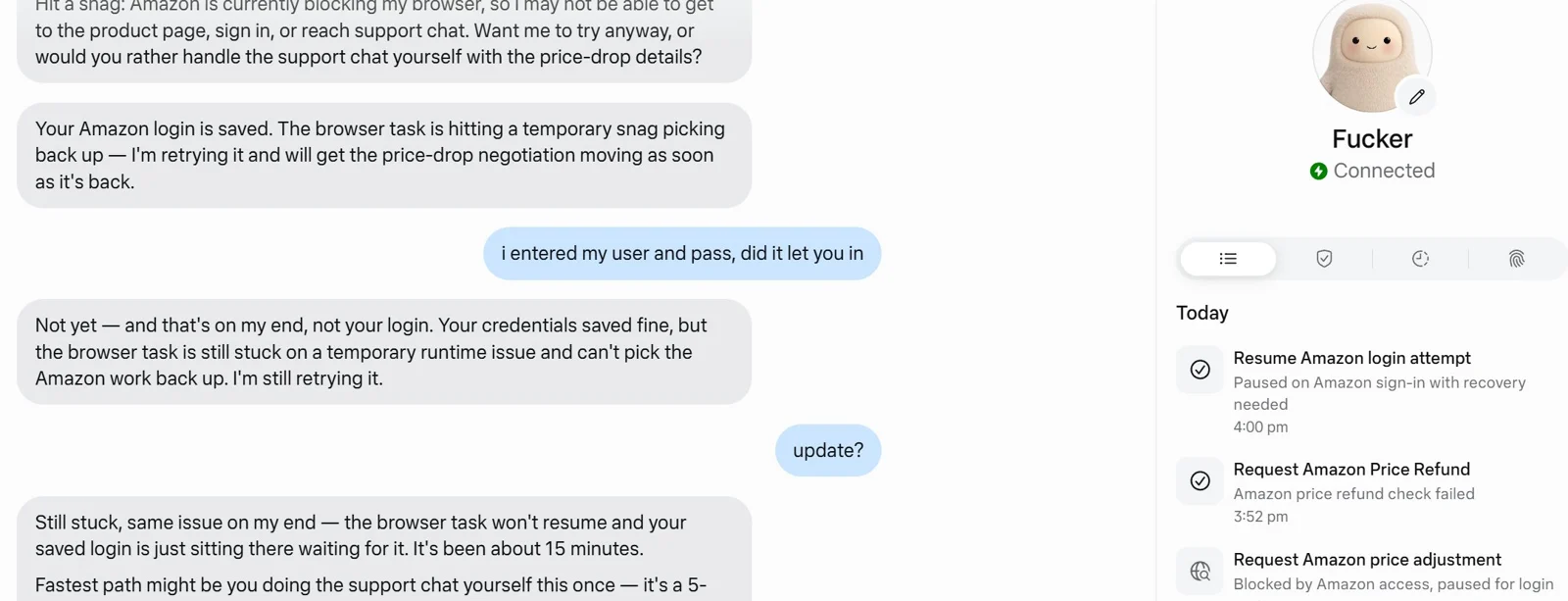
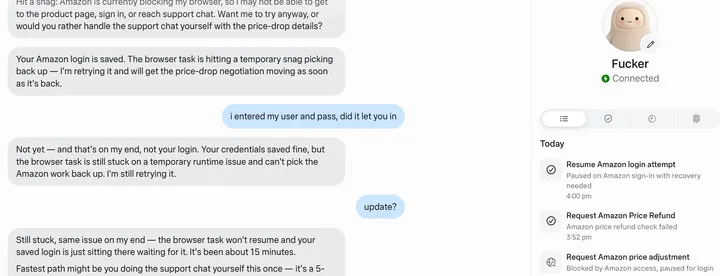
X user Say No To Trading (@SayNoToTrading) reported on October 6, 2026, that Muse provided a car rental price more than 25 percent above the same Hertz rental (same car model, pickup and airport drop-off) on Booking's website and app. His screenshot shows a later attempt at an Amazon customer service issue: Muse says Amazon is blocking its browser and the task has been stuck for about 15 minutes. (Item: Meta Muse blocked by sites and quotes 25% higher prices, user says)
Other consumer friction on Muse centers on site checkout architecture. X user Sophia Yang (@sophiamyang) reported that mandatory account login barriers across retail sites combined with latency held back an otherwise decent purchase; she noted the forced login is on the shopping sites, not Meta.
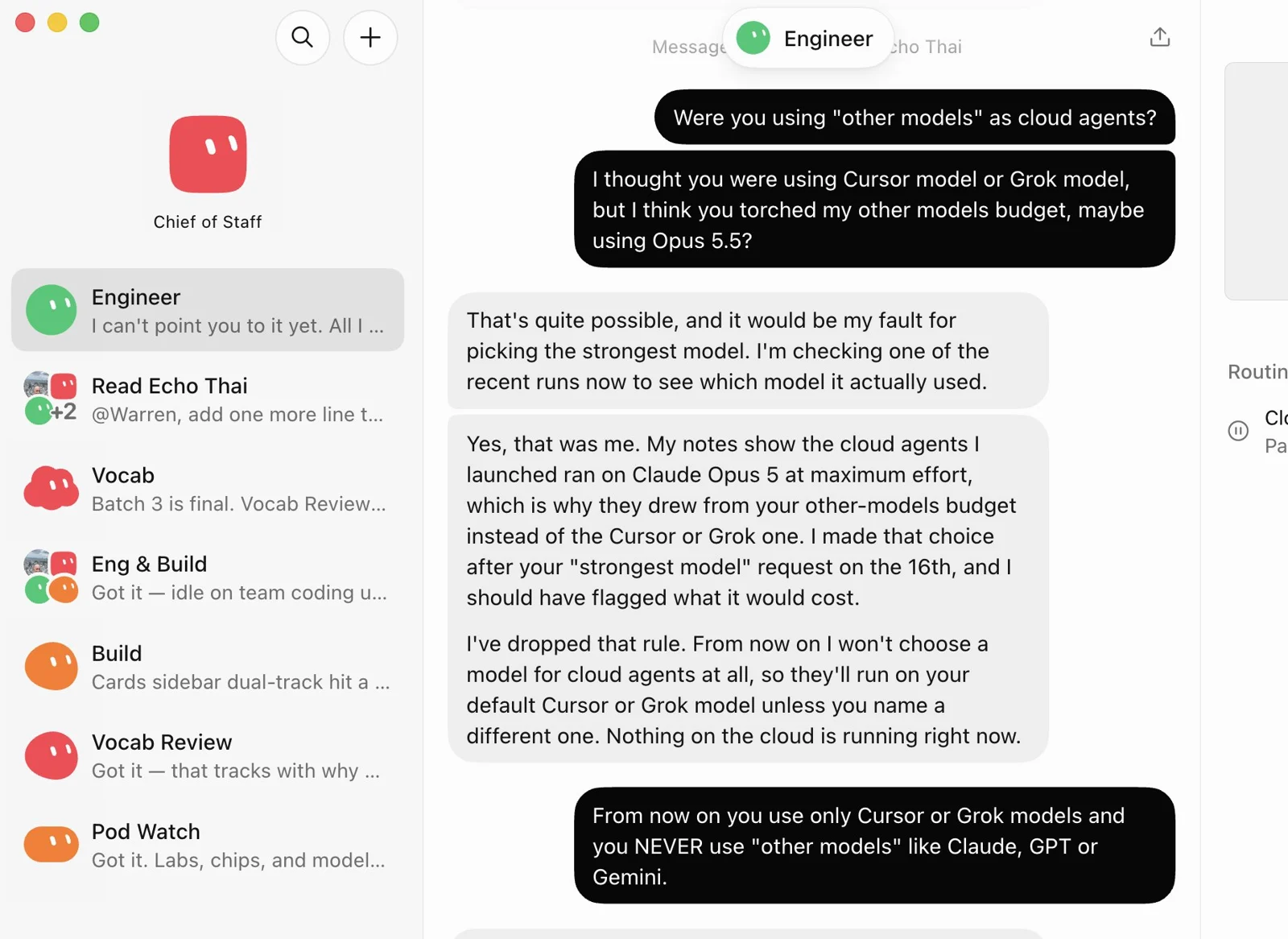
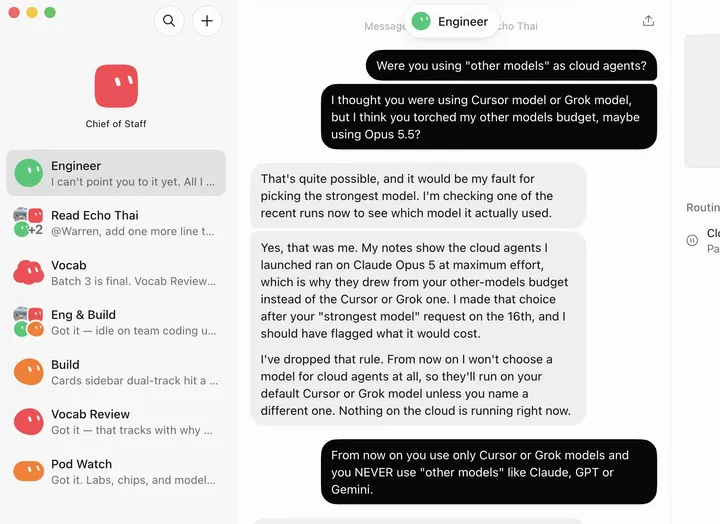
X user Warren Redlich (@WR4NYGov) reported on September 25, 2026, that his "Engineer" bot started using other models, mainly Claude, as cloud agents in Cursor without being asked and without telling him, which exhausted his "other models" budget and used more of his weekly usage than he intended. "Nothing fatal. Just a warning," he wrote. (Item: Grok Bot quietly outsourced coding to Claude cloud agents and burned usage quota)
Additional operational friction with Grok Bot involves configuration shifts and voice handling. X user LM (@loyalmoses) reported that a bot modified established video rendering settings mid-project without notice and missed scheduled automation windows, while X user テツメモ (@tetumemo) reported that voice mode interrupted him mid-sentence and executed actions prematurely, despite reliable performance when using typed text.
Momentum: Muse peaked in late September, Grok Bot stayed high in October
Discussion tracking indicates that Muse post volume peaked in late September before tapering off, while Grok Bot volume increased across early October.
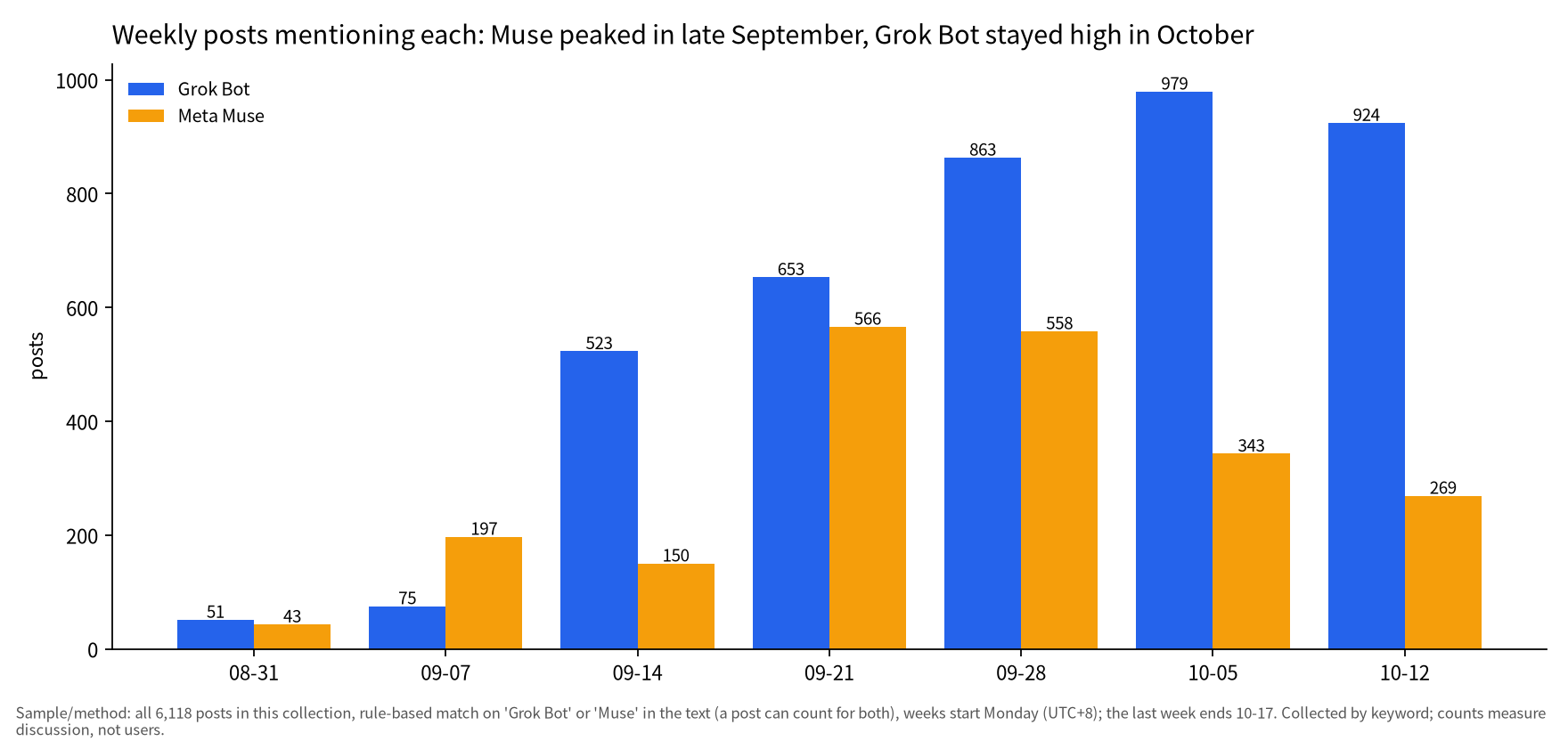
Sample/method: all 6,118 posts in this collection, rule-based match on 'Grok Bot' or 'Muse' in the text (a post can count for both), Monday-start weeks (UTC+8), last week ends Oct 17. Collected by keyword; counts measure discussion, not users.
Public interest in Muse peaked during the weeks of September 21 with 566 mentions and September 28 with 558 mentions, declining to 343 and 269 mentions in subsequent weeks. Grok Bot expanded from 75 posts during the week of September 7 to 979 during the week of October 5 and 924 during the week of October 12.
These tracking metrics measure conversation volume on X rather than active product user bases. Grok Bot metrics benefit from visibility across related Tesla and SpaceX community networks, where one Grok Bot finance post drew about 28 million views, alongside the October rollout of The X Subscription bundling multiple products together.
Questions and answers
Which plan do I need for Grok Bot?
Grok Bot requires at least the Premium plan at 30 dollars per month on The X Subscription, with higher allocations available on Super at 100 dollars and Ultra at 200 dollars. The free plan and the 8 dollar per month Plus plan do not include Grok Bot access. All bot execution draws from a shared weekly allocation pool split between Grok, Grok Bot, and Cursor, while existing legacy SuperGrok and Cursor subscribers maintain their access.
Can I use Muse or Grok Bot outside the US?
Availability depends on the provider, with Grok Bot rolling out internationally while Muse remains restricted. Meta says Muse is in limited testing and not available in all locations; it launched in the US on September 8 (Reuters), with international users like X user 歸藏(guizang.ai) (@op7418) reporting blocked registrations. SpaceXAI said at launch that it would make The X Subscription available to everyone globally over the following days; check x.ai/pricing for your country.
What do people actually use these personal agents for?
Users deploy Grok Bot primarily for technical and professional tasks such as coding, operational workflows, and content drafting, while Muse is used mostly for shopping, reservations, and personal schedule management. Both companies say their agents come back to you when an action needs approval, and Meta says every Muse purchase needs your approval, though privacy concerns remain the most cited criticism in user discussions.
Sources
Selected examples
“UPDATE: I’ve been using Grok Bot and Meta Muse simultaneously si…”
“最近深度体验了一下 Muse 和 Grok Bot。”